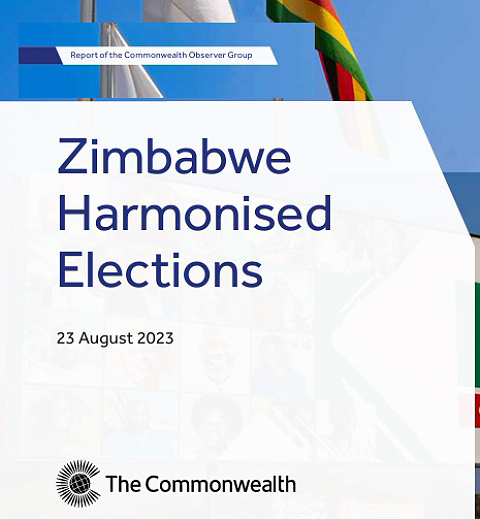
 Cover of the Commonwealth Observer Group report. [source: Commonwealth Secretariat]
[This is an excerpt from an article in The Round Table: The Commonwealth Journal of International Affairs and Policy Studies.]
Reviewing reports issued in the aforementioned countries, it also evident that in Zambia and Mozambique, the conclusions were somewhat different from those issued by the European Union’s EOM and the Carter Center. In Mozambique, the COG documented the death of civilians during the elections but further claimed that the campaign period was relatively calm and peaceful. The Group also noted that the incidents and shortfalls were not of ‘a magnitude significant enough to put into question the credibility of electoral outcomes’ (COG, Citation2024a, p. 83). This statement was contrary to a statement in its executive summary, where it was indicated that ‘Mozambique saw a surge in political violence’ (COG, Citation2024a, p. 15). This disconnection is also evident in the COG’s report to 2023 Nigeria. The report bemoaned the violence reported during the campaign period, and suppression of freedom of expression, but still provided an evasive conclusion. The overall assessment indicated that;
Notwithstanding the shortcomings identified in these elections, Nigerians were largely accorded the right to vote. We trust that the final stages of collation and announcement of results will continue to be handled in a transparent, peaceful, and credible manner. (COG, Citation2023, p. 75)
Examining reports issued by the COGs in African countries, it is evident that the mission is subtle when an election is marred by irregularities, and straightforward when the elections were clearly free, fair and credible. This is evident in the COG final report published for The Gambia, Kenya, Ghana and Botswana. In these countries, the COG reports clearly state that the elections were credible, met key democratic benchmarks and the challenges did not outweigh the credibility of the elections. This clarity and directness are not evident in their overall assessment for Zimbabwe and Nigerian elections, which were viewed to have significant shortcomings.
Election Observation and Deepening Democracy in the Commonwealth
Zimbabwe, the 2023 elections and Commonwealth membership
Crucially, directness is essential because the COG is amongst the venerated observer groups that endorsed and pledged to align with the Declaration of Principles for International Election Observation and Code of Conduct for International Election Observers. One of the suggestions from the Code of Conduct encourages observer groups to report accurately when drawing conclusions. Explicitly, observer missions and groups are encouraged to ensure that their observations note both negative and positive aspects of an election, holistically identify patterns that impacted the elections, that judgements should be of the highest standards and conclusions must not be drawn prematurely (International Institute for Democracy and Electoral Assistance, Citation2005). Cementing this line of thinking, Amanda Sives (Citation2010) encourages observer missions to provide direct and clear conclusions, bearing in mind that their objective is to convey their findings and not to confuse the citizens. Reflecting on this paradigm shift, it is plausible to claim that the Commonwealth did not wish to strain its relationship with Zimbabwe, which appears to be cordial of late, hence the caution (Mole, Citation2025). This does not imply that the COG colluded with the government of Zimbabwe, or the Zimbabwe Electoral Commission (ZEC), but rather that the incoherences and hasty statements relayed portrayed a bleak outlook. Reflecting on these dynamics, Thomas Carothers (Citation1997) claims that some observer missions tread carefully because they do not wish to be blacklisted, hence they resort to euphemism, which may limit independence to specific observation efforts.
Conclusion
Commonwealth Observer Groups stand out as among the best observers’ missions in documenting electoral anomalies from a procedural point of view, and their assessments are quite rigorous. Nonetheless, their choice of words or conclusions are slowly becoming overly cautious, embodied with linguistic euphemisms which may at times distort the significance of the findings. Experts in linguistics such as George Orwell argue that the misuse of language can lead to confusion and misunderstanding, which can have serious consequences for politics and society (Orwell, Citation1946). William Empson (Citation1953), reflecting on the seven types of ambiguities, states that something that adds richness and multiple meanings is considered good ambiguity, but anything that causes confusion or contradiction is bad ambiguity. In this respect the 2023 COG report to Zimbabwe was somewhat riddled with the latter.
Using hermeneutics as a method of analysis, it is evident that the language used in COG reports has changed; it has become more lenient and somewhat perfunctory. Hermeneutically there is vivid dissonance from the 2018 COG report on Zimbabwe, despite capturing shortcomings, and a non-condemnatory conclusion embodies a cautious tone. The report properly captured the anomalies but relayed diplomatic or euphemistic remarks that were not entirely aligned with the narrative. These, amongst other factors, compel aggrieved citizens to believe that election observation operations appear to be routine and not pivotal or life changing. Previously, the Commonwealth Observer Group used excoriations when calling out electoral anomalies i.e., the 2002 COG final report, but subsequently such groups have resorted to paradoxical euphemism. Appreciating that the formats used by observer missions evolve with time, the adjustments should be tailored in such a way that ensures that the report passes the test and aligns itself with the terms of reference guiding the mission. Going forward, future Commonwealth observation reports must strive to ensure that euphemism does not replace clarity and coherence. Only then can observation genuinely contribute to electoral credibility and advance the significance of norm development across the globe.
Bright Chimedza, Politics and International Relations, University of Leicester, Leicester, UK.