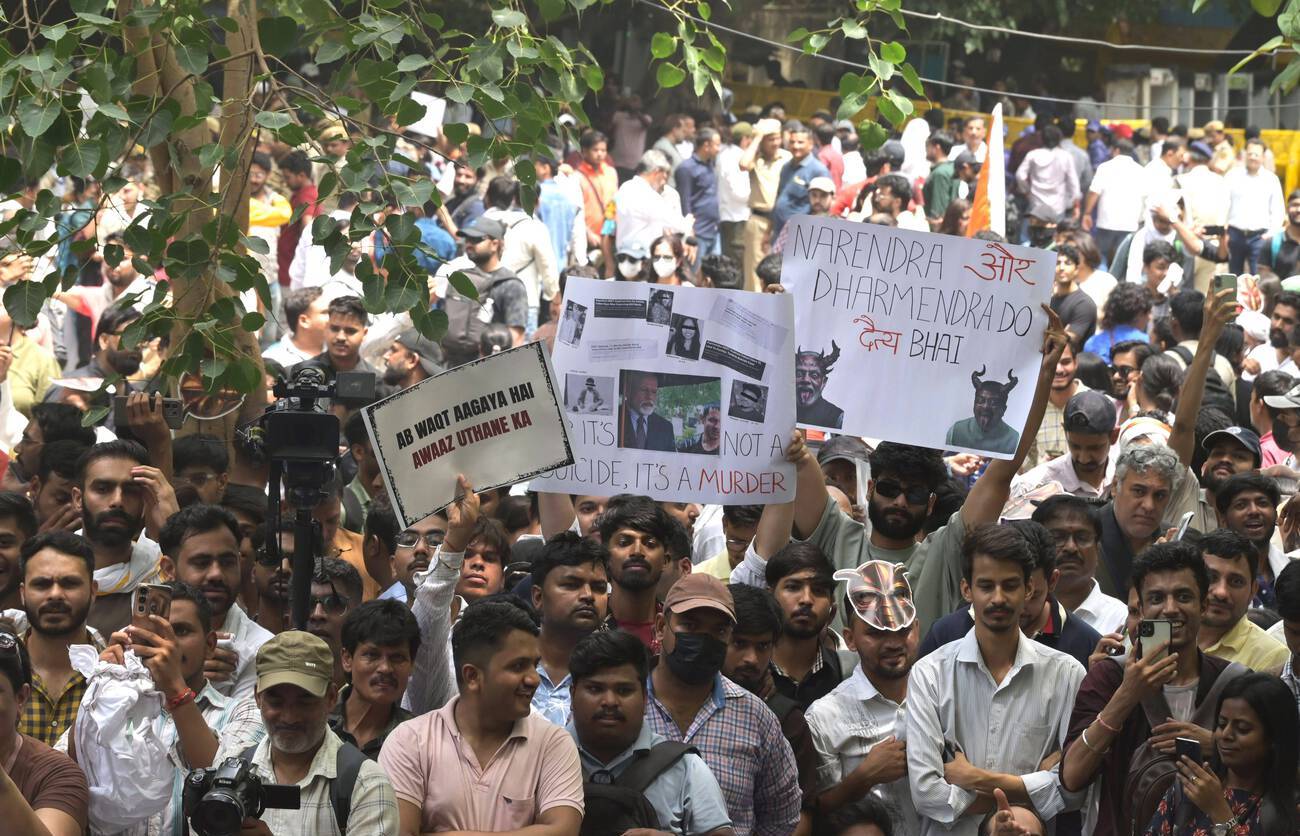
 June 2026: Cockroach Janta Party (CJP) protest in New Delhi. [photo: Imago/ Alamy]
[This article was shared with the Round Table by the author. Views expressed in articles do not reflect the position of the editorial board.]
Widespread agitation by Indian students against exam corruption and mismanagement since 6 June 2026 has tested the limits of the country’s receding democratic space. Satirically calling themselves the ‘Cockroach Janata Party’ after a Supreme Court judge disdainfully referred to them as ‘cockroaches’, tens of thousands of mainly college and school age youngsters and young professionals took to the streets. Some went on hunger strike for several weeks at the high-profile protest platform, Jantar Mantar, in Delhi. Their main demand was the resignation of Human Resources Minister Dharmendra Pradhan, who managed the Education portfolio. He eventually had to resign. The protesters held him accountable for the leak of exam papers which resulted in the suicides of 27 students, deeply distressed by the way the exams were mismanaged. These protests were against the backdrop of the rapid substantial expansion of tertiary education in India, but opportunities for graduates in quality well-paid jobs have failed to keep pace. (Approximately 370 million of India’s population are aged between 15-29. Of these, nearly 40% of 15-25-year-olds are unemployed; for 25-29 year olds the unemployment figure is approximately 20%; and, only a small percentage manage to secure stable paid jobs within a year of graduation.) The series of test paper leaks across various prestigious exams including NEET (for entrance into medical colleges) and CUET (for admission into the various universities), challenged Prime Minister Narendra Modi’s government in a rare show of spontaneous outrage against the inability of education officials to hold entrance exams.
In democratic societies, nationwide agitation like that of the students is not unusual. What has made the current protests stand out as a test case is because the protests are occurring at a time when Indian state institutions are under pressure to conform to the wishes of the Hindu nationalist Bharatiya Janata Party (BJP) Government; public dissent is frowned upon – with sometimes serious consequences, including incarceration. At the same time, many of those who criticise the government have been pressured by enforcement agencies; critics have been jailed pending trial for extended periods, underlining the process is the punishment for dissent. Many have, in fact, been acquitted of all charges after languishing in jail for months, if not years. Top opposition leaders, such as the former chief minister of Delhi, Arvind Kejriwal, have been arrested and jailed before being freed after the courts found no misdemeanour against them. Another oft-quoted case is of Umar Khalid, a student at Jawaharlal Nehru University, who played an active role in opposing the government’s move to amend the Citizenship Act (CAA) that discriminated against giving citizenship to undocumented Muslim migrants from neighbouring countries. Khalid was arrested for his alleged involvement in the Delhi riots in September 2020, and has since languished in jail, waiting for trial.
For many in India, the way elections have been conducted since independence in 1947 have been a source of pride. Despite issues with governance, corruption and increasingly constrained freedom of media, elections were always regarded as above board – free and fair. However, the latest round of elections to state Assemblies including in Bihar, West Bengal, have raised profound doubts over the fairness of polling. Under the Special Intensive Revision (SIR) of electoral rolls hurriedly undertaken in Bihar and then in West Bengal in 2025-6, over 4.5 million – particularly Muslim minorities – were disenfranchised on various grounds. While it is obvious that the names of the dead, those who have changed their addresses, registered in multiple places or migrated from their homes need to be delisted, many others who have voted in the past and who have appropriate documentation, were removed the electoral list. The numbers were large enough to affect the outcome of the elections.
Modi’s India, good or bad?
Key appointments of the Modi 2.0 cabinet: What they say about Modi’s second term
Since the start of SIR, in the last year alone, approximately 60 million names have been removed from the voters’ list across ten states. Such a mass disenfranchisement is unprecedented in the 79-year history of independent India. In past decades, the Election Commission (EC), originally designed as an autonomous institution, had largely been free from governmental interference. This appears to be no longer the case. There are scores of instances showing that the current EC has complied with the Modi government’s wishes. In July 2026, in an unusual move, the opposition parties approached the Supreme Court, alleging manipulation of elections and the partisan conduct of the Election Commission on the grounds that ‘democracy was in jeopardy’.
Given these extraordinary developments, one would have expected the media in India to call out the BJP government to halt the steady march towards autocracy. Barring exceptions in legacy print and digital media who seem to be maintaining editorial independence, the rest – in the electronic media – by and large appear to follow government diktat. Pejoratively termed the ‘godi’ media (‘lapdog media’), mainstream television channels unabashedly support the government. It is therefore no surprise that India’s ranking in the World Freedom Index has dropped sharply from 151/180 in 2025 to 157/180 in 2026. There are structural and financial reasons for this decline: historically the Indian media has been dependent on government and corporate advertising. Criticism of the government risks advertising revenue. The same is true for corporate sponsorship. Smaller, independent media outlets are reliant on reader/viewer subscription to avoid government or corporate control. Some succeed for a time, but these are far and few. As a consequence, in the post-2026 poll narrative, aided by a compliant media, the failings of the BJP have been ignored and instead a glowing picture of victory is headlined. Meanwhile, the massive delisting of eligible Indian citizens from the electoral process has been overlooked. The Supreme Court’s advice to the currently disenfranchised voters is to re-register to vote in the next elections.
This is the context of the Cockroach Janta Party’s agitation against blatant corruption and an increasingly repressive government which treats political opposition and criticism as enemies of the state.
Where is the Commonwealth, given the evident backsliding of democracy? India is a prominent member, and the supposed ‘largest democracy’ in the association. But India should not be immune to being held to the standards of the Commonwealth Charter.
K. S. Dakshina Murthy is Consulting Editor for The Federal, India.
Related articles:
CJP impact — BJP’s narrative hegemony dented, the pall of fear lifted – The Print India
India’s Gen Z Protesters Score Major Victory Against Modi Government – The Diplomat
‘This is just the start’: India’s Gen Z protesters force out a minister, but what next? – BBC News
Roaches reborn win big in India – The Lowy Institute
India’s Gen Z protesters puncture Modi’s aura of invincibility – Financial Times
What the World’s Gen Z Uprisings Tell Us About India’s Own – The Wire