[This is an excerpt from an article in The Round Table: The Commonwealth Journal of International Affairs and Policy Studies.]
A major strength of the volume lies in its treatment of Sardar Patel as a constitution maker and a critical constitutional thinker. Investigating the role of Patel as Chairman of the Advisory Committee on Fundamental Rights, Ranjita Chakraborty highlights his decisive influence on constitution-making, particularly his role in shaping fundamental rights, federal balance, civil services and national security (pp. 82–103). Harish K. Thakur in Chapter five undertakes a critical and comparative evaluation of the conceptualisations of nationhood and nationalism articulated by Patel, Nehru, Gandhi, Tagore and Aurobindo, thus foregrounding the philosophical foundations and political implications that guided their notions of the Indian nation (pp. 62–81). Khalid Mohammed highlights how Patel opposed the idea of a Hindu Rashtra and stood firm against sectarian politics, including the banning of the Rashtriya Swayamsevak Sangh (RSS) following Gandhi’s assassination (pp. 104–115).
The volume provides a significant discussion on the debates over governance and administration. Terry Beitzel assesses Patel’s enduring legacy in public administration, critiquing contemporary challenges such as corruption, elitism and lack of accountability (pp. 116–126). Pavithran Nambiar, relying on theories like Domestic Impact, Government Legitimacy and Power Distance, analyses Patel’s view of internal security and state consolidation and highlights how he transformed the colonial civil services into a patriotic national service (pp. 127–141). Although only touched upon here, in other chapters the volume consistently reflects on Sardar Patel’s strategic vision and counsel on foreign policy. Vinay Kaura examines the counterfactual possibility of Sardar Patel having become the first Indian Prime Minister, suggesting that his strategic realism and emphasis on military preparedness and intelligence consolidation might have altered India’s trajectory on Kashmir, Hyderabad and Tibet (pp. 142–151). R. Suresh and R. Viswambharan examine Patel’s view of China and Tibet. The correspondence between Nehru and Zhou Enlai, argue the authors, establishes that Patel foresaw the strategic consequences of China’s actions and advocated a firmer stance (pp. 152–160). One interesting take is by Chandrakant Langare and Charu C. Mishra, who examine Patel’s portrayal in Ketan Mehta’s film Sardar (1993). The authors argue that the cinematic representation of Sardar Patel has played a significant role in reviving his marginalised legacy. It has also enthused public reflection on the dynamics of post-independence politics in India (pp. 173–183). The chapter also notes the importance of cultural memory in shaping political understanding.
Commonwealth Bookshelf
Therefore, the volume Sardar Patel: An Icon of India’s Unity succeeds in presenting Sardar Patel as a great statesman whose contributions to the success of the Indian national movement, integration of princely states, philosophy of constitution, consolidation of Indian administrative service, and strategic realism remain ever relevant. The volume’s pluralistic approach avoids hagiography while offering a nuanced reassessment of Sardar Patel, situating him within the broader challenges of postcolonial state-building. This book not only acquaints the reader with the prominent available literature on Sardar Patel but also encourages critical re-engagement with Patel’s ideas, and thus makes a significant contribution to Indian political history. By bringing together 12 scholars with diverse areas of expertise, it offers a timely and valuable intervention in contemporary debates on leadership, unity and the nature of the Indian state.
Bhawna Sharma and Misbahuddin Yousufzai are with the Department of Political Science, Himachal Pradesh University, Shimla, India.
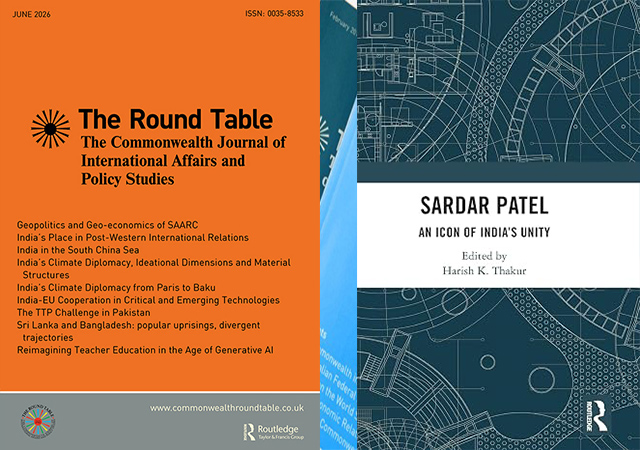
Sardar Patel: An icon of India’s unity by Harish K. Thakur (ed.), New York, Routledge India, 2025.