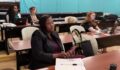
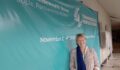
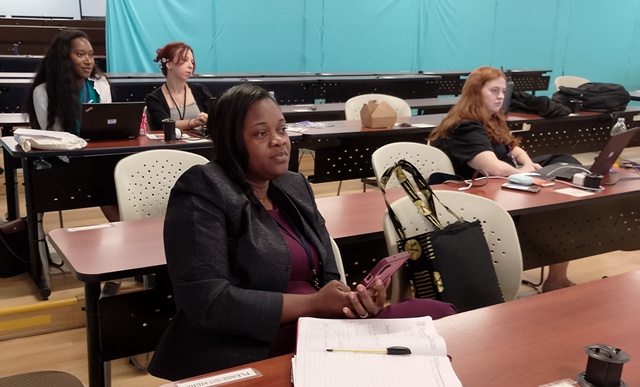
 Dianna DaSilva-Glasgow at CHOGM 2026. [photo: Debbie Ransome]
While the People’s Forum had an impressive line-up of panels and panellists on Tuesday, I opted to join the Women’s Forum. In the Caribbean, there has been much progress on gender equality with respect to political participation and public sector leadership, as well as access to education. However, gaps remain in areas such as private sector leadership and incomes. Further, women and girls continue to be disproportionately affected by domestic violence, while women in politics also face violence disproportionately more than men. For those reasons, I wanted to hear the Commonwealth dialogue around gender equality. There were two current panel sessions on very exciting issues, unfortunately I had to choose. I joined the session on ‘Advancing gender equality in a changing landscape – Countering Pushback, Protecting Investment and Building Collective power’. The other session was titled ‘Breaking the Silos: Building Collective Power for Gender Equality’.
The discussion on anti-gender actors and where does pushback come from was particularly interesting, as it shows where interventions may be required to achieve full gender equality in the region. Participants identified religious groups, men, patriarchal political systems, culture and sometimes other women as anti-gender actors. The CSO Coalition for the Women’s Forum, led by Integrated Health Outreach, developed a document outlining Civil Society Recommendations to Commonwealth Heads of Government. The document identifies eight recommendations: 1) Review and reform of colonial era laws that hinder equality and freedom of rights; 2) Long term funding for women’s rights organisations; 3) Remove educational barriers, build a leadership pipeline and create economic opportunity; 4) Recognise and invest in unpaid care and the care economy; 5) Advance women’s health across the life course; 6) End sexual and gender based violence, with real resources; 7) Advance climate justice for women and girls; 8) Build a shared feminist platform.
The main ask of the Civil Society group is for Heads to:
“Commit in the CHGOM 2026 communique to multiyear, flexible core funding for women’s rights and women led organisations, with a measurable target reported publicly at each Women’s Affairs Ministers Meeting, so that these organisations can drive the reform of discriminatory colonial era laws, build the next generation of women leaders, and reach the women and girls most often left behind.”
Participants considered the adequacy of the recommendations which they noted are aspirational. There was general support. However, recommendations were made to:
- address disability, accountability, and measurement as cross-cutting issues
- strengthen the recommendation related to the care economy to consider care for the elderly who are caring for others
- combat domestic violence and provide support for victims who need to escape abroad.
The mid-morning session also took the format of concurrent panels. One session focused on ‘The Health Sector Response to Gender-Based Violence in the Commonwealth: Evidence for Action’, and the other on ‘Strengthening accountability for gender-based violence in an evolving digital landscape: Partnerships, Practice, and Lessons Learned’. I attended the latter which had a very inspiring all-female panel consisting of women originating across several Commonwealth countries including South Africa, England, Samoa, Antigua and Barbuda, Australia, Cayman Islands and Barbados, with various roles related to address violence and human rights. The discussions reinforced the fact that women are affected by violence and referenced recent studies such as ‘The Chilling’ (UNESCO 2020) and ‘Tipping Point’ (2025) which are studies describing the experience of women in public life with violence, particularly online violence. Interestingly, it was noted that 70% of women in public life in over 190 countries had experienced violence, 41% had experienced in-person abuse triggered by online abuse. Participants spoke to the mental health and other consequences for victims of violence, including online censuring and complete withdrawal from the political landscape. Perhaps most useful is the discussion around solutions which centred on updating legislations, enforcing legislations (police enforcement in particular), addressing jurisdictional issues where criminals move across borders, holding social media companies accountable for online violence, developing capacity to record and report on case outcomes, filling data gaps (with regard to survivors, outcomes, service providers etc), improving stakeholder consultations and collaborations (especially among women), and addressing societal perceptions that lead to fear and lack of trust, enforcing international obligations (such as CEDAW) as a path to accountability, better regulation of technology products and development of toolkits to guide women leaders (an initiative the Commonwealth Parliamentary Association appears to have already commenced).
In the afternoon I attended the Governance and Democracy sessions (‘Safeguarding Democracy: Implementing the NADI Declaration’ and ‘Gender, Disability, Human Rights and Inclusion’). The discussions spoke to pressures or threats towards Democracy including public debt, Foreign interference and manipulation, lack of accountability. The Commonwealth has a strategic role in helping to safeguard democracy within the region, which remains fragile in some countries. The case of Gabon, which went through the CMAG [Commonwealth Ministerial Action Group] process, reinforces the role the Commonwealth can play in uploading democratic principles and values within the member states. Among the safeguards that are critical for protection of democracy are the independence of the judiciary (separation of power), functioning local government systems and other checks and balances.
Much to the delight of the participating audience, the session on Disability, Human Rights and Inclusion saw participants sharing their personal stories and country-specific experiences with respect to how systems are functioning to protect their rights. A noteworthy recommendation from the audience related to the protection of the rights of children (having a Child Ombudsman), which one participant noted was strongly emphasised at the Samoa CHOGM but did not feature as much at the ongoing meeting.
Dr DaSilva-Glasgow will be sharing more in-depth perspectives on the CHOGM 2026 Forums in the next edition of the Round Table Journal.
Related articles:
Journal editor Sue Onslow shares her daily impressions from CHOGM 2026
To CHOGM and beyond: The issues challenging the Commonwealth – Part one
To CHOGM and beyond: The issues challenging the Commonwealth – Part two