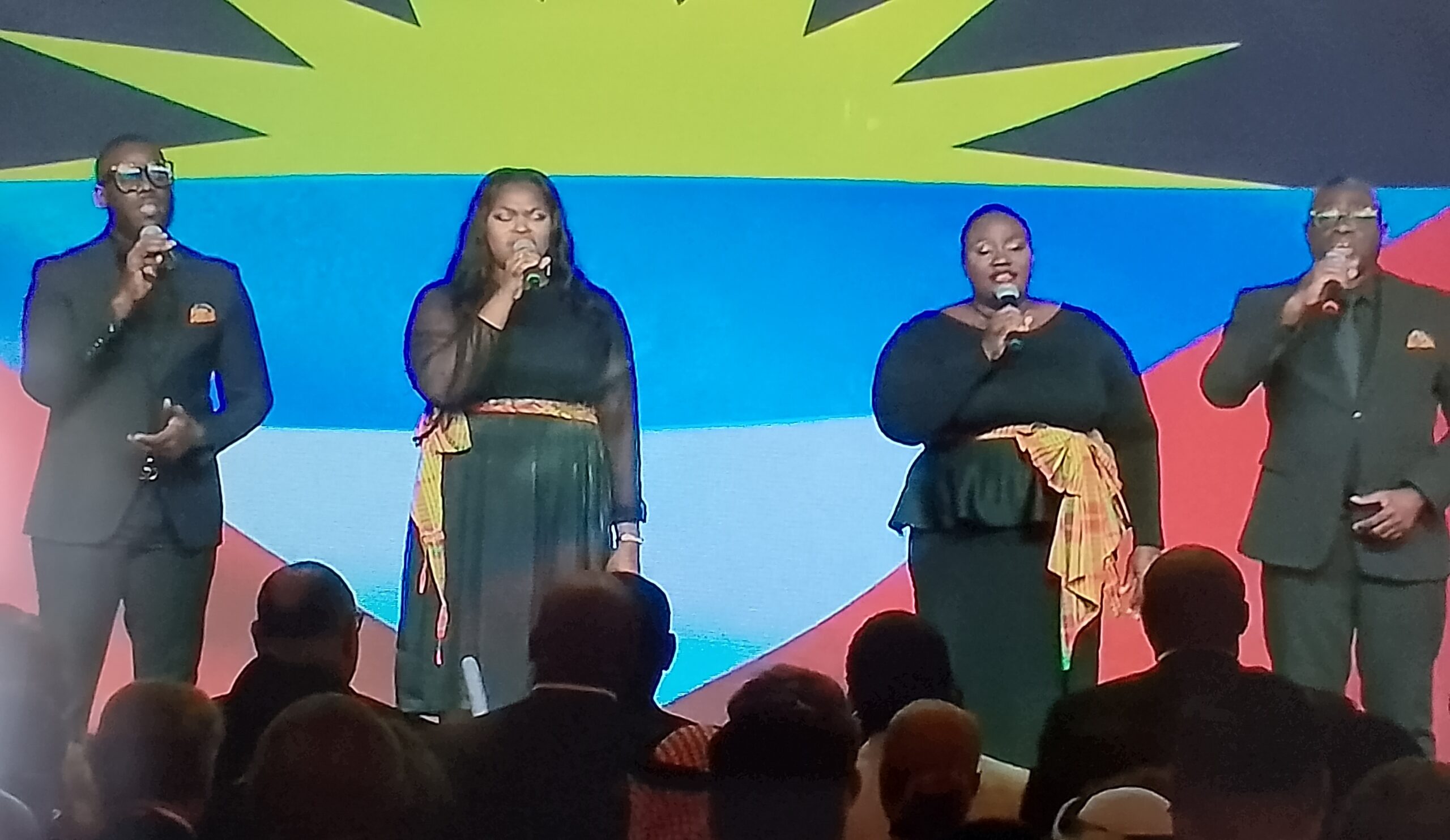
 The group Just Soul perform at the pre-Independence reception at Government House, St John's. [photo: courtesy ABS]
During the 2026 Commonwealth Heads of Government Meeting (CHOGM), the editor of The Round Table: The Commonwealth Journal of International Affairs and Policy Studies, Prof Sue Onslow shares her impressions from the biennial summit.
Day one – First impressions:
This is a beautiful country. The sun is shining and the flags are out along the main streets of the spruced-up capital, St Johns. Antiguans are famous for their warmth, generosity, hospitality – and being news savvy. The country is celebrating 45 years since independence, the King’s visit (his first as its head of state) and the 26th Commonwealth conference, the first in the Caribbean since 2009. In the words of my senior taxi driver from V.C. Bird international airport (named after the country’s first Prime Minister who also has a very large and colourful half torso concrete statue outside the Public Market place) Antigua has come a long way since 1981. “Water connectivity is much better, but there is still a way to go; the electricity supply is now much more reliable, but there’s room for improvement; roads, too, have improved a lot, but still need work.”
But there is trouble in Paradise. Antigua is officially listed as a high-income country by the World Bank, but wealth inequalities are rising. In 2020, 18% -22% of the population was at or below the poverty line, with about 29% either poor or at risk of sliding into poverty. The tourism sector is the country’s largest employer, but it is under pressure from the increasing number of cruise ships which notoriously keep the tourist spend on ship, rather than onshore. Petrol/diesel and electricity costs have risen dramatically since the start of the American war with Iran, while salaries have not. (As another taxi driver grimly put it: “Comfort comes at a cost”.) Only a small percentage of the country’s energy comes from renewables; most comes from the United States. The region’s geopolitics are increasingly fraught – quite apart from the US seizing of the Venezuelan head of state in January, Prime Minister Browne’s announcement last year of the two-phase, US$20m Economic and Technical Agreement with China (covering housing, agriculture, renewable energy and the blue economy) has prompted shrill criticism and pressure from the Trump Administration. Then there are the challenges of climate change: many, many buildings here are wooden with corrugated iron roofs, and so are particularly vulnerable to hurricanes. Fortunately, unlike 2017 when Hurricane Irma devastated Barbuda causing US$150-200m in property damage and forcing the evacuation of the entire population, this year’s hurricane season has been ‘very kind’ to this twin island nation. But every year, people hold their breath.
Antigua (population approximately 94,500) is the smallest member state ever to host a Commonwealth summit. This is also the largest conference event the country has ever organised, and it’s a significant occasion. The government is determined to develop Antigua’s caché as a conference destination. Organising the logistics of this Commonwealth meeting has clearly been an immense undertaking, requiring ‘a whole country’s approach: the organisation of 600 volunteers to help shepherd and support the 5,000 Commonwealth delegates, the manually printing and distribution of 13,000 accreditation badges at the old Coolidge air base (only handed back by the Americans in 1995), setting up shuttle systems linking widely dispersed officially designated hotels with conference venues has included commandeering yellow school buses, managing the security for visiting heads and the King and Queen has involved setting up an exclusion zone in central St Johns. Consequently, traffic in parts of the capital has come to a standstill, and local businesses and street traders are complaining about loss of earnings. I have also heard moans by the yachting community that naval security patrols are affecting mooring access. But local taxi drivers are benefitting – as one put it, “it’s a job, and I’m not doing it just because of my good looks.”
On Saturday evening, there was a Pre-Independence Day Reception in a marquee on the lawn at Government House, to celebrate both the 45th independence anniversary and the Commonwealth summit. This concert for the diplomatic corps, delegates and dignitaries was livestreamed on ABS [Antigua Broadcasting Service] Television/Radio, the national broadcaster, with an impressively informative opening commentary by Garfield Burfield, the anchorman. (One of his rhetorical questions did surprise me: Should the Commonwealth consider associate status with the European Union?) The evening’s celebration included a medley kicked off by a new song ‘Hello CHOGM’ from the Antigua Community Players. Also on the bill was a joyous performance by dancers and drummers from the Antigua Dance Academy and a steel band. Secretary-General Botchwey also made a short contribution, stressing again her message on arrival on Wednesday. This Commonwealth summit will be “game changing, epoch making”/ “for those who say summits only produce words, I say, “Watch this space”/ I assure you there will be action”. Prime Minister Garston Browne echoed this: “[It will be] a consequential meeting – it will not be a talking shop”.
These are bold words for the four-day Commonwealth meeting, which has been deliberately condensed. ABS has promised wall-to-wall coverage of the ‘consequential discussions’, but let’s see if there are measurable outcomes. How many heads of state will actually turn up is now a perennial question for Commonwealth summits (I have heard between 28 and 32.)
The listed agenda for the single day Heads’ Retreat is ambitious, to say the least. The abbreviated Peoples, Women’s, Business and Youth Forums are being run in parallel as before, but this time there doesn’t appear to be mechanisms to feed summary discussions to heads. This seems to be part of the SG’s and Secretariat’s bid to shift the Commonwealth ‘narrative’ away from advocacy towards substantive, cross-cutting partnerships. How successful this will be remains to be seen. Commonwealth associated and intergovernmental organisations have traditionally operated more in silos than across the Commonwealth ‘piste’. Some of these partnerships are of course very successful. For their part, civil society organisations have previously used the meeting with Commonwealth foreign ministers more for advocacy than as a discussion or bids for collaboration. This summit is the secretary general’s express pitch for multilateralism, Commonwealth style. If the ‘accelerated partnerships’ strategy is to work for the Commonwealth, these conversations have to start somewhere.
To CHOGM and beyond: The issues challenging the Commonwealth – Part one
To CHOGM and beyond: The issues challenging the Commonwealth – Part two
Day two:
Weather: hot, and much needed rain. Richard Bourne, a leading Commonwealth analyst over many years, has always argued that Commonwealth summits need a controversy to get the wider public to pay attention to the Commonwealth. This year reparations appeared to promise just such a heated argument. As the summit approached, there have been a crescendo of demands for a formal apology from the King, and substantial financial reparations from the UK government. In the UK media, King Charles was expected to be greeted by raucous widespread protests on his tour of the Bahamas, Guyana and now Antigua and Barbuda. Reality has proved very different. It was the Bahamas Prime Minister who met the small group of demonstrators and promised to pass on their petition, and the King was televised dancing in the street (a new rendition of ‘KC and the Sunshine Band?’) In Guyana, it was the same: small scale protests, and public emphasis on environmental projects. The morning before the King and Queen arrived in Antigua, Prime Minister Andy Burnham published an op-ed in the UK Guardian in which he announced the British government was open to the idea of a formal apology. Although Burham was clear the UK opposed financial reparations, he has committed to help identify substantial financial support for Caribbean nations. The speed with which Barbadian Prime Minister Mia Mottley welcomed the British statement on X shouted careful diplomatic choreography between No 10, the Foreign, Commonwealth and Development Office, Buckingham Palace, the Commonwealth Secretary General and Caribbean heads before the Commonwealth summit. Mottley’s endorsement was echoed by Antiguan host Prime Minister Gaston Browne, although he also stressed the need for a timetable. The CARICOM statement by chair St Lucia was more cautious: it welcomed dialogue but insisted on where both sides differ.
The signs are that the secretary general has a plan to help diffuse the issue within the Commonwealth, and to encourage discussions going forward. So enough of an argument to get the international press attention, and enough consensus to work towards a solution. As far as this important issue is concerned for this Commonwealth meeting: Result! (as my kids used to say), and this contrasts sharply with Keir Starmer’s and Rachel Reeves’ mishandling of the issue at the Samoa CHOGM. But different approaches to the reparation issue will require sustained commitment from present and future generations to address lasting legacies of centuries of slavery.
Related articles:
Editorial: The Samoa CHOGM and reflections on the Commonwealth