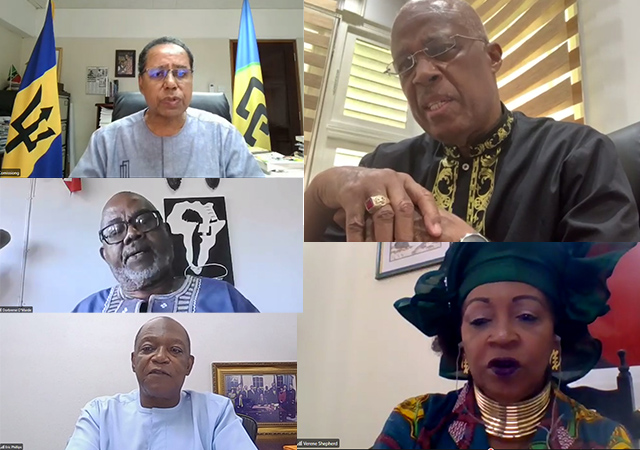
 [clockwise l-r] David Comissiong, Hilary Beckles, Verene Shepherd, Eric Phillips and Dorbrene O’Marde. [source: Caricom video]
In these days when multiple international conferences are heavy on the rhetoric and low on the follow-up, the Commonwealth Secretariat, its Secretary-General and incoming host chair, Antigua and Barbuda are determined to make the 1-4 November Commonwealth Heads of Government Meeting (CHOGM) a turning point for the organisation.
The CHOGM comes at a challenging time for the entire global order. For small states such as Antigua, the Commonwealth continues to provide a lifeline for being seen and heard. For a Secretary-General in the post since 2025, the 2026 CHOGM provides a chance to show what she’s made of. And for King Charles III, Head of the Commonwealth, it’s a chance to try and steer the organisation, and to energise its progressive agenda. Ideally, the journey should go beyond the echoes of empire and into a relatively safe space where reparations and republicanism can be discussed with the volume turned down.
To assess the challenges facing the Commonwealth at its November summit and beyond, the editor of The Round Table: The Commonwealth Journal of International Affairs and Policy Studies, Prof Sue Onslow, joined forces with the Round Table web editor Debbie Ransome to examine the major issues facing the 56-member organisation in late 2026 and going into 2027.
Reparations
Ahead of CHOGM, this issue might not be at the top of the formal agenda, but it has been the topic attracting the most headlines. Following a flood of British media focus on the King’s first Caribbean visits to the Bahamas and Guyana, before Antigua, and calls for reparations, Caribbean Community’s (CARICOM) Reparations Commission laid out its case at a 22 October media briefing. CARICOM Reparations Commission Chair, Sir Hilary Beckles made an impassioned plea for this summit to be “THE CHOGM of reparations meeting.” He said that reparatory justice was “the one item on the table”. Beckles, who is also Vice-Chancellor of the University of the West Indies, and chair of the Global Reparations Commission, called on the head of the Commonwealth, ‘Charles Windsor’, as a parent and grandparent and “as a man, as a human brother” to preside over a Commonwealth as a global and moral institution to steer on the issue of reparations. This call builds on decades of Caribbean advocacy on the issue of slavery and reparations which led to CARICOM’s 10-Point Reparations Programme. These international pressures culminated earlier this year in the United Nations Declaration of the Trafficking of Enslaved Africans and Racialized Chattel Enslavement of Africans as the Gravest Crime against Humanity, sponsored by Ghana – and it must be remembered Secretary-General Botchwey is the former Ghanaian Foreign Minister. (Ghana was also appointed the African Union’s Champion on Reparations under the AU’s Theme of the Year, ‘Justice for Africans and People of African-Descent through Reparations.’) In September, Jamaica submitted a landmark US$10 billion
reparations petition to the King; this appeal has gone to the Judicial Privy Council, asking for a ruling on the legality of transportation and enslavement; whether it breached international law; and whether the UK has a binding legal obligation to provide ‘a reparatory remedy to Jamaica and its people’. (It is due to be heard in March 2027.)
The CARICOM Reparations Commission has also repeatedly sent high-level delegations to London to push for reparatory justice. At the media briefing on 22 October, CARICOM Reparation Commission vice chairs called for a Commonwealth foreign minister-led focus on a “dialogue of decency” on reparations. “The Commonwealth has a very important part to play in this,” Sir Hilary said. He urged governments to “reject the noise in the margins” and join the “conversation with integrity” already taking place with banks, the families of former slave owners, the Church of England and other institutions to found “partnerships for development”.
Barbados Ambassador to CARICOM, David Comissiong told the briefing that a “fundamental illegality” laid at the heart of the slave laws which made humans “non human”. He described the reparations movement as a “call to justice”. “Destiny is on the side of those who are willing to do the right thing,” Ambassador Comissiong said.
Chair of the reparations committee in the CHOGM host country, Dorbrene O’Marde, said that King Charles would be aware of the Church of England’s apology and that the “no apologies” comments from royal circles had inflamed the people of Antigua and Barbuda, and the formation of a local Citizens for Reparations Support Group. However, O’Marde stressed the respect Antiguans had for King Charles as their head of state and stated that the issue would come up at side forums at CHOGM and at a separate launch of a global reparations discussion, aimed within and beyond the Commonwealth. Vice Chair Verene Shepherd warned again the “narrow focus” on direct monetary compensation.
“The King is a decent man,” Chairman of Guyana’s Reparations Committee, Eric Phillips, said. King Charles is visiting Guyana and the Bahamas ahead of CHOGM, Phillips called on King Charles as “an enlightened monarch” to promote “a dialogue of decency”.
The CARICOM (Caribbean Community) Ten Point Plan for Reparations: A Manifesto for the Coming Enlightenment – CARICOM
CARICOM Reparations Commission Delegation Returns to UK to Strengthen Global Reparations Movement – CARICOM
King Charles urged ‘as human brother’ to support reparations talks at Caribbean summit
Asked for her personal view on reparations during a Sky News interview, the Commonwealth Secretary-General said: “I believe that the time has come for that conversation. I don’t believe we can run away from it.” She added that it was important to determine the form that reparations should take. “Whether it takes the form of financial reparations or reparations in kind, that is for the countries to decide on.”
On an apology for slavery, the Secretary-General said that countries had asked for an apology from the King. Asked if she would like to see that, she responded, “It wouldn’t hurt to have that.”
This raises two issues:
First, past Secretary-Generals have enjoyed regular private discussions with Buckingham Palace. It is highly unlikely that Secretary-General Botchwey would have tried to put the King on the spot. Botchwey also has a strong media and communications background, so we may take it that these remarks were deliberate. Since the King has determinedly supported the Commonwealth as a progressive force since his accession, can we see a power play on Downing Street?
Secondly, would a formal apology by the King lay his government open to legal financial redress for historic acts of slavery?
Will all this lead to a formal apology by King Charles III? At times the King has seemingly been ahead of the British government. Yet his striking speech at the opening ceremony of the Kigali CHOGM in 2022 bore the fingerprints of the Foreign Office; as Prince of Wales deputizing for his elderly mother, Charles was firm in expressing his ‘deep sorrow’, declaring ‘the time is NOW’ for an honest discussion about Britain’s role and the legacies of slavery. Secretary-General Patricia Scotland echoed this, underlining that these would be uncomfortable but necessary conversations. In 2023 The King also authorized research into the monarchy’s involvement in the Royal Africa Company’s enslavement and trafficking of Africans. But – and it is a large BUT – as constitutional head of state of the United Kingdom, the King is in a diplomatic bind: while his use of language has gone further than his predecessors, he is still constitutionally bound by the advice of his ministers; and at the 2022 Samoa CHOGM, Keir Starmer’s delegation tied itself in knots in its efforts to scotch calls for financial reparations. The Commonwealth famously gave the late Queen the space to be a highly effective royal diplomat. The signs are that King Charles III will do the same. But it is a challenging tour.
The King said on 27 October in the Bahamas at the start of his three-nation Caribbean tour that it was only right “to acknowledge the great suffering and injustices of the past in these islands and beyond, even as we rejoice in the successes of the present and build on new opportunities for the future.” He said that Commonwealth leaders will discuss the matter at their summit.
Climate
While the issue of reparations is of prime concern to some members of the Commonwealth, for others there are more pressing environmental issues – indeed, existential threats.
The issue of climate has been increasingly linked to the arguments for climate justice, particularly by Pacific Island States. From its roots in lobby activity by the University of the South Pacific, small island Pacific states, and most recently Nepal, have pursued the idea of linking direct climate impact to concrete cases for climate justice payments.
Nepal has become the most recent test case for the loss and damage cause, following its August Trishuli Valley disaster. The UN Loss & Damage fund finally allocated a US$21.6 million grant which campaigners said represented only 0.4% of Nepal’s estimated US$4.77bn cost of recovery and reconstruction, and with strings attached.
“This landmark decision reflects the spirit of multilateral cooperation, climate justice and collective responsibility towards countries vulnerable to the adverse impacts of climate change,” said Maheshwar Dhakal of Nepal’s Ministry of Forests and Environment, who is currently serving with the Fund for responding to Loss and Damage from the Least Developed Countries (LDC) Group told the Nepali Times.
“It is not only a significant milestone for Nepal but also a powerful message of hope and solidarity for developing countries,” he added.
Countries continue to argue about who is responsible and therefore who should pay for climate damage. The Indian Union Minister Piyush Goyal told the 2026 Berlin Global Dialogue that developed nations had caused the climate crisis. “Who’s responsible for this mess in the first place? Where did this ozone get damaged?”, he asked delegates on 23 October.
The importance of these issues was underlined at the Patsy Robertson annual lecture given by Lord Sharma (British Climate Envoy at the Glasgow COP, and lead negotiator on the issue for the Boris Johnson government) at Marlborough House on 27 October.
As Lord Sharma stressed, the vast sums required for climate justice and mitigation will overwhelmingly have to come from the private sector. In his view, where the Commonwealth can take an effective lead for its LDC members is helping states identify climate mitigation projects, supporting their regulatory frameworks and removal of red tape, to help stimulate and speed up vitally needed inward investment. He called for the Commonwealth to “speak with one voice” going into the COP31 meeting in Turkiye (Turkey) to be held four days after CHOGM. The Commonwealth has done this before, at the 2009 Port of Spain heads of government meeting, before the Copenhagen COP summit (although that COP collapsed in shambles, delegates commented that the Commonwealth as a global group had the most coherent stance and recommendations), and again at the 2015 Malta CHOGM, which met before the historic Paris COP21. Time for the Commonwealth to do it again. Lord Sharma’s lecture was followed by a roundtable discussion including the Fijian High Commissioner andthe Australian Deputy High Commissioner, on the pre-COP31 meeting in Fiji in earlyOctober, and its outcomes. So factor in the Fiji-Tuvalu Declaration and the fact that Australia and Pacific Island States are certainly coming to this CHOGM with this firmly in mind.
Part two of this article will look at AI, migration, the future of the Commonwealth and republicanism.