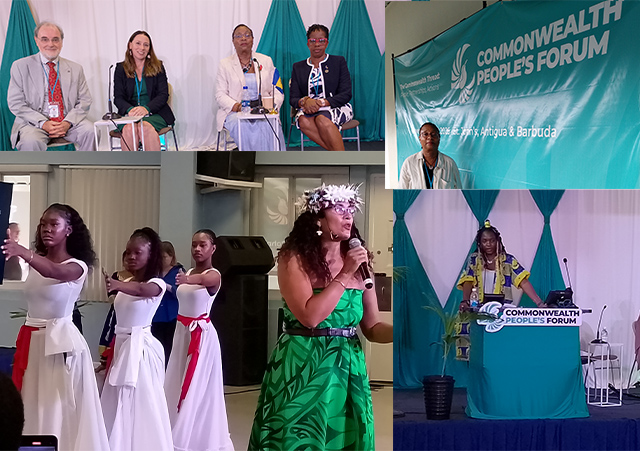
 [clockwise] Panel on Strategic Partnerships, Debbie at the People's Forum, Esther Mwema, Selina Tusitala Marsh, [photos: Mostly Debbie Ransome]
Debbie Ransome is the website editor for the Commonwealth Round Table. Her job is usually the publication of others’ observations. However, her participation in the Commonwealth Heads of Government Meeting (CHOGM) Round Table team in Antigua provided a perspective on the summit beyond the leaders’ speeches and communiqué.
Sometimes, the final day of a conference can perfectly crystallise the mood among the departing delegates. And that was exactly what happened at one of the events on the last afternoon of the Commonwealth summit on 4 November 2026.
As heads began the process of issuing the closing communiqué and holding media briefings, the day-three delegate-led session Generation Rewrite: Youth shifting the narrative for climate justice at the People’s Forum invited views on difficult questions. This included: “Are international forums truly influencing decisions or creating a cycle of speeches, photos and repeated patterns?” The session required digital responses from participants that echoed comments made in Antiguan and wider Commonwealth societies on whether CHOGM 2026 could become more than a talking shop and deliver the promised “turning point” for the organisation.
The Generation Rewrite session focused on climate justice, but the on-screen question about real participation led to messages from the event’s youthful participants that echoed way beyond the closing ceremony. The digital delegates format allowed people to scan the QR code and issue their responses from their phones anonymously. One line of discussion, framed around youth participation in climate meetings, led to complaints that young people were being used to create a cosmetic sense of buy-in to a project or idea. “Stop making youth a token entry,” said one message. “Stop the tokenism,” said another. One delegate spoke of the “tick-box tendency”.
Panel members for this session also echoed the need to use young participants’ contributions properly, not just for photo opportunities, as well as the need to set short-term targets on climate to make implementation measurable. One panellist said that young people needed to feel that they were walking away from such get-togethers “with more than a water bottle”.
Final session and closing ceremony:
Anyone who is tempted to dismiss these grievances as a youthful moan should think again. I spent the next few days not only enjoying catching up with Antiguan and other Caribbean friends and new acquaintances, but also following local and regional media as people questioned what CHOGM 2026 had achieved and whether there would be tangible follow-up.
And it wasn’t just a Caribbean concern. As web editor for the Commonwealth Round Table, I received an insightful contribution from Derek McDougall, Professorial Fellow in the School of International Affairs at the University of Melbourne, who had covered the Samoa CHOGM for Round Table. His article during the Antiguan summit found the Caribbean’s youthful pushback on foreign summits echoed in the domestic pressure on Australian Prime Minister Anthony Albanese over his decision to attend the event.
CHOGM ‘of action’
Despite the issues raised above, the overall mood of the summit was positive. Host Prime Minister Gaston Browne spoke at the Joint Forums opening of a “CHOGM of action” and a “CHOGM of concrete results”. He continued to promote this message as his fellow leaders flew out of Antigua. In post-summit speeches and interviews, his government’s emphasis on the Business Forum achievements outlined for Antiguans and Barbudans what CHOGM would deliver for them.
The final media briefing and statements from the Commonwealth Secretariat also spoke of CHOGM 2026 raising half a billion US dollars in “new commitments for a range of initiatives, including renewable energy, skills development for young people, and new opportunities for trade and growth”.
The final communiqué confirmed the reaffirmation of the Commonwealth Ministerial Action Group (CMAG) as “the principal mechanism for safeguarding our values and principles”. It added: “We encourage CMAG to broaden its engagement to support efforts to strengthen adherence to the Commonwealth Charter values.”
Notably, as already highlighted in copious column inches, the leaders managed to defuse and shift the reparations issue, both through a deftly crafted speech by King Charles in Antigua and via a co-ordinated move to what the communiqué described as “a structured, time-bound, inclusive and good-faith dialogue with affected parties addressing the transatlantic trafficking of enslaved Africans and its historical harms”. The diplomatic manoeuvring avoided what could have become the reparations summit.
Read the final communiqué
Final media briefing
The 2 November opening ceremonies around CHOGM’s joint forums opening event and Antigua’s 45th independence anniversary were full of hope. Australian leader Albanese delivered the keynote address at the Forum and Events launch at St John’s Episcopal Church, offering support to Antigua for coral reef preservation. It is the kind of stuff that binds the Commonwealth together in today’s complicated world.
Another standout session on 3 November was on artificial intelligence (AI) and how the Commonwealth could use its unique family network to take control of the global narrative on AI.
AI session:
The Commonwealth Quilt
The Commonwealth Quilt project was conceived by the Commonwealth’s inaugural Poet Laureate, Selina Tusitala Marsh, inspired by her poem “How to Make a Commonwealth Quilt” and showcased at the American University of Antigua (AUA).
The Quilt project was one part of the clever incorporation of cultural celebrations into the in-depth debate. The forum hosts pulled Commonwealth participants into a joyous celebration of the Antiguan and wider Commonwealth family. Volunteers from AUA and the rest of Antigua steered delegates and made us all feel like part of the extended Antiguan family.
Space for the youth
Given my former role as head of the BBC’s Caribbean Service for 14 years, as well as my current membership of the executive of the Commonwealth Journalists’ Association (CJA), I am acutely aware of the aspirations of young Caribbean journalists seeking space to do more in-depth journalism. In this context, it is important to stress the role of CJA, working together with other Commonwealth associations, in getting the Media Freedom Principles adopted at the Samoa CHOGM.
After I took part in a panel on Commonwealth partnerships and made contributions on the Media Freedom event, young journalists approached me at the summit seeking CJA help in their quest for more opportunities. I realised that these young journalists were still exploring investigative journalism in one of the freest media spaces in the Commonwealth. When I expressed a cynical comment about summit fatigue over lunch with some young delegates on the final day, one Caribbean documentary maker said that such conferences allowed him to meet people like me and all the people in the lunch marquee area. It cast a new light on the need for such events, despite the airmiles.
Being interviewed by the Antigua Broadcasting Service’s editor-in-chief, Garfield Burford, reminded me of the amazing professionalism of former colleagues in the Caribbean. Garfield’s encyclopaedic knowledge of the Commonwealth was on display on-screen at every event.
Daily CHOGM reports from Round Table Journal Sue Onslow
Report on the Women’s and Youth Forums from Journal Regional Editor Dianna DaSilva-Glasgow
Antigua’s turn
St John’s retained the bunting attached to CHOGM, the King’s visit and its independence celebrations as delegates flew out – some of them on the way to the next summit, COP31 in Turkey. Antigua’s quietly global capital hopes to become more of an international events venue because of its CHOGM rollout. Shopkeepers and business people in Antigua hail from as far away as Mumbai, China, Guyana and Canada. Yet unlike capitals of larger Caribbean nations, St John’s does not shout about its diversity as it goes about its non-CHOGM business of hosting nearly one million cruise ship visitors a year from all over the world.
Antiguans’ work ethic led them to take pride in the 10- to 11-hour workdays many of them put in while looking after 5,000 delegates on an island of 94,759. None of this detracted from their sense of fun. As I clung to a golf buggy taking me to the exit gate, a short pause allowed one Caribbean delegate to shout joyously: ”Ransome…BBC.” I waved and laughed all the way to Gate 5, wondering whether the hard-working people of Antigua might just be the chair-in-office the Commonwealth needs to overcome global summit fatigue. Maybe this CHOGM would go beyond returning home with a nice water bottle.
Related articles:
PM Browne says grants covered 80% of CHOGM spending, defends cost of hosting summit
From CHOGM to COP31: Small islands will not be small talk
Can Albanese regain political altitude for Labor – and himself?