[This is an excerpt from an article in The Round Table: The Commonwealth Journal of International Affairs and Policy Studies.]
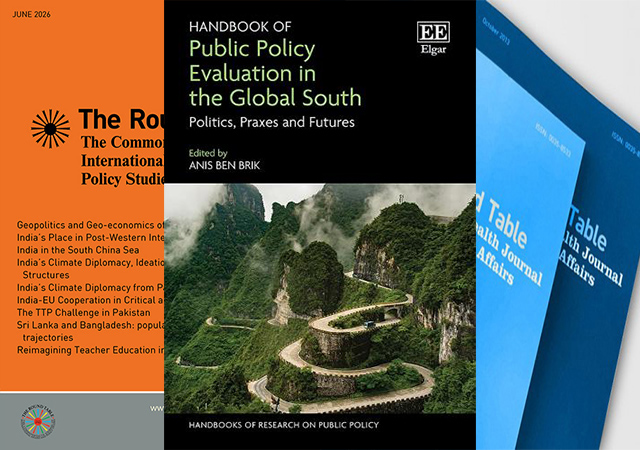
Handbook of Public Policy Evaluation in the Global South, compiled under the editorship of Anis Ben Brik (College of Public Policy, Hamad Bin Khalifa University, Qatar), remedies a critical deficiency in the existing body of public policy and evaluation research.
While the assumptions, frameworks and standards of evaluation have long been dominated by the Global North, this collection of essays explores the Global South on its own terms. Authored by scholars and practitioners possessing profound regional or country-level expertise, the volume interrogates the ways in which historical trajectories, prevailing political configurations, institutional vulnerabilities and indigenous innovations collectively configure the landscape of policy evaluation practice across Africa, Asia, Latin America, the Middle East and the Caribbean.
This timely, significant and path-breaking work delivers a rigorous, sustained interrogation of the Northern-centrism that dominates mainstream evaluation literature. It stands as both an authoritative scholarly resource and an impassioned summons to expand and decolonise transnational conversations within public policy and evaluation studies.
From threat to justice: Rethinking the securitisation of climate-induced migration from the Global South
Who can lead the global south? Navigating the elephant and dragon’s rise
Anis Ben Brik’s edited volume is structured into seven parts comprising 24 chapters, moving from broad theoretical and political discussions to specific practices, capacities, innovations and challenges. Specifically, Part I (Chapters 1–2) lays the foundation with the editor’s chapters on theoretical frameworks and the politics of evaluation. Part II (Chapters 3–9) examines institutional frameworks, systems and cultures through diverse country and regional case studies, including the Middle East and North Africa (MENA), the Caribbean, China, India, South Africa, Uganda and Bolivia. Part III (Chapters 10–12) focuses on evaluation capacity development, with particular attention to North African countries, India and Pakistan. Part IV (Chapters 13–15) explores multi-level governance and implementation, featuring strong coverage of Mexico at the local and sub-national levels. Part V (Chapters 16–19) addresses indigenous approaches, decolonisation and transformative visions, drawing on examples from Latin America and the Caribbean, Bhutan and Sri Lanka. Part VI (Chapters 20–22) analyses political instability and international influences through case studies on Nepal, Yemen and Sudan. Finally, Part VII (Chapters 23–24) provides a synthesis and forward-looking reflections by the editor.
New global structures for the new global age
The handbook’s greatest asset is its deep contextual grounding. Contributors consistently show how a series of factors significantly influence public policy evaluation in the Global South, that is, ‘colonial legacies and institutional frameworks, external actors and international influences and domestic political dynamics and public sector capacity and stakeholder engagement’ (p. 469). The case studies are both wide-ranging and empirically grounded. Especially noteworthy are Chapters 16–19, which foreground indigenous and decolonial perspectives, while resisting the reflexive adoption of Western frameworks and benchmarks.
It should be noted that the editor constructed five scenarios to illustrate potential futures for public policy evaluation in diverse Global South contexts, including but not limited to democracies, authoritarian regimes and military governments. Specifically, the five scenarios are as follows: technological divide, participatory paradox, ethical tightrope, adaptive resilience and globalised evaluation (pp. 496–498).
If one were to identify a weakness in this otherwise ambitious volume, it is that a number of contributions are stronger in description than in critical or theoretical depth. As a result, the overall analytical rigour feels somewhat inconsistent across chapters. This limitation partly stems from the volume’s methodological reliance on secondary materials and expert views, which – as the editor candidly acknowledged – ‘partially captures the nuances of on-the-ground evaluation practices in each country’ while also carrying ‘a potential bias toward English-language sources’ (p. 470).
Kai Chen, School of International Relations, Xiamen University.
Handbook of Public Policy Evaluation in the Global South: Politics, Praxes and Futures edited by Anis Ben Brik, Cheltenham, UK, Edward Elgar, 2024.