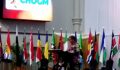
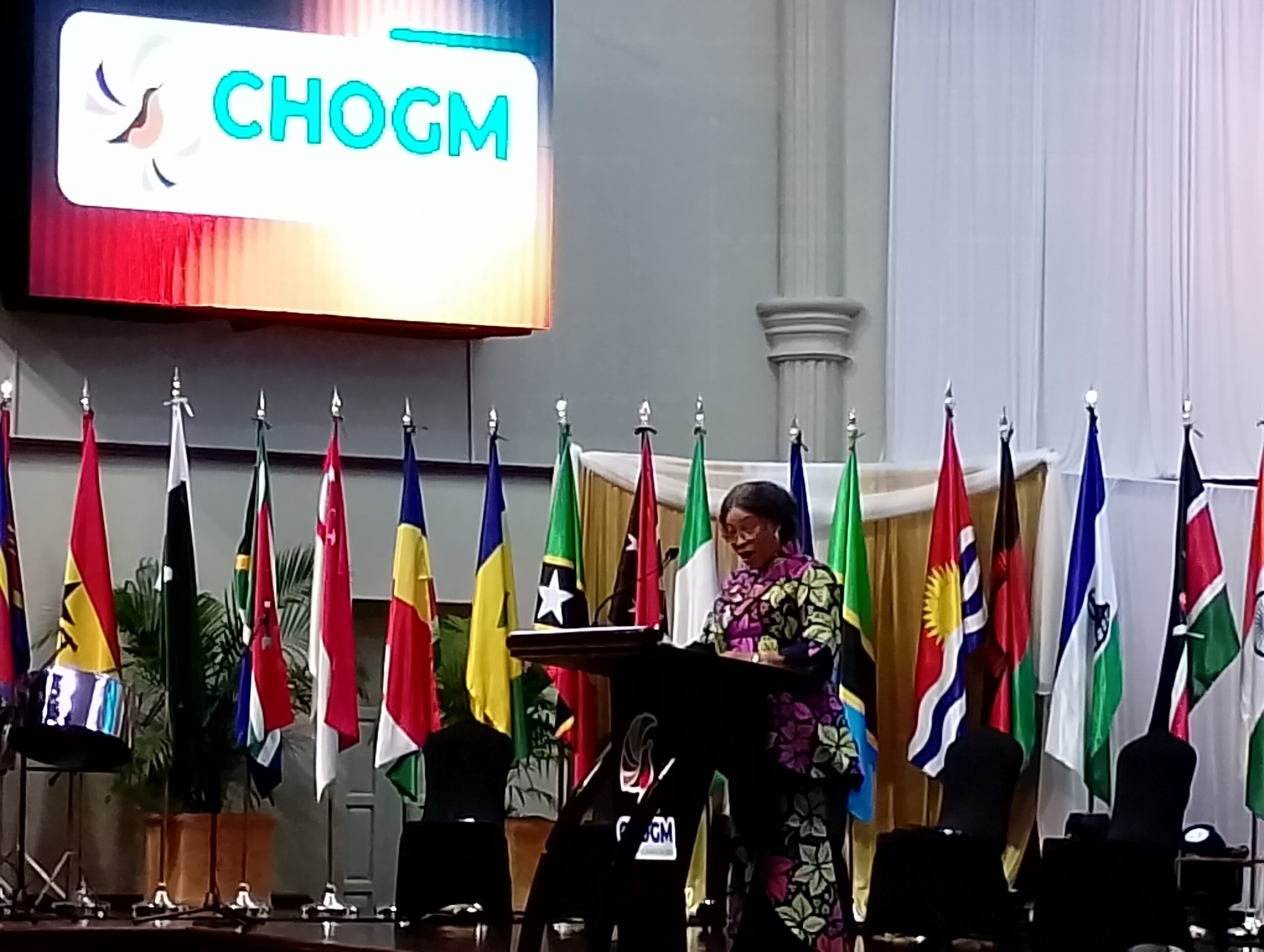
 Secretary-General Shirley Botchwey at the Joint Forums and Events launch. [photo: Debbie Ransome]
During the 2026 Commonwealth Heads of Government Meeting (CHOGM), the editor of The Round Table: The Commonwealth Journal of International Affairs and Policy Studies, Prof Sue Onslow shares her impressions from the biennial summit.
Sunday:
ABS, the Antiguan national broadcaster, was firm this evening: following on from the packed interfaith service at St Johns Pentecostal Church, ‘today is all about unity’. Critics of CMAG [Commonwealth Ministerial Action Group] would say that went too far as CMAG’s current nine Commonwealth Foreign Ministers met in closed session all afternoon. While Gabon is now off the formal agenda, there is wider Commonwealth ‘surprise’ that there was no mention whatsoever of any other states in the CMAG statement, particularly Tanzania and Uganda which were formally listed on the longer CMAG Concluding Statement published on the margins of the September United Nations General Assembly meeting. There has been quiet speculation by some international media observers that a) that Zambia was left off CMAG’s announced formal agenda now because the Foreign Minister is currently CMAG deputy chair; and b) President Samia Suhulu Hassan was waiting to see how the Tanzania government’s crackdown on opposition would be handled at this CHOGM meeting. Now we know.
On a hot and humid Sunday afternoon, the gates opened at the Sir Viv Richards Stadium as hundreds of Antiguans and Barbudans began filing into the 10,000-capacity stadium. The Antiguan and Barbudan 45th Independence Ceremonial Parade was led by a military band, the Antigua and Barbuda Defence Force (245 personnel, with 80 reservists) and Royal Police force (600 active duty, with approximately 200 fire personnel) marched. Judging by the reaction of the appreciative and supportive crowd and online comment, it was a proud moment. In a ceremony that would be familiar to other Commonwealth Realms countries, armed, immaculately uniformed officers presented the King’s Colours. (Antiguan defence forces regularly train with other Caribbean forces, and Canadian airforce personnel hold specialised workshops.)
Understandably, security was tight, and parking restrictions were in force (you don’t want to get a parking ticket in downtown St Johns in normal times which could set you back EC$150). The pomp and circumstance of the Antiguan Defence Forces parade on National Independence Day was accompanied by a short, sharp, intense rain shower. The King gained considerable respect for refusing to take the royal salute under an umbrella. This was followed by a T-5 exhibition Leaders cricket match, and a T-10 match with the future stars of the Commonwealth (both were organised around the Commonwealth Caribbean vs. the Rest programme). Antigua’s cricketing national icons, Sir Viv Richards, Curtly Ambrose and Andy Roberts, were very much in evidence. Although this was presented as a first, it echoed the 1991 Leaders Cricket match at the Harare Commonwealth summit. Just as in 1991, the leaders were ‘good sports’ (the bowling was ‘enthusiastic’. Let’s leave it at that), the crowd cheered loudly and were entertained, and the Antigua Broadcasting Service’s very experienced West Indies sport commentators provided tongue-in-cheek assessments of the Leaders T-5: comments of ‘slightly unorthodox bowling’, etc. It was all accompanied by a drone light display over the stadium.
From the editor – part one
Monday:
The day began with the Joint Forums Opening Ceremony at St John’s Pentecostal Church, and the Antiguan national anthem played by a steel band and three Scottish bagpipes. (‘A brave decision, Prime Minister’. I’m happy to say it worked.) Against the distant backdrop of public media briefings and counter briefings around the reparations issue, the Commonwealth summit got down to business. The care put into the summit themes of ‘partnerships and collective action’, and emphasis on the need of a Commonwealth summit of ‘results,’ was clear from the selection of speakers, and choreography of cultural performers. The format of this opening ceremony of the Joint Forums differed markedly from other Commonwealth opening ceremonies I’ve witnessed for the past eleven years: No opening speech by the King as ceremonial head of the Commonwealth (apparently that’s for tomorrow, Tuesday), fused Commonwealth music and dance performances; a keynote by Australian Prime Minister Anthony Albanese – very much from the ‘leader of the Pacific region’ standpoint, the climate crisis and approaching COP [Congress of the People], and squeezing in a pitch for Australia’s bid for a UN Security Council seat. This was followed by moderated panels with President Paul Kagame of Rwanda, the Prime Minister of Jamaica (who made the most cogent contribution), and the Deputy Prime Minister of Samoa, Mulipola Anarosa Ale Molioʻo. Yes, their remarks were scripted, but they had clearly given thought to summarizing current challenges, opportunities, and possible paths forward. The second panel which included Commonwealth business leaders and innovators, and a Canadian astronaut had again been selected to reflect the breadth of the Commonwealth’s membership.
I then disappeared to the Commonwealth Business Forum (CBF) at Coolidge Cricket Ground next to the international airport. Antiguan Prime Minister Garston Browne gave a lengthy presentation, underlining economic challenges facing SIDS (small island developing states), and calling for using the ‘Commonwealth advantage’ in practical ways, rather than as mere rhetoric. In a series of keynote lectures, panel discussions, and fireside style chats, the CBF drew together an extraordinarily impressive range of panel speakers over the day. These included Dr Ngozi Okonjo-Iweala, Director-General of the World Trade Organisation, Prime Minister Mia Mottley of Barbados who signed a landmark MOU for Barbados/Nigeria pharmaceutical collaboration amounting to US$32 million for the creation of manufacturing capacity of IV fluids in Barbados, senior officials in the African Export-Import Bank, the President of the East Caribbean Development Bank, senior Commonwealth reps at the IMF, the Royal Bank of Canada, quantum tech entrepreneurs, etc. etc. (I have not included them all, and this was just Day One of the CBF. The Forum had clearly put a great deal of effort into ‘Commonwealth’ convening power). The Commonwealth Enterprise and Investment Council announced their Commonwealth Family Initiative (it was unclear to me exactly what this involved). Frameworks for harnessing the investment potential of Commonwealth diaspora was only set out later in the day, and I was struck by the absence of any references to India, South Asia and the Pacific. When examples were cited of boosting South /South trade and investment business cooperation, these were firmly Caribbean/Africa. But the contributions from the podium and the platform were impressive, and (as always at international events) there was great value in the chats next to the coffee machine. Pulling this all together into a discernible Commonwealth framework doesn’t appear to be the agenda.
Meanwhile, at the People’s Forum, the particular highlights were the wonderful performance by Commonwealth Poet Laureat Selina Tusitala Marsh with a poem about the Commonwealth Quilt and its power to pull people under the same canopy, and the lively panel session on funding and supporting the creative economy. More on that tomorrow.
Related articles:
To CHOGM and beyond: The issues challenging the Commonwealth – Part one
To CHOGM and beyond: The issues challenging the Commonwealth – Part two