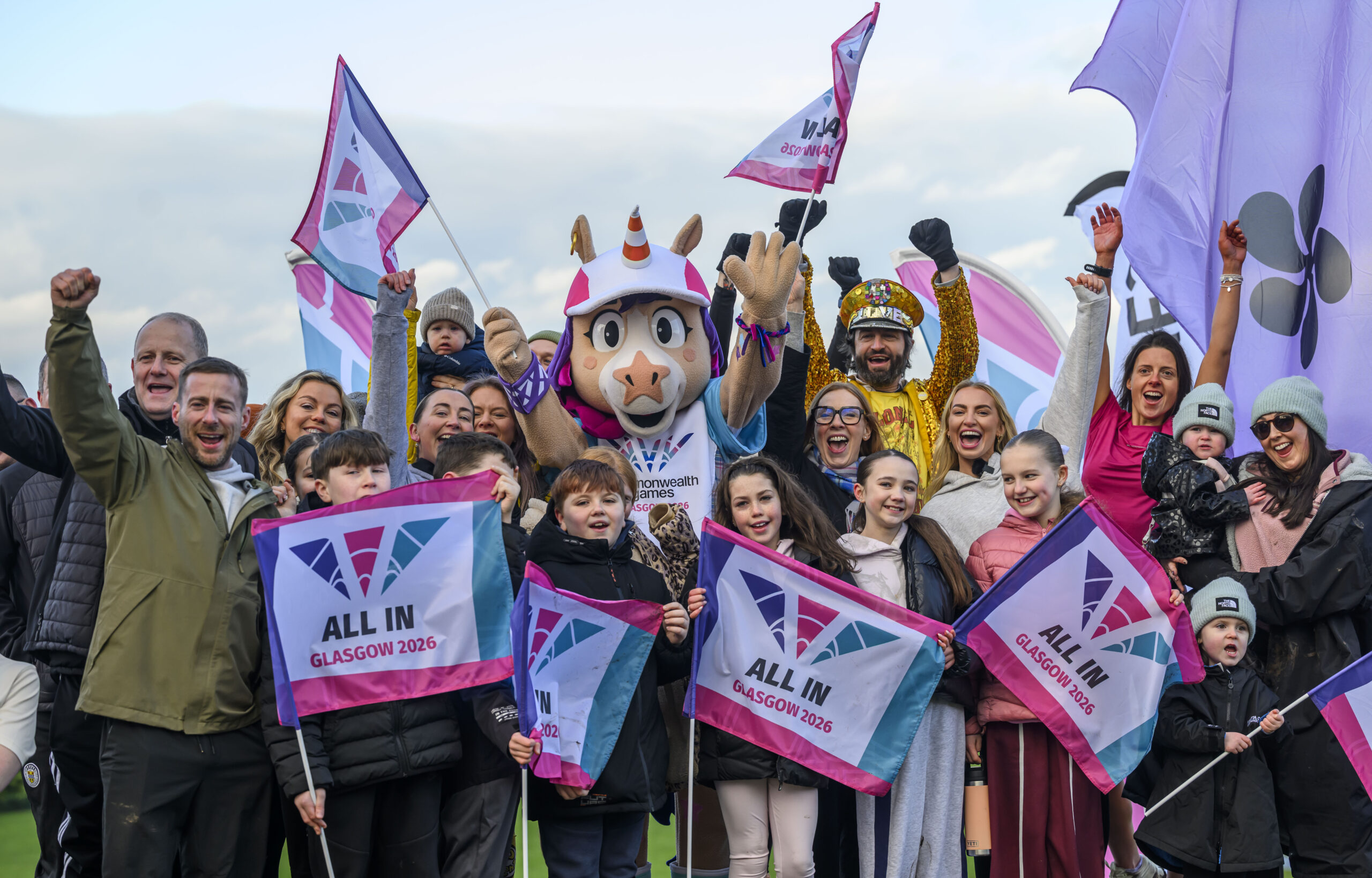
 Community organisations kick off the All In campaign with Glasgow 2026. [photo: Commonwealth Games Glasgow 2026 MediaBox.]
The Glasgow 2026 Commonwealth Games set the seal on the first century of a multi-sport celebration which now attracts 74 nations and territories but still has the feel of sport among friends.
The idea of such a gathering had been mooted even before the revival of the Olympics for the Modern Era in 1896. Although the First World War halted international sport, when peace returned, the 1920, 1924 and 1928 Olympics were all held in Europe. After each, athletes from Commonwealth countries took part in a bi-lateral challenge match against the United States before returning home.
The idea of a separate event “designed on the Olympic model” but just for Commonwealth countries was motivated to some extent by dissatisfaction with the way regulations on amateurism were applied at the Olympics.
At the urging of Canadian official Melville Marks “Bobby” Robinson, the inaugural British Empire Games were fixed for Hamilton, Ontario in 1930. Only eleven teams took part. The six sports included bowls, still part of the Games to this day. Women competed only in swimming and diving.
The Games were to be “merrier and less stern and will substitute the stimulus of a novel adventure for the pressure of international rivalry.”
Some International Olympic Committee (IOC) members fretted that the Commonwealth nations might break away from the Olympics altogether, but IOC President Henri Baillet-Latour was invited to Hamilton and returned home reassured. He also borrowed an idea after witnessing the use of a victory podium, this became a part of every subsequent Olympics as well.
The “Friendly Games”
The Commonwealth Games have stood the test of time, held every four years since, with the exception of 1942 and 1946.
They were also dubbed “Friendly Games” although the spectre of politics had lurked in the background for many years.
South Africa took part in 1930, but already there existed a discriminatory system which ultimately became “Apartheid”, with segregation extended to sport. Whenever New Zealand rugby teams toured South Africa, there was a tacit understanding that no Māori players would be chosen.
Even so, South Africa was invited to host them in 1934, most probably in Johannesburg. South African authorities insisted policies of segregation would not be changed “even at the risk of appearing discourteous”. They were quietly replaced by London.
There were other flashpoints when members of the South African team were involved in an unpleasant argument with Trinidadian runner Noel Stanford during the 1938 Sydney Games.
South African boxer Robey Leibbrandt won bronze at the London 1934 Games. He also boxed at the 1936 Berlin Olympics. He was so impressed by Hitler’s regime that he later spied for Nazi Germany.
Although South Africa did not compete after 1958, the 1970 Games in Edinburgh were threatened with boycott because South Africa’s cricket team was scheduled to tour England. This was ultimately cancelled and the Games went ahead unhindered. There was however a major boycott in 1986 when the Games returned to the same city. This was in protest at the British government’s refusal to enforce the 1977 Gleneagles Agreement which discouraged sporting contact with South Africa as long as Apartheid remained.
It was only a few days after the 1990 Auckland Commonwealth Games closed that Nelson Mandela walked free from prison and the dismantling of Apartheid was set in train.
The case for the Commonwealth Games
The plan to ‘reset’ and ‘redefine’ the Commonwealth Games
Time for a new Commonwealth Games?
Commonwealth Day 2026: A ‘family of choice’ in troubled times
Indigenous culture
Those Games had been noticeable for embracing indigenous culture. At 95 years old, Māori elder and activist Dame Whina Cooper and scholar and statesmen Sir Hugh Kawharu both spoke at the opening ceremony in Auckland.
For the 1994 Games in Victoria, British Columbia, a central part was played by Kwaxistala Chief Adam Dick of the Kwakwakaʼwakw first nation, a key figure indigenous culture.
For most Games since 1958, the connections of the Commonwealth family have been reflected in a message to the athletes sent by late Queen Elizabeth II in a symbolic Baton. It is a tradition followed by King Charles III.
Yugambeh elders Ted Williams and Patricia O’Connor were at Buckingham Palace to see the 2018 Baton depart for Games on Queensland’s Gold Coast. At the opening ceremony, a traditional indigenous smoking ceremony was performed. ”It cleanses us, blesses us and connects us to this land, this country,” a performer said.
In 1998, the Games arrived on Asian soil. Held in Kuala Lumpur, they embraced Malaysian culture. An elephant even helped convey the Queen’s message and a giant traditional drum was given to the 2002 hosts Manchester as a physical embodiment of the connections of the Commonwealth.
Gaining experience
Hitherto an event only for individual sports, the Games introduced team sports from 1998 as they underwent a reset for the future, a process which has continued ever since with the introduction of new sports and updated versions of old ones.
Nations such as Cameroon and Mozambique, hitherto not part of the Commonwealth, are now regular participants at the Games.
From a purely sporting point of view, the Games offer a valuable opportunity for athlete development. Large scale multi sports events are relatively rare. They are very different to the annual World Championships in individual sports. The adjustments necessary to compete at top level whilst living in an athletes’ village with competitors from all other sports and nations are considerable. Those who participate are able to gain experience of the spotlight’s glare.
After Glasgow, the Games are set for a return to India as 2030 marks at the beginning of a new century. Delhi hosted the Games in 2010. Ahmedabad (also known as Amdavad) is the choice for 2030, a city which has made no secret of its ambitions to host the 2036 Olympics.
Similarly, many have first won medals at the Commonwealth Games before Olympic glory. The 400m gold won by Australia’s Cathy Freeman was arguably the most symbolic single moment of the Sydney 2000 Olympics. Six years before she had carried the Aboriginal flag on her lap of honour after winning the same event at the 1994 Commonwealth Games.
The winner of the women’s 200m individual medley at Manchester 2002 was a Zimbabwean swimmer called Kirsty Coventry. A double Olympic champion, she is now arguably the most powerful individual in world sport as President of the IOC.
At the last Games in 2022, more medals were awarded to women than men, a demonstration that gender equity was at the heart of the Commonwealth sport movement. Those pioneers from 1930 would be truly astonished.
Philip Barker is a freelance sports journalist and broadcaster. A specialist in international sports politics, history and the Olympic movement, he is editor of the Journal of Olympic History.
Related articles:
Can Glasgow show that the Commonwealth Games still has a future? – Sky News
Is Glasgow ready for the Commonwealth Games – and does the city care? – BBC News
This athlete says Victoria ‘gave up’ the Commonwealth Games. Taxpayers are still footing the bill – The Age Australia
Scots’ joy as Vic taxpayers hand over $194m for Comm Games – The Herald Sun Australia
Sports, Politics & the Commonwealth – Commonwealth Parliamentary Association podcast