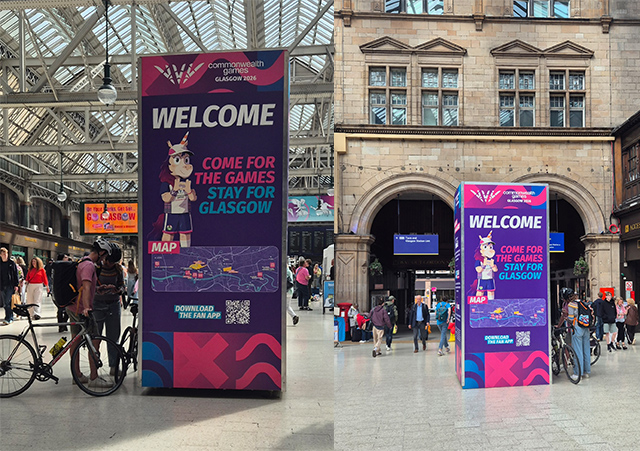
 Welcome boards in Glasgow for the Commonwealth Games. [photos by Grace Carrington.]
A month on from the Glasgow Commonwealth Games, it is worth reflecting, not only on the wider impact of the Games in Scotland, but also on what Glasgow 2026 tells us about the state of the Commonwealth as it approaches the Heads of Government Meeting (CHOGM) in November. Like their predecessor twelve years ago, the Glasgow 2026 Games arrived at a moment when questions about Scotland’s constitutional future and its international identity were prominent, particularly following the popularity of the Tartan Army in Boston during the FIFA World Cup.
Back in 2014, Glasgow hosted the Commonwealth Games just weeks before the Scottish independence referendum. Inevitably, sport became entangled with politics, even as organisers sought to keep the two apart. Scotland competed under its own flag and anthem, offering a vivid demonstration of a distinct national identity within both the United Kingdom and the Commonwealth. However, polling at the time suggested that the Games had not had a significant impact on voting intentions. In the referendum that followed, the ‘No’ campaign ultimately prevailed with 55% of the vote.
In 2026, the constitutional context is different, but underlying tensions remain. On the day the Games opened, the new Prime Minister, Andy Burnham, met First Minister John Swinney in Glasgow. Their discussion ranged across devolution, economic growth and relations between the UK and Scottish governments. However, Burnham apparently made it clear that another independence referendum was off the table.
That exchange underlined how Glasgow 2026 has again become intertwined with the debate about Scotland’s place in the UK. Scotland’s sporting presence on the international stage reinforces an identity and reputation distinct from the UK as a whole. Following the high-profile presence of Scotland’s Tartan Army at the World Cup in June, the Commonwealth Games provided another stage on which Scottishness could be projected internationally.
There were some powerful expressions of this during the Games. After winning the mile in front of a cheering home crowd, Scottish athlete Josh Kerr spoke emotionally about how special it had been to hear Flower of Scotland during the medal ceremony, rather than the British national anthem. The Scottish Government has tried to build on these international sporting moments and widen the impact domestically through a ‘Summer of Sport’ programme for children and young people.
Yet the domestic reach of such moments was arguably diminished by the lack of live terrestrial television coverage in the UK. The Games’ move away from the BBC contributed to substantially lower UK viewing figures than those recorded in other Commonwealth countries.
But the Games also raise a broader question: what exactly is being celebrated when the Commonwealth gathers for these kinds of major sporting events? For Glasgow, this is particularly complicated given that the city’s historic wealth and prosperity is deeply connected to empire, trade, and slavery.
Running alongside the Commonwealth Games, parts of the Glasgow 2026 Festival sought to actively interrogate and engage with this colonial history. Prize-winning artist Jasleen Kaur’s Superstructure, for example, placed eight sculptures along the Clyde at locations connected with trade, industry and empire. The installation asked viewers to reconsider the infrastructure of contemporary Glasgow alongside the imperial systems that helped produce it. Meanwhile, Jasmine Togo-Brisby’s Liquid Land explored histories of enslavement and forced labour in the South Pacific, connecting Glasgow to wider histories of colonial exploitation across the Commonwealth.
These interventions matter because debates about imperial history are not peripheral to the Commonwealth’s contemporary relevance. They go to the heart of its claim to have transformed itself from an institution rooted in empire into a voluntary association based on equality and shared values.
The legacy of the Commonwealth Games
The case for the Commonwealth Games
Time for a new Commonwealth Games?
Tensions over identity and belonging were brought into particularly sharp focus during the Games themselves. On 25 July, a far-right rally at Glasgow Green was met by anti-racism counter protesters, with clashes spreading into the city centre and Police Scotland making 15 arrests. At a time when Glasgow was welcoming athletes and visitors from across the Commonwealth, the disorder offered a stark counterpoint to the Games’ rhetoric of diversity, friendship, and international solidarity.
Glasgow 2026 also illustrated how Commonwealth events cannot be insulated from wider international politics. Various protests were held during the Games, including by the group ‘Show Israeli Genocide the Red Card’ which sought to draw attention to the number of Palestinian athletes who have been killed in Gaza.
Other events demonstrated the contested nature of the Commonwealth. The Zero Flags Commonwealth exhibition, staged in Glasgow in connection with the Games, drew attention to the continuing criminalisation of same-sex relationships across parts of the Commonwealth. Its presence was an uncomfortable but necessary reminder of the distance that can exist between the Commonwealth’s stated commitments and the legal and political realities within some member states.
From Scottish independence to colonial history, Glasgow 2026 exposed some of the tensions running through the modern Commonwealth. The organisation’s relevance will depend less on its ability to escape these issues than on its willingness to provide a space in which they can be discussed and confronted.
Amid these tensions, sport remains one of the Commonwealth’s most visible and potentially powerful means of bringing people together. This will continue into the next major Commonwealth gathering: CHOGM. When Commonwealth leaders gather for CHOGM [the Commonwealth Heads of Government Meeting] in Antigua and Barbuda from 1 to 4 November, sport will have a particularly prominent place on the agenda. Cricketing legend Sir Vivian Richards has been appointed as the CHOGM 2026 Envoy, with several cricket matches planned alongside the Summit.
Meanwhile, the inaugural Commonwealth Sport Summit will bring together governments, businesses and international organisations to consider how sport can contribute to Commonwealth priorities including health, development, equality, and social cohesion.
Glasgow 2026 showed that sport cannot resolve disagreements within the Commonwealth over identity, history, and values, but it can provide a space in which those differences coexist alongside moments of competition, connection, and shared experience.
Dr Grace Carrington specialises in politics and decolonisation in the Anglophone and Francophone Caribbean and is a member of the Round Table editorial board.