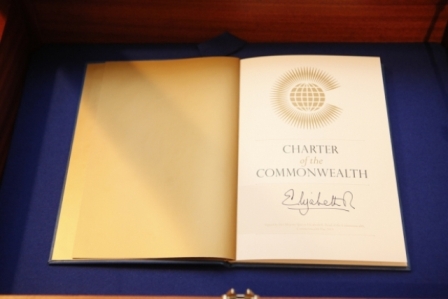
 Is the modern Commonwealth is a prime exemplar of international society with its Charter as a guide to its common values? [photo: ComSec]
[This is an excerpt from an article in The Round Table: The Commonwealth Journal of International Affairs and Policy Studies.]
While states are still the primary actors in the Commonwealth system, there is an openness to the value of non-state actors. This is made explicit in the Commonwealth Charter, which welcomes ‘the valuable contribution of the network of the many intergovernmental, parliamentary, professional and civil society bodies which support the Commonwealth … ’ (Commonwealth Secretariat, Citation2013). There was recognition of this openness with the establishment of the Commonwealth Foundation in 1965, which is ‘an intergovernmental organisation mandated by its Member States to advance the interests of Commonwealth civil society’ (Commonwealth Foundation, Citation2022). Indeed, Shaw prefers to refer to the Commonwealth(s), i.e., in the plural, to reflect the Commonwealth’s ‘non-state as well as interstate character’ (Shaw, Citation2004, p. 515). More recently, the adoption of the Principles on Freedom of Expression and the Role of the Media in Good Governance at the Commonwealth Heads of Government Meeting in 2024 highlighted the Commonwealth’s support for civil society and non-state actors. Initially championed by civil society, the comprehensive framework protects free speech and media freedom, including protection for journalists across many Commonwealth jurisdictions (Aurora, Citation2024). In English School terms, this reflects a shift from international society – focused on state coexistence – to a world society, where civil society actors and normative commitments begin to shape collective expectations and institutional practices across borders. Interconnecting the concept of global civil society and a world society could offer an interesting avenue of future investigation, as both highlight ‘the political dimension of the non-state universe, and both also carry a liberal programme aimed at constraining and/or reforming state power’ (Buzan, Citation2004, p. 77).
Furthermore, a myriad of Commonwealth civil society organisations and networks work directly with citizens in Commonwealth countries to build a more inclusive Commonwealth, inspired by the values encapsulated in the Charter (Kamall, Citation2023). For example, the Commonwealth Foundation website lists its areas of focus as health justice, climate justice and freedom of expression, with cross-cutting themes of gender equality, small and vulnerable states, and young people. In November 2020, the Commonwealth Foundation, with funding from the Government of Canada, issued a Special Grants Call to support those worst affected by COVID-19, awarding ten grants spread across the Commonwealth. One recipient, the Turning Point Foundation, worked with disability organisations in Bangladesh, resulting in 2,000 people with disabilities, their parents and caregivers having received COVID-19 vaccines and government support including cash, food, hygiene supplies and vaccinations. Another organisation, the Association of Commonwealth Universities (ACU), connects academics and students across the Commonwealth to strengthen partnership in universities, to support sustainable development and to develop skills, knowledge and networks. One project, the Commonwealth Futures Climate Research Cohort, supports early career researchers from Commonwealth countries to focus on climate change mitigation and adaptation (Association of Commonwealth Universities, Citation2023). Such examples highlight the many ways in which the Commonwealth demonstrates active inclusion of institutions and individuals, beyond the state, demonstrating an international society aspiring to be a world society. It perhaps echoes Stivachtis and McKeil’s (Citation2018) argument that a world society emerges when actors sharing common interests and values organise collectively to address an international issue of sufficient breadth to mobilise transnational individuals, groups or movements.
Introduction: The Commonwealth @77 special edition
Thematic evolution in Commonwealth academic research: a big-data and machine learning analysis across 75 years of cross-disciplinary scholarship
With such initiatives and inclusion of non-state actors, the Commonwealth may well now be illustrating international society aspiring to be a world society and this may well reflect Shaw and Ashworth’s (Citation2010) idea of a Commonwealth School; but perhaps it is too early to make that assertion. After all, the Commonwealth is still ultimately governed by its member states, meaning that even when it includes non-state actors in its initiatives, decision-making and authority remain in the hands of states. Thus, the sovereignty of states constrains the development of a world society. For English School scholars, therefore, the example of the Commonwealth lets them grapple with what exactly constitutes a world society, and what the conditions are upon which a world society exists. English School scholars still need to further clarify and develop the concept of a world society, but at the same time the Commonwealth continues to grapple in practice with how far to include and empower non-state actors within a fundamentally state framework. Thus, the theoretical tensions within the English School mirror that of the empirical realities of the Commonwealth; future research may bring this to light.
Conclusion
Fifteen years on from Shaw and Ashworth’s prediction that a Commonwealth School of International Relations could supersede the English School of IR, little progress has been made to justify that assertion. However, their writings should be recognised for highlighting the fact that the English School offers a useful IR lens through which to analyse the Commonwealth of Nations, especially given the limited analysis of the Commonwealth from different schools of IR theories. Developments in both English School theory and the increased activity of various levels of the Commonwealth increase the pertinence of viewing the Commonwealth through the lens of the English School.
This article has offered an original reappraisal of the Commonwealth of Nations using the English School IR theory. The authors believe it can be argued that the modern Commonwealth is a prime exemplar of international society; a site where English School notions of pluralism and solidarism coexist; and a potential bridge between an international and a world society. Such advances in English School thinking over the last decade make it a fruitful theoretical framework for analysing the Commonwealth.
Future research can build on this article by, for example, using current Commonwealth initiatives and activities to conceptualise better a ‘world society’ and its relation to international society, or by utilising an English School framework to analyse other institutions like the Organization of Ibero-American States, La Francophonie, or the Association of Southeast Asian Nations (ASEAN).
Marianne Rozario, Vinson Centre, University of Buckingham, UK and Syed Kamall, Faculty of Arts, Business, Law, Education and Theology (School of Business and Law), St Mary’s University Twickenham, London, UK.