[This is an excerpt from an article in The Round Table: The Commonwealth Journal of International Affairs and Policy Studies.]
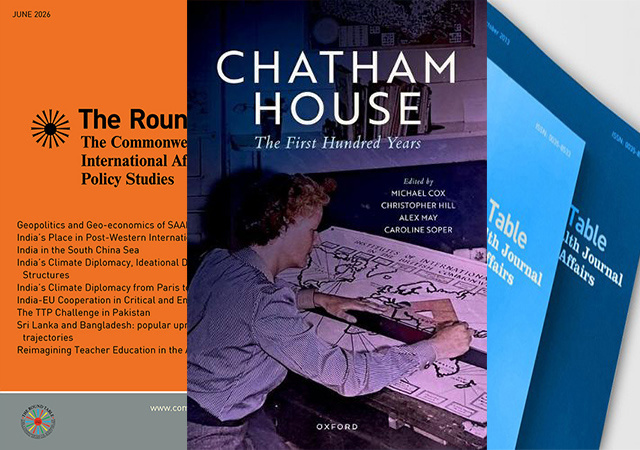
On 30 May 1919, 35 British and American delegates to the peace conference in Paris met to consider how to improve the public understanding of international relations and thereby address the shortcomings of the current negotiations. The following year the British Institute of International Affairs began life in two rented rooms in London and the Council on Foreign Relations a year later in New York. In 1923 the Institute moved to Chatham House, an imposing mansion in London’s St. James’s Square, donated by a rich imperialist-minded Canadian benefactor, and on gaining royal patronage in 1926 it became the Royal Institute of International Affairs, more commonly known as Chatham House. To mark its centenary, Chatham House invited its senior editor, Caroline Soper, to compile a history of the Institute and she in turn recruited as co-editors Alex May, longtime honorary secretary of The Round Table, and two professors of international relations with close links to the Institute, Christopher Hill and Michael Cox. The result is this excellent volume comprising 14 chapters, some chronological, others thematic, and all broadly similar in length and quality.
The Chatham House founders eschewed the promotion of specific policies but held decided views on the direction of world affairs and how Britain could best adapt to changing circumstances. Lionel Curtis, the moving spirit in the Institute’s early years, Arnold Toynbee, its longtime director of studies, and others involved between the wars were liberal imperialists. While sustaining wide-ranging research, seminar and guest speaker programmes, their preoccupation with imperial unity and Anglo-American harmony led them broadly to support Britain’s policy of appeasement.
The Second World War created something of a hiatus in Chatham House activities, when most of its personnel relocated to Oxford and turned to information sourcing for government departments. Harold James describes its interest in economic reconstruction and ‘development’ but acknowledges that it played only a minor role in post-war planning. Subsequently it focussed mainly on the crises of decolonisation and Britain’s integration into the European Community. Fundraising remained a preoccupation of the Institute’s directors and subtly shaped its research and speaker programmes. Thus, between 1952 and 1958 it hosted a Board of Race Relations focussed upon ‘revolutionary race and racial power shifts’ principally in sub-Saharan Africa, with funds provided by prominent British mining firms with interests in the region.
British Commonwealth relations – The Chatham House conference 1945
Commonwealth policy studies: Is there a case for a centre? 1988
To the Institute’s founders, public opinion meant in practice the views of that narrow slice of population who participated in public affairs. With some justice, therefore, it acquired a reputation as an elitist body which, despite its research interests, was slow to recognise several popular trends affecting British and world affairs. To Sue Onslow, writing on post-war decolonisation, ‘what is striking is the extent to which in Chatham House circles … the expectation was that Britain would remain a significant imperial power for many decades to come’. Christopher Hill similarly observes that Chatham House was slow to recognise the growth of English nationalism which resulted in the Leave majority in Britain’s 2016 referendum on EU membership. ‘[F]or all its undoubted expertise on Europe’, he writes, ‘[it] existed in the echo chamber of mainstream, policy-centred, discussion, [and] could be blindsided both by unorthodox politics and by social trends coming from outside the M25 “beltway”’.
That said, Gregorio Bettiza, writing on ‘Identity politics, Islamism, and the “war on terror”’, suggests that Chatham House’s elite composition probably contributed to speaker and publication programmes that remained sceptical of fashionable theories of civilisational conflict in favour of ‘realist and critical perspectives’ and ‘generally avoid[ed] simplistic, monolithic, and orientalist generalisations of the region, Islam, and Islamism’. And Michael Cox, writing on Chatham House’s popular research programme on the United States’s world role, which got fully under way after 9/11 (2001), suggests that expert knowledge combined with professional scepticism yielded deeper insight into America’s loss of international direction than was common at think tanks elsewhere.
Since the early 1970s the UN and other organisations directed attention to global environmental issues, but as Robert Falkner writes, Chatham House deserves credit for being ‘the first major international affairs think tank to put environmental issues firmly on its research agenda’. From the late 1980s it instituted regular meetings with government officials, industry representatives and scientists, and its promotion of greenhouse gas emission trading soon established it as a leading source of policy advice for British, European and international decision-makers. Environment and energy research became the largest thematic programme at Chatham House by the new millennium, and while the value of its contributions diminished in an increasingly crowded field, its high-quality research and regular meetings enabled it to retain a respectable place in a vastly expanded global network of expertise.
As the authors of this volume acknowledge, no satisfactory means exist to measure the influence or value of a think tank like Chatham House. To the question whether its research, publications and semi-public lectures have enhanced British policy or international relations, the authors wisely offer only a severely qualified answer. They acknowledge that, constrained by limited resources and its self-imposed refusal to advocate policies, its stature has sometimes appeared modest compared to its American counterparts. Nevertheless, their essays convincingly demonstrate that over the past century it has substantially contributed to the circulation of ideas among British and international decision-makers, which after all is what its founders set out to achieve.
Sheetal Chauhan, Research Scholar, Amity Law School, Amity University Madhya Pradesh, Gwalior, India.
Chatham House: The first hundred years edited by Michael Cox, Christopher Hill, Alex May and Caroline Soper, Oxford, Oxford University Press, 2026.