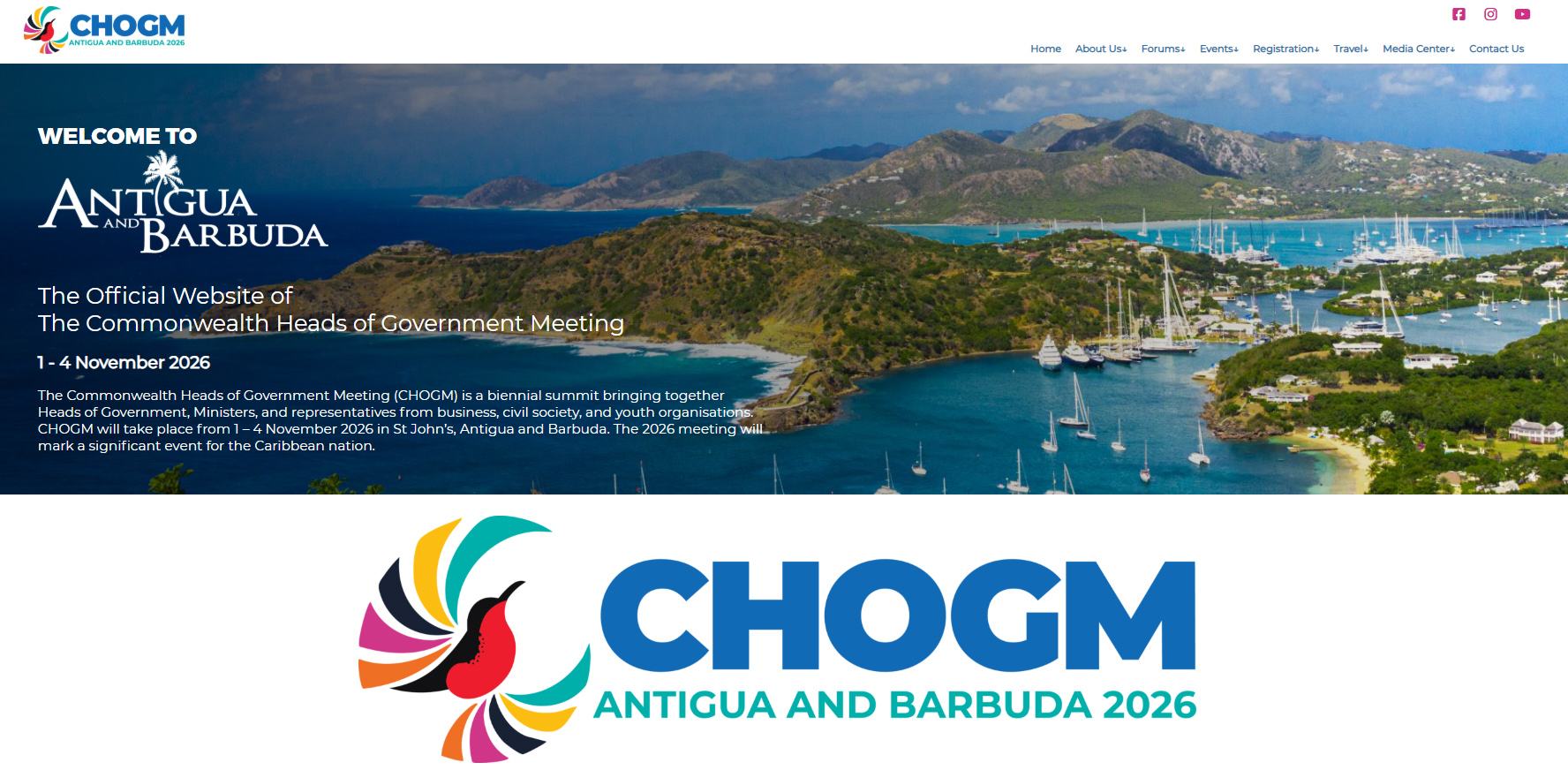
 Official website for the 2026 Commonwealth Heads of Government Meeting.
[This is an excerpt from an article in The Round Table: The Commonwealth Journal of International Affairs and Policy Studies. Opinions do not reflect the position of the editorial board.]
Will future historians ask whether it was in the 2020s that the UN went into terminal decline, just as the League of Nations did in the early 1930s when its pretensions were exposed by Adolf Hitler’s unopposed remilitarisation of the Rhineland, and Benito Mussolini’s march into Ethiopia? Or is the Commonwealth, whose leaders at the Harare CHOGM in 1991 pledged support for the UN in the world’s search for peace, prepared to put diplomatic effort into the reform and rescue of a totemic product of the Second World War?
On the positive side, the Commonwealth has worked closely with the UN in a few crises that could have ended in war, notably in finding a negotiated end to South African apartheid in the 1980s and 1990s. Currently, member states make a disproportionate troop contribution to the UN’s peacekeeping blue berets. Five Commonwealth states are among the top 10 states that provide boots on the ground.
Yet while the Commonwealth has many votes in the UN General Assembly it is a small player when it comes to finance. An estimate by the Institute of Chartered Accountants in England and Wales in 2025 suggested that Commonwealth member states were only providing 9.3% of the UN’s assessed contributions, compared with 24% by the European Union, 22% from the United States pre-Trump, and 20% from China.
Further, around a quarter of Commonwealth governments were in arrears in 2025–2026; these included some of the bigger states, like Nigeria and Pakistan. Dominica lost its voting rights in 2025. The financial crisis for the UN is illustrated by a total US$1.57 billion in unpaid contributions towards the end of 2025, of an assessed US$3.75 billion, and the fact that only 73 of 193 member states had paid up by February 2026. Financially, the Commonwealth has not been part of the solution and, if money talks, its voice is only just audible.
Yet the Commonwealth has range and intellectual muscle and could make a contribution in what is a supreme crisis for multilateralism. In the Ramphal era, a string of expert groups, backed by quality research from the Secretariat, moved ideas forwards in fields ranging from debt relief to youth unemployment. All this was in the midst of the Cold War.
Out of every crisis, an opportunity. Enter the Commonwealth?
Wilton Park and the Commonwealth
Canadian Prime Minister Mark Carney has drawn attention to the diplomatic potential of middle-ranking powers – where the Commonwealth has significant resources when governments pool their assets. The Commonwealth has mistakenly allowed itself to be defined as an association of small states. Yet it draws much of its strength from states like Malaysia, Nigeria, Pakistan, South Africa, Kenya, Canada and Australia, and CARICOM too when it works as a bloc. When India and the United Kingdom deign to join in, the Commonwealth matters on the world stage.
So, surveying global challenges in the sunshine of Antigua and Barbuda, at the CHOGM in autumn 2025, might leaders consider setting up a high-level group, focused on rescuing the UN’s peacekeeping? It would need to address the tough issues, blockages in the Security Council, lack of finance, the sprawl of UN activities that divert even the boldest and most capable of Secretaries-General, as well as insufficient support from the Commonwealth and its members, and regional bodies like the AU, the European Union and the Organization of American States.
In an important address to Commonwealth Foreign Ministers in September 2025, Secretary-General Shirley Botchwey said, ‘[t]he multilateral system is under serious pressure, but it remains our greatest tool. Without it, the fractures in our world will deepen. With it we can still find solutions.’ Commonwealth assets go beyond intellect and diplomats. It has the resources of civil society and the media, capable of promoting ideas through the magic of the English language, via social media and the internet. These assets are not used enough, and the UN needs to be made aware of its too shy friend.
Sonny Ramphal’s much-quoted mantra – ‘The Commonwealth cannot negotiate for the world, but it can help the world to negotiate’ – can be brought out, dusted down, and put to use. An expert group to see what to do to rescue the UN’s key role – peace – is overdue.
Richard Bourne, The Round Table Editorial Board emeritus member.