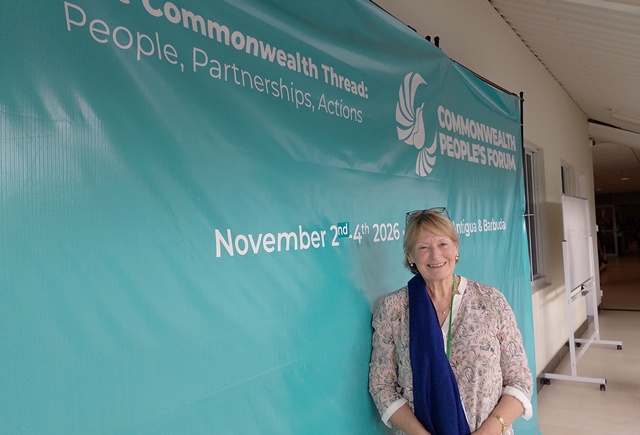
 Sue Onslow at the People's Forum. [photo: Debbie Ransome]
During the 2026 Commonwealth Heads of Government Meeting (CHOGM), the editor of The Round Table: The Commonwealth Journal of International Affairs and Policy Studies, Prof Sue Onslow shares her impressions from the biennial summit.
This week has been multilateralism in action, Commonwealth style. Through bursts of energy, advocacy and action around the People’s Forum, the Women’s Forum, the Youth Forum, delegates have listened to and discussed key contemporary issues, collaborations and perspectives. The Business Forum is part of this but is obviously a more carefully curated space. Of course, while all this was going on, there’s the key aspect of political will and political leadership: what have heads’ been up to?
Since Monday, thanks to the various Forums, I have had a good view of the grassroots and middle layers. There’s been so much going on, it has been very difficult to keep track.
For me, today was about trying to draw together the world of advocacy, capacity & expertise, governments, and action. Late last week, I was asked to moderate the second session of the Commonwealth Foreign Ministers roundtable with Associate (i.e. intergovernmental) Organisations. The wonderful and wise former Barbados Foreign Minister Billie Miller once told me, “When you are running a meeting, Sue, you should always know what you want to get out of that meeting before you even start.’ So, saying ‘yes’, meant having a plan.
The consistent theme of this Commonwealth summit has been Commonwealth ‘accelerated partnerships’. As the SG (Commonwealth Secretary-General) and Antiguan host Prime Minister Browne have stressed repeatedly, these need specifics and clear deliverables. So, I thought hard about how ‘my’ session’s dialogue could be directed towards case study examples and their essentials (there are plenty of those, from the Commonwealth of Learning, the Commonwealth Foundation, the Commonwealth Parliamentary Association, Commonwealth Local Government Forum, the Institute of Commonwealth Studies’ collaboration with Legal Division in the Secretariat, Commonwealth Telecommunications Group; the Association of Commonwealth Universities’ collaborative work as a coordinated ‘hothouse’ for specific research and knowledge transfer; and the Independent Forum of Commonwealth Organisation’s (IFCO’s) work, and other wider examples of effective civil society/government collaboration. But there are also huge gaps, and sadly, this morning’s roundtable only had two 40-minute sessions to try to seize the attention of busy CFMs’ or their delegated representatives.) ‘My’ session’s dialogue discussed possible issues and themes for government/inter-government/CSO collaboration, and the need be inclusive, well planned, and funded. Suggested ‘big issues’ included, for example, AI & digital sovereignty? Resource sovereignty, both land based and under the sea? How to strengthen democratic inclusion at all levels of society? Could peer review mechanisms of governance and institutions in Commonwealth states be useful with the regular measurement of democratic benchmarks (along the lines of the African Union’s Peer Review Mechanism)? Other important ideas were floated, particularly around the need for Commonwealth collaboration on international debt relief, and climate change resilience. This dialogue around big ideas and possible Commonwealth whole society solutions has to start somewhere. Hopefully, as this morning’s ‘conversations’ continue, specific big issues will attract regional champions, or a cross-Commonwealth regional coalition of states to lead on a detailed Action Plan, how to deliver and fund it. As speakers argued: yes, funding is key – perhaps from composite sources such as diaspora remittances, faith-based institutions, or private philanthropy?
From the editor part two
As the past three days drew together with a wonderful closing ceremony, I’ve been thinking about the heads’ ‘layer’ of this Commonwealth summit. The ‘middle powers’, their domestic and multilateral agenda have been very much in evidence: Mark Carney of Canada, supported by senior government officials and members of the Royal Bank of Canada, emphasised both trade deals and Canadian support for sustainable development in specific Commonwealth countries; understandably, Mark Albanese of Australia made a particular pitch on climate change issues in the lead up to COP31, but also trade and other international issues ; India (disappointingly through Foreign Minister Shankar, not Prime Minister Narendra Modi) has also used this Commonwealth platform to stress India’s primacy in digital public infrastructure; South African President Cyril Ramaphosa sent his deputy (critics of his non-attendance don’t seem to have noticed South Africa is facing crucial local elections this week in which the African National Congress is likely to be pummelled in the polls, air travel between South Africa and Antigua takes approximately 24 hours and there are no direct flights; furthermore, the US cancellation of the African Growth and Opportunity Act (AGOA) on Monday might have triggered performative US visa transit ‘problems’ for the ANC President). Britain’s Andy Burnham, Ed Milland and team have sought to divert the narrative away from the contentious reparations issue into collaborative areas, such as ‘blue finance and ocean innovation.’ (The UK government could have taken a great deal of ‘heat’ out of the reparations issue by ‘leaning in’ and actively listening at a much earlier stage of Commonwealth conference planning).
I need to investigate further how African Commonwealth middle powers, Ghana, Kenya and Nigeria, have tried to use this Commonwealth platform. Ditto, South Asean ‘dragon’ economy countries, Malaysia and Singapore; and Caribbean states, individually, and through CARICOM. Then there are the ‘bilaterals’: specific planned discussions on the margins of the wider Commonwealth meetings. Meanwhile, heads were criticised for staying on the luxury Jumby Island while ordinary people back home were suffering from cost of living spikes and declining living standards. It’s an easy shot: this CHOGM has been an enormous security challenge for the small Antiguan government, even with regional and other Commonwealth assistance and financial support.
With the Heads’ communique, and the Secretariat’s firm statement of over US$0.5 billion mobilized through partnerships and deals, the ‘Commonwealth critical friend’ in me asks what does ‘mobilized’ actually mean? I am hearing endorsements such as ‘the most successful and productive People’s Forum in my 25 years of attending’. The energy, hype, and declared commitments have featured prominently over this short week. But, always, it is the joined-up thinking, action and demonstrable results between Commonwealth summits which is the proof of the pudding. As I said at the beginning of the week: let’s see.
Related articles:
To CHOGM and beyond: The issues challenging the Commonwealth – Part one
To CHOGM and beyond: The issues challenging the Commonwealth – Part two