[This is an excerpt from an article in The Round Table: The Commonwealth Journal of International Affairs and Policy Studies.]
Readers will find insights into AUKUS and its context in all the chapters of this book. Each chapter is worthy of appraisal but that is not possible in a review of the book as a whole.
Overall, the book provides valuable context, a critique of AUKUS from various angles, and proposals for alternative approaches. While I am broadly sympathetic to the critique, I would have liked to see more attention to the issue of how the proposals for an alternative approach might be furthered. The book appeals to the reader as a rational and no doubt peace-loving citizen, but what basis is there for proceeding politically? There is clearly opposition to AUKUS from the Greens and from within the Labor Party and various elements in the labor movement. However, the Greens are not a ‘party of government’ and Labor functions as a ‘cartel party’. Past Labor leaders such as Paul Keating (prime minister, 1991–1996) and foreign ministers Gareth Evans (1988–1996) and Bob Carr (2012–2013) have been prominent among the critics, but there has not been a widespread anti-AUKUS movement. State Labor governments in Western Australia and South Australia have seen AUKUS-related developments in their states as boosting their local economies (military Keynesianism).
Book reviews from The Round Table Journal
Change in relation to Australia’s commitment to AUKUS is most likely to come about in the form of ‘external shocks’. While President Donald Trump has made clear his commitment to AUKUS (no doubt seeing it as a ‘good deal’ for the US given the advance payments Australia has made to support the building of submarines in US shipyards), ‘crunch time’ is likely to come in the early 2030s when the US president of the day will have to determine whether to authorise transfer of the 3–5 Virginia-class submarines to Australia. Unless the US increases its production rate for nuclear-powered submarines or it decides that fewer submarines will suffice for its own needs, the likelihood is that the transfer will not be approved. The US might offer to base a few of its submarines in Australian ports (such as the HMAS Stirling base south of Fremantle in Western Australia (perhaps with some Australian crew), concurrently projecting US military power into the Indian Ocean. As far as the second phase of the AUKUS submarine project is concerned, the issue is likely to be whether the UK can keep its commitments given its patchy record in building submarines. Even if this aspect of AUKUS continues, it is likely to take a lot longer than previously planned, in turn meaning a continuation of Australian reliance on the US for this aspect of its defence. But is this dependence wise in terms of how the US is positioning itself under Trump, an approach likely to continue post-Trump in some form? (Note also that Australia’s six Collins-class submarines, due to retire in the mid-2020s, are being periodically re-fitted and are likely to be still in service in the 2040s given the issues with AUKUS.)
Search for Security provides much food for thought on AUKUS as it has developed so far, proposing various alternatives for how Australia should proceed. Politically it is a matter of ‘watch this space’, but the prospects at this point are not very heartening.
Derek McDougall is with the School of Social and Political Sciences, University of Melbourne.
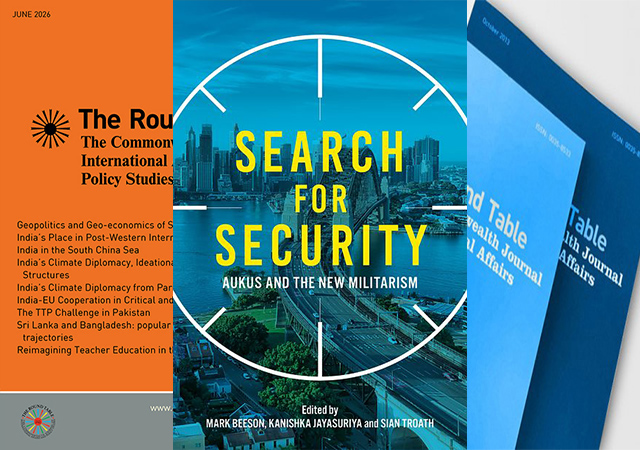
Search for security: AUKUS and the new militarism edited by Mark Beeson, Kanishka Jayasuriya, and Sian Troath, Carlton, Vic, Melbourne University Press, 2025.