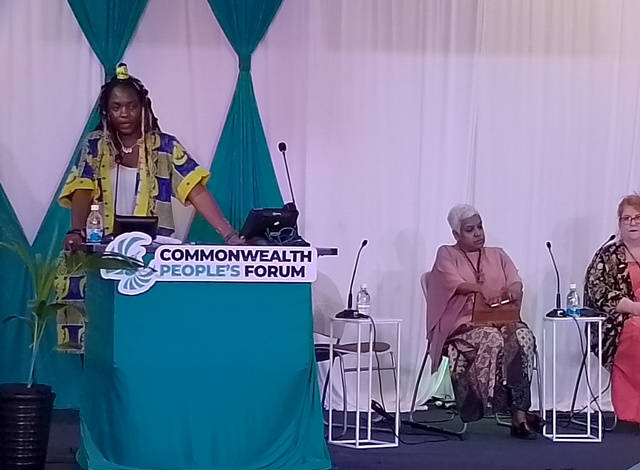
 Poet Esther Mwema during the Who controls the narrative on AI session. [photo: Debbie Ransome]
During the 2026 Commonwealth Heads of Government Meeting (CHOGM), the editor of The Round Table: The Commonwealth Journal of International Affairs and Policy Studies, Prof Sue Onslow shares her impressions from the biennial summit.
Tuesday
The challenges of understanding and analysing ‘the Commonwealth in action’ were rammed home to me on Official Day 2 of this 4-day CHOGM meeting. This international meeting is about public diplomacy, private debates, exchanging ideas, discrete arguments as well as substantive deals. Each leading player has their own agenda – Antigua and Barbuda as hosts; for Secretary-General Shirley Botchwey at her first summit, it’s a test of her evolving strategy of partnerships and trade, and ability to deliver. This is a Caribbean summit, so the perspectives and ‘asks’ of Commonwealth Caribbean states are towards the top of the agenda. Who is, and is not, ‘in the room’, is also part of the vital public diplomacy performance. Then there is the outside space: the media platform, or click-bait generated frenzy. Take your national media space (and audience), select your issue. For British media, it’s REPARATIONS. Nothing I can say on platforms about the range of vital issues being discussed at this Commonwealth meeting seems to shift this dial. But here goes.
The organisation of this condensed summit means choosing which event to attend, all of which are run in parallel, with additional complexity of the delegate-led and side panel events at different locations. Some are carefully curated and by invitation only, others much more accessible. It proved to be potluck. I had applied to the Official Opening Ceremony, but my application was officially refused. So, I went instead to the People’s Forum (a definite plus) event on the Blue Economy. Here, the take-away message was unanimously that the Commonwealth needs to coordinate its stance against the scourge of deep-sea mining. The most striking comment of that session was, ‘Imagine a machine the size of this room [an Olympic swimming-pool] scraping the floor of the ocean, and everything that’s there’). However, I learnt afterwards I could have just turned up to the opening ceremony to hear King Charles’ 15-minute speech in person. It fell short of a straight apology for Britain’s role in the slave trade and slavery, but these were the most political and pointed opening remarks I have ever heard from the Commonwealth’s ceremonial head and were much more wide ranging than simply the issue of reparations.
That set the tone of my day: too many competing events clamouring for attention, transport challenges, and a sense of frenetic pressure. This Commonwealth summit has been a real challenge for me trying to analyse what is going on, why, and what could be the positive outcomes – beyond specific issue advocacy, or silo of activity. No wonder individual heads, their teams of officials and their comms also flounder. That said, our Antiguan hosts have been extraordinary and continue to bend over backwards to accommodate delegates. And this year the Commonwealth People’s Forum, Women’s Forum, Youth Forum and Business Forum have been live streamed, so we can always catch up afterwards.
From the editor – part one
From the editor – part two
For me, today’s highlight was the Secretary-General’s lunch. There were only two speakers, in addition to the Secretary General: first, former Chancellor of the Exchequer and Prime Minister, Gordon Brown, now the British Government’s Special Envoy for Global Finance and Cooperation in the run up to next year’s G-20 summit in the UK. He was clear and cogent, setting out an agenda to persuade the World Bank and IMF to make more financing available to LDCs; to persuade bilateral donors to introduce a debt moratorium, and private financing (which comprises 40% of debt in Global South countries) to ease their terms. He was followed by Dr Ngozi Okonjo-Iweala, Director General of the World Trade Organisation, whose remarks made clear she had worked closely with Brown when she was Nigerian Minister of Finance (2003-2006): it was Commonwealth trust networks in action. Afterwards, when I commented to a (young) prominent South African banker that Brown had been a leading Commonwealth actor in Multilateral Debt Relief (MLDR) in the early 2000s, he made a beeline to speak to him. I think he planned to introduce himself to Brown anyway, but a bit of history didn’t hurt.
Related articles:
To CHOGM and beyond: The issues challenging the Commonwealth – Part one
To CHOGM and beyond: The issues challenging the Commonwealth – Part two