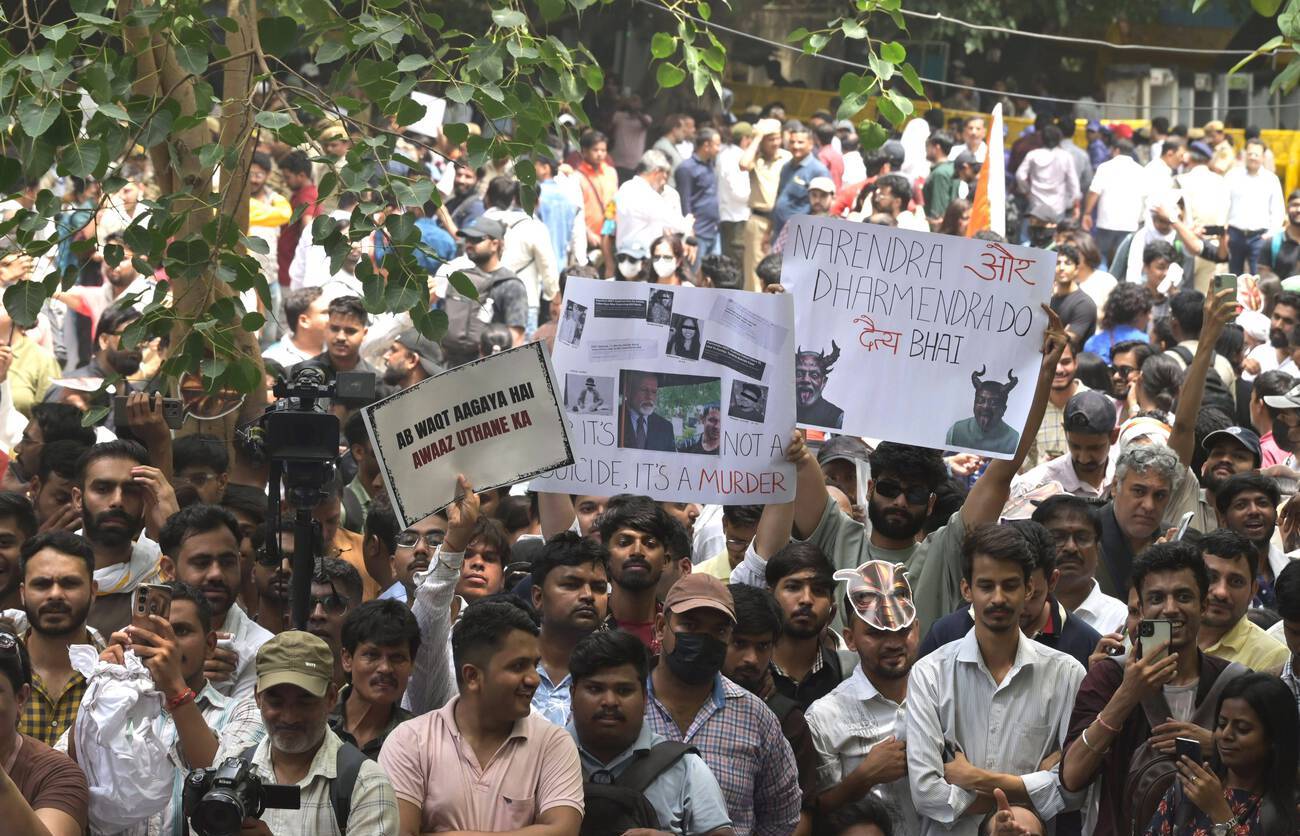
 June 2026: Cockroach Janta Party (CJP) protest in New Delhi. [photo: Imago/ Alamy]
[This is an excerpt from an article in The Round Table: The Commonwealth Journal of International Affairs and Policy Studies. Opinions do not reflect the position of the editorial board.]
Media credibility in the global south commonwealth
India is experiencing a historic transformation in its media landscape. The reporting space in the country’s news media has become heavily politicised and partisan, leading to a deterioration in credibility (Onslow, Citation2018). A similar trend of declining press credibility is also reported from its Commonwealth neighbours such as Bangladesh, Pakistan and Sri Lanka. There is also a declining trend in the news media’s credibility and press freedom in other Commonwealth nations in the Global South, such as Nigeria, Kenya and South Africa (Wasserman & Madrid-Morales, Citation2019).
According to a report by the Commonwealth Human Rights Initiative, Commonwealth Journalists Association and Commonwealth Lawyers Association (Citation2025), over 6 billion people are experiencing curtailment in freedom of expression, while around one-third of the global population reside in countries where freedom of expression is in ‘crisis’ (CHRI et al., p. 9). The report further highlights that, like many other Commonwealth nations in Africa and Asia, India is witnessing state usage of colonial-era sedition and defamation laws to suppress criticism of the government as well as to influence ‘public discourse’ (p. 12). Ironically, the growing control over public discourse not only coincides with declining journalistic freedom (Neyazi, Citation2025), but also with a progressive decline in academic freedom (Pillai, Citation2026), and democratic indicators (Nord et al., Citation2026).
While the Indian Constitution allows its citizens to organise non-violent protests, the mainstream television coverage tried to portray the CJP protests as anti-national supported by foreign funding. On the one hand, the thousands of students were demanding transparency and accountability from the government for better education and examination systems; on the other, TV news narratives were framing the protestors as politically motivated gangs trying to destabilise the country. Since independence, India’s flourishing democracy has relied on a vibrant press that allowed spaces for critical debates on policy failures and posed tough questions to governments. Commentators have observed that the BJP-led governments at the national and state levels have been continuously using stringent laws such as the Unlawful Activities Prevention Act (UAPA) and Public Safety Act (PSA) to suppress media freedom and incarcerate journalists, and that the owners of the media houses are themselves becoming subservient due to their dependence on government advertisements for revenue (Iyer, Citation2024; NL Team, Citation2024). Concentration of media ownership with clear political affiliations and pro-government bias, raids by government agencies on media organisations doing critical stories on the government and interventions/pressures by government officials in the newsrooms have been flagged as factors leading to the suppression of a free press in India (Iyer, Citation2021; Murthy, Citation2026; Sharma, Citation2025).
Young Indian ‘cockroaches’ reclaim democratic space
Commonwealth shadows: Journalists navigating report and reprisal in India
Lessons from India
The CJP protests also indicated a growing level of media literacy among Indian citizens, particularly young Indians. While the protestors were hostile to mainstream journalism outlets, they were seen welcoming independent journalists reporting for their YouTube and other internet and social media-based platforms; these independent journalists appeared to be doing objective journalism using limited resources. The coverage and shows by independent journalists such as Ravish Kumar, Ajit Anjum, Abhisar Sharma and Akash Banerjee (all of whom have moved away from mainstream television networks citing diminishing editorial freedom) and others in the aftermath of the lathi-charge (baton charge) by the Delhi Police on protestors on 20 July 2026 attracted millions of views on YouTube. The short video stories uploaded to social media by these journalists and other independent platforms such as News Pinch and The Red Mike also registered millions of views indicating their growing popularity as well as credibility among the masses. As PTI (Citation2026) reported, because of the protestors’ creative and strategic use of social media, mixing the political messaging with viral internet memes and trends, platforms like Instagram and X served as the extensions of the movement.
While the Indian mainstream news outlets appeared highly partisan, independent online platforms-based journalists made up for the lack of objective coverage of a movement led by the students and unemployed youth. The onus now, therefore, is on these large news networks to recognise the widening gap between their reportage and citizens, particularly as the protestors form a vital section of Indian democracy. There needs to be a genuine effort to address the crisis to restore Indian mainstream news credibility among the masses, and to make ordinary Indians feel heard if the world’s largest democracy is to be strengthened through its fourth and the crucial pillar.
Ambris Tripathi, Faculty of Media and Social Sciences, Jagran Lakecity University, Bhopal, India and Ram Awtar Yadav Department of Journalism & Mass Communication, University of Allahabad, Prayagraj, India.