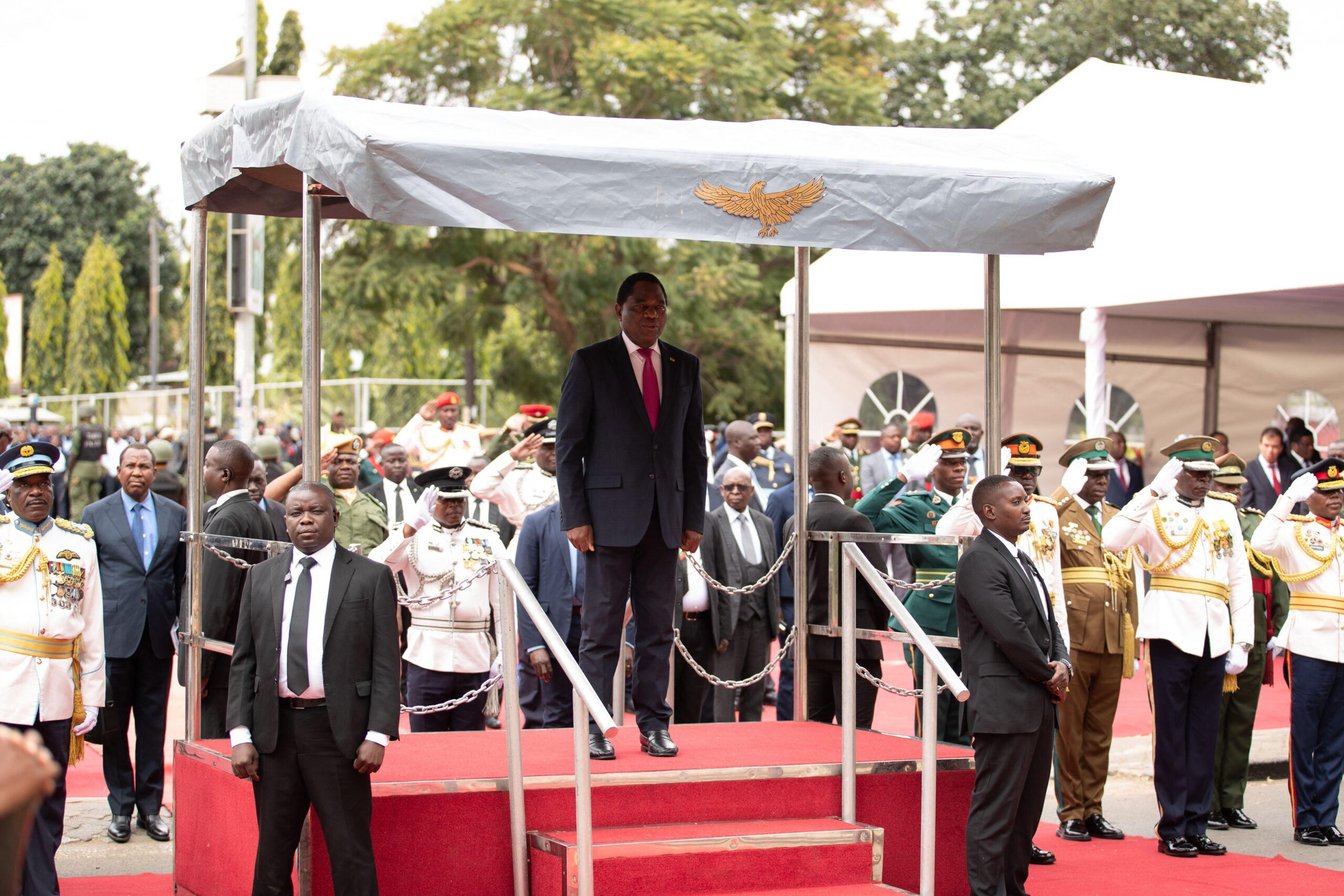
 25th May, 2025: Zambian President Hakainde Hichilema attending an Africa Day Commemoration in Lusaka, Zambia. [photo: Peng Lijun/Xinhua/Alamy Live News]
On 18 August 2026 Hakainde Hichilema was re-elected as President of Zambia for a second five-year term, having won 61.4% of the 5 million votes cast. In a country where 70% of the population live on less than US$3 a day, a majority of voters backed his economic reform programme. In his first term Hichilema restructured Zambian’s debt, encouraged international lenders to invest in Zambia and brought inflation down from around 23% to 6.5%, its lowest level for almost a decade. In his victory speech Hichilema promised that his second term will focus on economic growth through increased investment and job creation.
Zambia’s economy is growing at about 5% percent a year, which is one of the higher growth rates on the African continent. The copper industry sits at the heart of this growth, and it remains vital to Zambia’s future. Zambia is Africa’s second-biggest copper producer and copper is its biggest export. Copper is key to the production of electric vehicles and numerous renewable energy projects. The demand for it is growing year on year and Hichilema has promised to triple the country’s copper production by the end of his second and final term.
According to the Zambian Development Agency’s Director General, Albert Halwampa, international investors are looking at Zambia with new eyes after years when the economy was in the doldrums. In 2020 Zambia became the first African country to default on its debt, since then the country had received investments worth more than US$19 billion. According to Halwampa, ‘Investor confidence has never been this high’. Halwampa argues this achievement is ‘evidence of Zambia’s growing attractiveness as an investment destination’ and ‘it has created 149,956 jobs, with mining providing 46,759 of those jobs’.
Manufacturing accounts for the largest share of investment with more than US$7 billion being invested, followed closely by the mining sector with US$6.6 billion. The agricultural and transportation sectors are also growing rapidly, attracting investment and creating jobs.
But if the time-honoured election winning campaign strategy of ‘It’s the economy stupid!’ has again proved to be a vote winner, there are still several red flags for Hichilema as he begins his second term. There remains a gap between these reports of a macroeconomic boom and how much of this newfound wealth is trickling down to the mainly poor population. Many Zambians are continuing to report stories of extreme poverty and are finding that the cost of living in the country is a daily strain. (Inflation is currently running at 6.5%.) Hichilema himself is a self-made businessman who presides over a business empire that ranges across finance, cattle, property, healthcare and tourism. The gap between his wealth and that of most Zambians is large. He cites his introduction of free primary and secondary education and skills training programmes as some of the measures the government has implemented to address these inequalities. But even this bold and well-meaning initiative seems to have created as many problems as it sought to solve. Although the free programme is backed by a US$1 billion investment into the education system, the building of 170 new schools and the training of 55,000 teachers has resulted in a school system that has been overwhelmed by demand. Teachers report classroom sizes mushrooming overnight from 40 pupils to more than 100 children.
Then there are issues of political intimidation and a lack of media freedom. The main opposition party, the National Reconciliation Party for Unity and Prosperity (NRPUP), contends that its campaign was disrupted by violent tactics by the police acting on government orders. It is angry that eleven of its party workers were arrested during the campaign, amid claims of intimidation and violence. In the most serious allegation, the main opposition leader Brian Mundubile says his house was attacked by armed government supporters. He says he has been forced into hiding and to seek refuge at a United Nations agency in the capital, Lusaka.
Commonwealth Secretary-General statement on the post-election situation in Zambia
Opposition leaders claim some of their campaign meetings were disrupted by the police, while at the count itself proceedings were suspended for six hours following reports of violence against polling station staff and the alleged theft of ballot papers. According to the reputable Africa Report magazine, there are also further alleged irregularities in the vote that, if proven, could bring demands for the election to be declared null and void. There are also accusations that independent media is being stifled in Zambia. A Reuters investigation reported that Zambia was ‘a shrinking room for dissent’. The report concluded that people are wary of speaking out online for fear of recriminations.
That said, Zambia has a largely peaceful record in elections since its return to multiparty politics in 1991. International observer missions like the European Union declared election day ‘generally peaceful and orderly’ while the Southern Africa Development Community mission said the vote was ‘calm and peaceful at 99% of the polling stations visited’.
So, all eyes are now on President Hichilema as he begins his second term. Zambia remains one of Africa’s more resilient democracies, as he declared in his victory speech:
‘Zambia is a place of peace, law and order, a democratic nation that settles our differences at the ballot box and nowhere else…. we must never go back to the days of thuggery, corruption, plundering of national resources and lawlessness’.
The next five years will determine how true that is.
Peter Burdin is a former BBC Africa Bureau Chief and a member of The Round Table editorial board.
Related articles:
Zambia’s election was flawed and may need to be rerun
Zambia’s election: The anomaly is real; the conclusion is not
Presidentialism and Vice Presidentialism in a Commonwealth Country: A Cameo in Zambia