
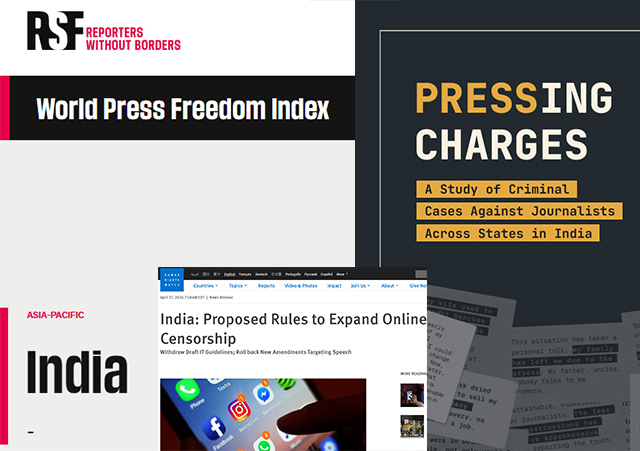
 Covers of reports on media freedom in India. [sources: RSF, HRW, National Law University, Delhi.]
[This is an excerpt from an article in The Round Table: The Commonwealth Journal of International Affairs and Policy Studies. Opinions do not reflect the position of the editorial board.]
On 11 August 2023, the Union Home Minister formally declared the repeal of the sedition law in the Indian parliament while introducing the Bharatiya Nyaya Sanhita, 2023 (BNS). This new law replaced all the provisions of the IPC, including sedition. This came as a profound relief to Indian liberals and advocates of free speech until the passing of S.152 of BNS as sedition redux.
The new provision invigorates sedition law with more stringent punishment, sabotaging freedom of speech and expression under the guise of protecting India’s sovereignty, unity and integrity. The provision includes electronic communication and financial means, augmenting application of the law; it also includes nebulous terms such as ‘subversive activities’ and ‘encouraging feelings of separatist activities’, which may result in life imprisonment regardless of the tangible effect.
The application of Section 152 by the Assam Police against the news website The Wire and its editors Siddharth Varadarajan and Karan Thapar for reporting on comments regarding the loss of military aircraft during Operation Sindoor demonstrates its grave abuse. The Supreme Court issued notice to the government on The Wire’s petition challenging the constitutional validity of S.152 of the BNS and protected the journalists from any ‘coercive action’ by the Assam Police. However, on the same day, summons were issued to its editors by the Guwahati Crime Branch in a fresh sedition FIR (The Hindu, Citation2025). This indicates that, despite the Supreme Court’s order, the State persisted in its persecution.
It is noteworthy that not all journalists have the financial resources and access to the superior courts, making them more vulnerable to abuse. While journalists in major cities were arrested in 24% of all recorded incidents, this figure rose to 58% in small citiesFootnote1 (National Law University et al., Citation2025). Most of these cases never proceed to trial, making the process inherently punitive. Irrespective of the eventual outcomes of the proceedings, most journalists face significant repercussions of financial hardship, heightened fear, and substantial disruption to their personal and professional lives (Khattab, Citation2025).
In addition to abuse of sedition legislation, digital censorship and surveillance have peaked with a stream of amendment notifications in the Information Technology (Intermediary Guidelines and Digital Media Ethics Code) Rules. By expanding their scope to digital media outlets in 2021 and establishing a fact-check unit (FCU) in 2023 to determine whether the news related to the government is fake, false or misleading, these regulations now empower the government to scrutinise any digital dissent. However, the constitutionality of the FCU remains pending before the Supreme Court after the Bombay High Court held the regulations to be unconstitutional in 2024. Again in 2025, the government launched the Sahyog portal, which allows government agencies to issue takedown notices to intermediaries with limited transparency and even fewer safeguards. In February 2026, a further amendment shortened the compliance window for online platforms to obey government blocking orders from 36 hours to 3 hours, significantly restricting the opportunity for legitimate review. Additionally, the Draft Second Amendment to the IT Rules, notified on 30 March 2026, requires intermediaries to comply with a range of executive orders to retain their safe harbour protection.Footnote2 These gazetted amendments also extend the same surveillance to individual users who are not publishers, but who post or share content related to ‘news and current affairs’ (India: Proposed Rules to Expand Online Censorship, Citation2026).
Young Indian ‘cockroaches’ reclaim democratic space
Modi’s India, good or bad?
The Commonwealth and Challenges to Media Freedom
Modi gags the BBC with red tape
Other contested legislation is the Digital Personal Data Protection Act, 2023 and its 2025 Rules; these waived disclosure of all ‘personal information’ without the explicit consent of the individual and made regressive amendments to the Right to Information Act, 2005, by removing the provision of disclosure of personal data if this involves a larger public interest. With its heavy penalties of up to Rs. 2.5 billion, the Act does not provide exemptions for journalistic activities to access, process and publish personal information, contrary to the global benchmark set by the European Union’s General Data Protection Regulation. Thus, journalists will be classified as data fiduciaries and will have to seek consent before collecting or publishing any digital personal data. This creates a bend-or-break scenario through economic coercion in the digital news media landscape, which is a crucial space for investigative and independent journalism. Although the Supreme Court is yet to decide the constitutionality of various provisions of the Act, these regulations demonstrate the government’s implementation of new SLAPP (Strategic Lawsuit/Legislation Against Public Participation) measures to stifle the diverse media ecosystem.
The scale of suppression of freedom of expression and attacks on media practitioners in India is stark. In 2025, India recorded 14,875 cases of free-speech violations, including eight killings of journalists, and 117 citizen arrests, among them eight journalists; there were also 11,385 instances of censorship and 208 lawfare cases, implying ‘mass’ censorship and filing of vexatious criminal cases against multiple individuals. Thirty-three of the 40 attacks, 14 of the 19 instances of harassment and 12 of the 17 threats were recorded against journalists for their professional work (Free Speech in India 2025: Behold the Hidden Hand, Citation2025).
However, it is also the pro-government bias of the majority of mainstream media outlets that is responsible for the crumbling of ethical journalism, due to the political climate, partisan ownership and incentives such as ratings and advertising revenue. The closely allied corporates of the BJP ruling party, such as Reliance Industries ownership of Network 18 (one of India’s largest media conglomerates), and the Adani Group’s hostile takeover of the much-revered NDTV in 2022, have reduced media pluralism. Other outlets popularly called ‘Godi media’ with their star anchors, such as Aaj Tak, Republic TV, Times Now, India TV and Zee News, are infamous for sensationalisation, gatekeeping news and conducting prime-time debates with their own personal, often aggressive views that favour the ruling narrative. Rather than fact-driven and objective reporting, these media stations amplify the ruling party’s propaganda of Hindutva, communal hatred, national security and jingoistic nationalism through rhetorical narratives, with loud performative debates and disproportionate coverage of critical issues and agenda omission. The recent intense media coverage of the viral video of Prime Minister Modi eating Jhalmuri during his campaign for Bengal elections, in contrast to the lack of coverage of ongoing ethnic conflict in Manipur, is a stark example of the decline of India’s pluralistic free media; eight more lives were lost in April 2026 alone (Nabi, Citation2026). Despite this, Sibi George, Secretary (West) in the Ministry of External Affairs, asserted that India is a ‘vibrant democracy’ that guarantees free speech to its 1.4 billion people, rejecting allegations of declining media freedom and the erosion of religious and minority rights (TNIE Online Desk, Citation2026).
Sheetal Chauhan, Research Scholar, Amity Law School, Amity University Madhya Pradesh, Gwalior, India.