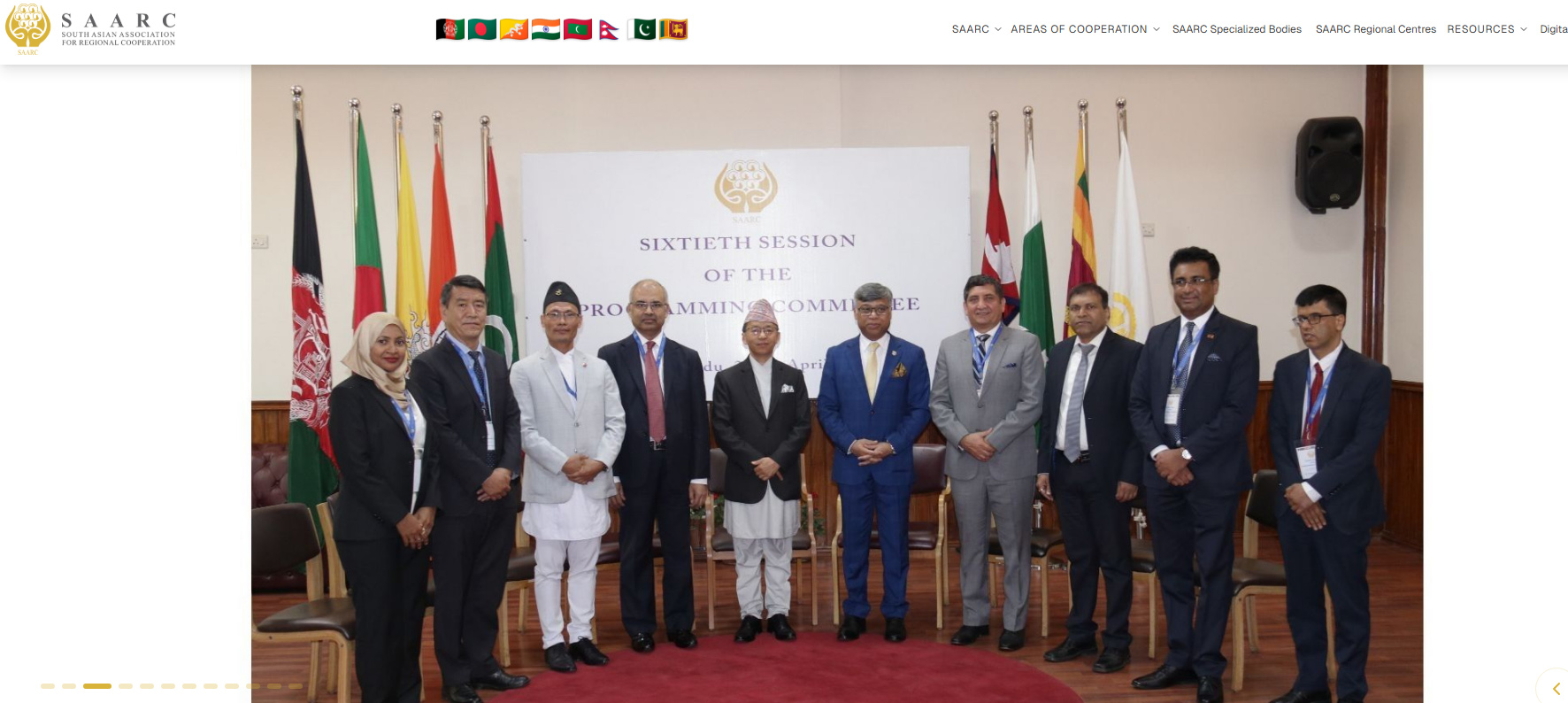
 Picture shows the 60th session of the SAARC Programming Committee. [photo: SAARC website]
[This is an excerpt from an article in The Round Table: The Commonwealth Journal of International Affairs and Policy Studies.]
Domination of geo-economics
SAARC has come a long way since its evolution. At the start, SAARC’s economic prospects held considerable promise given the geographical proximity of its member countries and also the fact that prior to Partition the region functioned as a single economic entity. It is true that, since Partition, the domestic economies of member countries have grown apart. Weaponisation of economic cooperation has rendered SAARC defunct as a viable regional entity. Tariffs remain high; there is also a long sensitive list maintained by each country not to allow trade in certain commodities. While the end of the Cold War led to the reduced salience of geopolitics, geo-economic instruments are being weaponised. As Professor S.D. Muni points out, business and manufacturing fear that ‘the growth of regional cooperation will harm their prospects of growth and prosperity. Such fears of the economically entrenched ground have been coinciding with those of the ruling elites to produce centrifugal economic and politico-strategic policies in the region … . Built into the prevailing structure of political economy of the region’. (Muni & Muni, Citation1984, p. 59).
For its part, India is ‘committed to making projection of its commercial and economic interests a centrepiece of its foreign policy’ (Ministry of External Affairs, Citation2016b). As countries pushed to develop economically and attract foreign investment, economic cooperation looked both meaningful and viable compared with security cooperation. This was in spite of the fact that India and Pakistan, as competing and rival powers, look at trade and economic relations from very different perspectives. For example: India regards trade as a ‘win–win’ situation and thinks that the zero-sum power competition that characterises the relationship between the two countries can be blunted through economic cooperation; in contrast, Pakistan look at geo-economics from a zero-sum perspective, in the belief it will lose out on ‘core issues’ in its conflict with India, and its interests risk being undermined through geo-economic cooperation within SAARC that will benefit India. It was not surprising that close economic cooperation with India was believed to have an impact on Pakistan’s security policy (Research and Economic Development Cell, Citation1996, p. 1).
In 1993, SAARC countries agreed on the South Asian Preferential Trade Arrangement (SAPTA) and later graduated to the South Asian Free Trade Area (SAFTA), which was ratified by the member states in 2006. SAFTA not only promised to move to zero tariffs for Least Developed Countries but also held the prospect of a South Asian Economic Union and a single currency in the future. This appeared to be a ground-breaking initiative for the apparently stagnating organisation. Until 2012 India–Pakistan trade was based on a positive list; however, that year the Islamabad government decided to publish a negative list comprising 1,209 tariff listings for India. This indicated Pakistan was not yet ready to normalise trade with India. India argued that ‘this constitutes a derogation of SAFTA, since no reservations are permitted under Article 23 of the SAFTA Agreement’ (Press Information Bureau, Citation2014). However, Pakistan was given five years to reduce the negative list. In response, Pakistan agreed on Non-Discriminatory Market Access (NDMA) to India instead of Most Favoured Nation (MFN) status. Two important objectives of SAFTA mentioned in the agreement were (i) eliminating trade barriers and facilitating the cross-border movement of goods between the signatory countries; and (ii) promoting conditions of fair competition in the free trade area, and ensuring equitable benefits taking into account the stages of their economic development (Ministry of External Affairs, Citation2004). Implementation of SAFTA also requires custom facilitation and multimodal transport connectivity.
Several non-tariff measures such as quality assessment of items imported, their rule of origin, difficulties in opening letters of credit, delays clearing perishable goods consignments at the border, countervailing duties, and lack of laboratory facilities to test food items near the international trading points have hampered trade; Edward Luttwak described these measures as ‘the commercial equivalents of the ambushes of war’ (Luttwak, Citation1990, p. 23). These factors have kept inter-regional trade limited to only 5%. As Professor Rasul Baksh argued more than a decade ago, ‘South Asia is still struggling to establish the primacy of economy over divisive political issues and menacing security postures’ (Rais, Citation2010, p. 237), and a zero-sum attitude to regional economic cooperation as smaller economies politicise balance of trade issues.
Shock to strategy: Trump’s tariffs and trade conflict in South Asian Commonwealth countries
Strategic dilemmas: India’s Global South aspirations and fraying bonds with SAARC nations
SAARC has several agreements covering a wider canvas of cooperation. While regular meetings are held among the bureaucrats of the member countries, summit meetings have stopped. At the 16th SAARC summit in 2010 which marked the 25th anniversary of SAARC, Bhutan pointed out that SAARC was losing its focus because of the requirement of close to 200 meetings per year, which is unrealistic, and also they have not furthered cooperation. Bhutan suggested a substantial reduction in activities and meetings to ensure focus (Dixit, Citation2010; Pattanaik, Citation2010). As Bhutan pointed out, the lack of political will is very much evident among the member countries (Thinley, Citation2011). The Maldives also expressed its frustration over the lack of progress in SAARC due to the India–Pakistan problem. President Mohammad Nasheed did not mince his words when he said a ‘comprehensive review of the on-the-ground effectiveness of SAARC’ was essential. He said ‘neighbours can find ways to compartmentalise pending differences, while finding areas on which they can move forward’ (Nasheed, Citation2010). As member countries emphasised the need for introspection, President Mahinda Rajapaksa of Sri Lanka encouraged improvement of ‘the existing mechanisms through review, rationalisation and reinvigoration’. He further added that countries ‘should not hesitate to build new structures and mechanisms, to enable SAARC to reach its full potential’ (Daily Mirror, Citation2010). Although he attributed terrorism as singularly responsible for the derailment of SAARC, President Hamid Karzai of Afghanistan argued that without addressing current bottlenecks and expeditious overland movement of goods, the benefits of a modern transport infrastructure would not be felt.
When it was originally conceived, SAARC was seen as an important vehicle of foreign policy for relatively smaller countries of SAARC. Some scholars argued that regional cooperation would help Nepal to manoeuvre its external relations and ensure ‘the rights of the smaller nations to participate in dealing with regional issues important to them’ (Khatri, Citation1985, p. 438). Nepal had always proposed regional cooperation in harnessing its water resources. Nepal continues to pin its hopes on the revival of SAARC. For Nepal, harnessing hydropower, issues of climate change and connectivity to Bangladesh can be achieved through SAARC. As the original main proposer of subregional cooperation in 1997, Nepal is able to fulfil its objectives through BBIN. Sri Lanka was the first country to have mooted the idea of liberalising trade in 1991. For Sri Lanka and Bhutan, SAARC is the vehicle to further their foreign policy and partner with other countries in the region. Regional connectivity is important for them.
While smaller countries of South Asia value the importance of SAARC in helping regional integration and emphasising the importance of multilateral institutions to escape asymmetrical bilateral arrangements, they do not possess the coercive capacity to force India and Pakistan to cooperate. Moreover, Pakistan does not attach importance to SAARC processes and has very little trade with member countries.
Smruti S. Pattanaik is a Research Fellow at the Manohar Pannikar, Institute for Defence Studies and Analyses (MP-IDSA), Delhi, India.