[This is an excerpt from an article in The Round Table: The Commonwealth Journal of International Affairs and Policy Studies.]
This study further underscores the structural distinction between writing and publishing. The author’s role is again quite different from the publisher’s role. Whereas the former’s role is a personal journey involving a great degree of creativity, the latter’s role considers the consumer’s taste and the marketplace in a different temporal and spatial setting. As soon as the author enters the publishing domain, their role undergoes a transformation. When the book marks its entry into the realm of publishing, it impetuously enters the concomitant world of the paratext, thereby involving the publishing world, where their creativity will speak to each other. The process of writing, therefore, involves one singular author figure, whereas publishing is a collaborative act that includes the publisher, editor, readers, commissioner, book artists, etc. This marked distinction between the authorial and the publisher’s roles, although often treated as separate entities, is far from simplistic. Rather, it reflects a complex mediation between creativity and marketing, as their roles flow into one another during the production of a book. Apart from Bonita’s brief anecdote about Avni Dosi’s Burnt Sugar (2019) in this interview (see below), another classic example that evidences the fluidity of the author–publisher relationship is Shehan Karunatilaka’s unpublished manuscript Devil Dance; Chats with the Dead (working title). Karunatilaka’s novel was required to be rewritten and repackaged as Seven Moons of Maali Almeida (Karunatilaka, Citation2022) at the behest of the British publishers:
Shehan’s editors had demanded that he make ‘extensive’ changes to his original text before reprinting it … As I pondered this, the crafty little yakka that bedevils all writers hopped up on to my shoulder and hissed at me that it might be worth reading this version too, just to see how much had changed. You’re an editor yourself, he reminded me; here’s a once-in-a-lifetime chance to see how the real pros operate. Call it a research opportunity (Simon, Citation2023).
The book-making process incorporates a liaison of words and images that complement and speak to each other. Although the author is solely responsible for writing the book, there are many constraints on what works with publishers and how much can be given to readers through the creative process of writing, as publishing always involves questions of representation and censorship.Footnote7One of the most crucial constraints faced by writers is that of censorship by the publishing industry: ‘regardless of the target audience you had in mind while you were writing your book, your publisher and their marketing team may alter your work to better market it to their audience’ (Book Publishing Support, Citation2022). This current discussion with the author, designer/publisher, reveals a few aspects of making the novel Independence and offers a more nuanced understanding of ‘book-making’ in general. It offers a comprehensive picture of postcolonial publishing and the making of a cover illustration that caters to readers from the world, the subcontinent, and the West.
Forecasting India’s potential
The cooking of books: A literary memoir
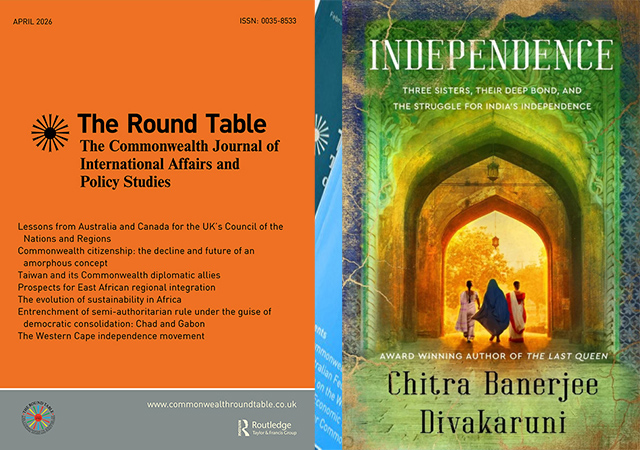
Situating this discussion at the intersection of paratextuality and Partition makes the study a timely intervention, particularly as Partition fiction has emerged as a flourishing genre within global publishing. Partition remains an event saturated with affective resonance and cultural trauma, sustained through collective memory, oral histories and intergenerational recollection. Consequently, the global circulation of Partition narratives also raises questions about how histories of violence are represented internationally and about what forms of empathy, legitimacy and political understanding are reproduced through cultural consumption. Divakaruni’s novel engages with Partition through textual narration, while the HarperCollins cover registers the period’s violence through visual grammar and tactile design. The three-dimensional sensory quality of the cover evokes domestic textures and inherited histories of labour, thereby translating a geopolitical rupture into an affective cultural commodity that becomes marketable across borders. The Indian edition of the novel foregrounds the kantha stitch, which occupies a central position in the narrative. In the novel, selling kantha becomes a means of survival for a household of four women after the assassination of Nabakumar Ganguly, the father of the three sisters. Published in India by HarperCollins in 2022 and later in the United States by William Morrow Publishers in 2023, Independence is set against the backdrop of the geopolitical rupture of 1947, which led to the formation of Pakistan. The novel narrates the lives of three sisters: Priya, Jamini and Deepa, against the backdrop of rising communal violence and Hindu-Muslim riots. Opening in the village of Ranipur in West Bengal, the narrative unfolds over a timeline from August 1946 to 1954, tracing familial bonds, separation and survival in a fractured nation. As such, the text and its cover jointly operate as a cultural archive of Partition, contributing to the global circulation of South Asian political memory and the formation of global narratives around displacement, borders and postcolonial nationhood.
While postcolonial book marketing has been widely examined within literary studies, the implications of cover design and paratextual materiality for global cultural politics remain underexplored. The following interview, therefore, reflects on an attempt to tie visual creative practice, publishing studies and postcolonial critique, demonstrating how literary circulation participates in the construction of international discourses of the Commonwealth through the book-making practice. The conversation between the publishing executive and an author provides a direct intervention into how publishing industries operate within the broader formation of postcolonial books. It brings to the fore an insider’s perspective on the factors responsible for the commodification of a book through ‘prolonged discussions’, as Divakaruni stated, among editors and other publishing executives to reach the global market. In doing so, the study opens a space for further interdisciplinary intervention, particularly through frameworks of the politics of memory, cultural diplomacy, questions of heritage, cultural preservation and representation, which are increasingly central to global discourse.
Afroj Jahan and Sarbani Banerjee are with the Department of Humanities and Social Sciences, IIT, Roorkee, India.