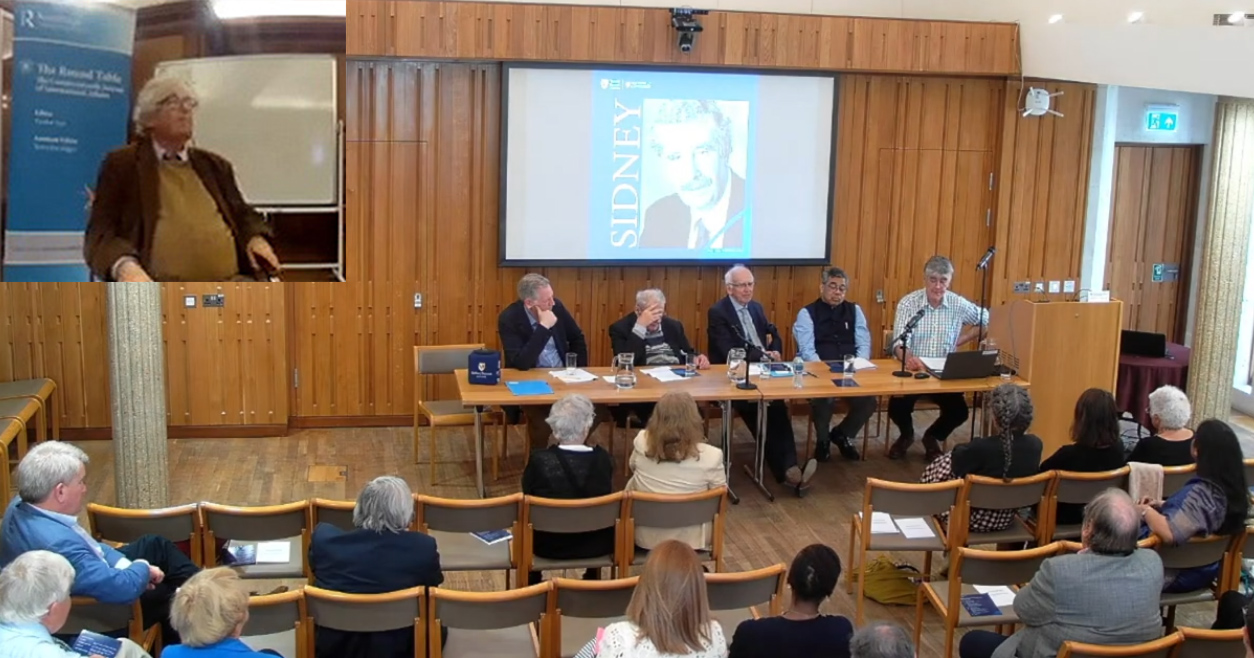
 [Video: James Mayall Celebration of work/ Sidney Sussex College, University of Cambridge YouTube. Inset: James Mayall at a 2024 Round Table event/ photo: Owen Tudor.]
James Mayall’s life overlapped and was intertwined with the evolution of the British empire into the Commonwealth. Indeed, the empire and Commonwealth provided both the thread through the various and many countries and regions and subjects he studied, and the context in which he came to them.
James was born in 1937 in Swindon. His mother, Rhoda, had returned from Sudan where his father, Robert, was an official in the Sudan Political Service. James spent the very earliest years of his life between Sudan and England: the passenger lists of the Bibby Line’s SS Derbyshire has him arriving back in England two weeks before his second birthday, accompanied by his mother and sister and a nanny, Edith Barker. He would have spent more of his early life in Sudan had it not been for the Second World War. His father stayed there, as governor of the Blue Nile province; later he was the Sudan government’s agent in London, until he retired in 1956 when Sudan became independent.
James at this point was doing his national service in West Africa before first arriving in Sidney Sussex to read history – a subject or perspective or training or approach which was to remain with him. (I got the impression that James had little time for IR theory of the more highfalutin kind.) His first job was with the Board of Trade, which sent him to New Delhi to serve with the British High Commission, a period which coincided with the death of Jawaharlal Nehru and the premiership of Lal Bahadur Shastri. When he entered academia he was then unusual, for having experience of the ‘real world’ of diplomacy.
At the LSE and later James’s particular interests – Africa, South Asia, nationalism, regionalism, non-alignment, international organisations, the relations between the West and the underdeveloped world, wrestling with the legacies of colonialism and an uncertain place in the international system – all entangled in different ways with his reading of the empire into Commonwealth story. Indeed, his last (posthumously published) book, Empires of the Mind (2026), interrogated afresh the legacies of empire – as well as highlighting the continuing and pervasive imperial mindsets of the two great powers, China and the United States.
James was never by any stretch of the imagination a cheerleader for the Commonwealth, or an acolyte of it. As he wrote, ‘I think of the modern Commonwealth as a happy accident. If it did not exist it would neither be necessary nor perhaps possible to invent it’. But it did exist, and, slightly more than that, he did think it had some demonstrable successes even if it did sometimes pursue chimeras. It played an important convening role in debates over development and debt, the ending of white minority rule in southern Africa, climate change, promoting the interests of small states, and a commitment (not always adhered to of course) to democracy, the rule of law, and human rights. In none of these areas did it achieve what some people hoped, but in all of them it did achieve something.
Unlike probably most IR scholars and certainly most politicians, James didn’t see the Commonwealth as an irrelevance or an organization on the way out. He spoke of its reinventions to meet the needs of the time, and in 2010 he wrote, ‘at a time of international transition and flux, the utility of an organization whose membership straddles most of the world’s economic, cultural and religious divides, and which has developed an ethos of pragmatism and flexibility, can be expected to increase not diminish’.
For James I think the Commonwealth was most interesting because it provided a microcosm of the world, in which on certain issues you could see different impulses or trends or dispositions played out. And even the fact that great aspirations ran into great obstacles was fascinating to him – for the reasons why that was so. As he put it, ‘Not all member-states value Commonwealth membership for the same reasons or to the same extent … How the Commonwealth is viewed depends on what a particular country seeks to achieve by belonging, the competing demands on its loyalties and attention, and the angle of vision itself’. The Commonwealth itself was ‘a framework for informal cooperation’ and ‘the mutual exercise of soft power’.
James was always acutely aware that the Commonwealth was shorthand for a set of bilateral, multilateral, sometimes regional, ever-shifting relationships with many dimensions besides the intergovernmental one, including (but not limited to) law, language, literature, and civil society and professional associations. Indeed he could be said to have invented the idea of the Commonwealth as a network of networks long before David Howell coined the phrase. He was himself a one-man Commonwealth network – with numerous of his former students now working in universities across the Commonwealth, many of them now themselves hugely distinguished.
James was great friends with Peter Lyon, who had joined the LSE three years before him, and who both there and at the Institute of Commonwealth Studies made the Commonwealth the focus of his life’s work. In 1983 Peter became editor of The Round Table (subtitled The Commonwealth Journal of International Affairs) – a post he was to hold for 21 years. He brought James onto the editorial board, where he remained until his death, for most of the time an invariable attender of meetings (helped latterly by Zoom) and for all of the time a giver of wise advice.
The Round Table, founded in 1910, was both then and now something more than an editorial board, being also a forum for discussion, an association, and a promoter of research on the Commonwealth. At the time James joined it also had some elements of both a dining club and a think-tank – both of which James enthusiastically embraced.
Between 1985 and 2005 James went to all eleven CHOGMs (or Commonwealth Heads of Government Meetings), including crucial ones such as Harare in 1991, Auckland in 1995, or Abuja in 2003. He travelled with Peter, and later wrote an affectionate memoir of his time as Peter’s book-carrier, as he put it; but also of their escapades seeking opinion on the ground. In Harare, I quote,
‘a few of us … took a minibus to the university, where the students had been gated to prevent them petitioning the Heads with a list of grievances. I do not know whether these were justified—most probably not—but we never found out since, as we drove up to the perimeter fence of the university, from where we could just about make out a gaggle of students in the distance, someone … lobbed a tear gas canister through the mini bus window. It had the desired effect and we withdrew in some disarray.’
Finding out what was really happening, looking at the facts dispassionately, trying to understand all angles, applying scepticism and a dollop of humour – these characterized James’s engagement with the Commonwealth as with any other matter.
James’s was a rare voice of authority, subtlety, and depth in a Commonwealth world constantly in churn and sometimes seemingly re-inventing the wheel. He will be much missed.
This was written as a contribution to the memorial meeting for James Mayall held at Sidney Sussex College, Cambridge, on 29 May 2026. Details of the event can be found at Professor James Mayall (in memoriam) | Sidney Sussex College Cambridge and a recording here.