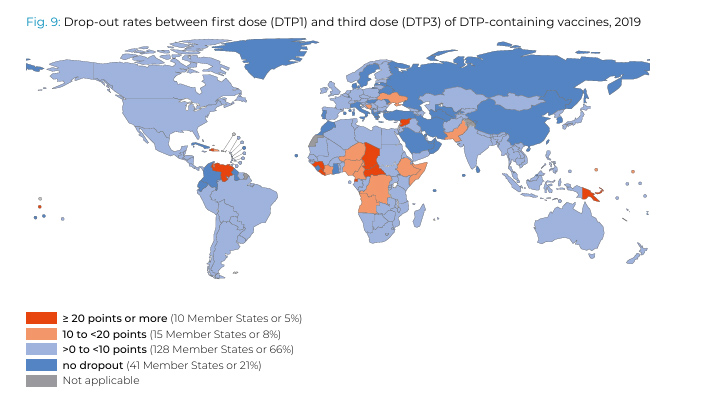
 Drop-out rates between first dose (DTP1) and third dose (DTP3) of DTP-containing vaccines, 2019. [Source: WHO Global Vaccine Action Plan]
[This is an excerpt from an article in The Round Table: The Commonwealth Journal of International Affairs and Policy Studies.]
When comparing immunisation policies between the two countries, it becomes evident that social determinants such as socioeconomic status, education and public awareness play a crucial role in the success or failure of immunisation programmes. In India, inequities in healthcare access and vaccine distribution exacerbate gaps in immunisation coverage, particularly in rural areas and among communities with lower educational levels (Srivastava & Agarwal, Citation2020). Meanwhile, in Australia, although the policies in place have been effective in increasing immunisation coverage, vaccine refusal remains a significant barrier, particularly in addressing misinformation within certain groups. Both countries demonstrate that to achieve optimal vaccination coverage, policies need to focus not only on infrastructure and vaccine distribution but also on strengthening social aspects such as raising awareness and building trust in vaccines, which remain the primary challenges that must be addressed through community-based approaches and effective communication.
Conclusion: addressing the social determinants of immunisation in India and Australia
Immunisation policies in India and Australia present distinct outcomes, driven largely by their respective healthcare systems and the social determinants of health (SDH) that shape public health efforts (Marmot, Citation2005). Australia has successfully maintained high immunisation coverage through a combination of strong policies, such as ‘No Jab, No Play’, and robust healthcare infrastructure (Hull et al., Citation2025). These efforts have ensured that most children in the country are protected from vaccine-preventable diseases. However, even in Australia, challenges persist, especially with vaccine hesitancy. Misinformation, distrust in the healthcare system and social norms contribute to resistance in some segments of the population, despite the country’s well-established healthcare framework (Leask et al., Citation2021). On the other hand, India, while making strides in expanding immunisation coverage through initiatives such as Mission Indradhanush, still faces significant challenges (Gurnani et al., Citation2018). These include uneven vaccine distribution, limited healthcare infrastructure and low public awareness, particularly in rural areas. Many children, especially in remote regions, remain at risk of missing out on life-saving vaccinations due to these ongoing barriers (Vashishtha, Citation2012).
Commonwealth health ministers meet in Geneva
The comparison of these two nations underscores the critical role that social determinants such as education, socioeconomic status and access to healthcare play in the success of immunisation programmes (World Health Organization, Citation2018). Both India and Australia need to address these determinants to improve vaccine uptake. In India, the focus must be on strengthening healthcare infrastructure in rural areas, improving cold chain storage and increasing the number of trained healthcare professionals to ensure vaccines reach underserved populations (Lahariya, Citation2014). Public education campaigns should be tailored to local communities to combat misinformation and build trust in vaccines, especially in regions where vaccine hesitancy is high. Similarly, Australia must intensify efforts to combat vaccine refusal, particularly in the face of rising misinformation. Public health education should focus on debunking myths surrounding vaccine safety and highlighting the collective benefits of immunisation, using trusted community leaders and healthcare professionals to spread accurate information.
Both countries could also benefit from deeper international collaboration, particularly in sharing best practices and leveraging technological advancements to improve the distribution and tracking of vaccines. India, for example, can benefit from Australia’s experience with immunisation monitoring systems like the Australian Immunisation Register (AIR), while Australia can learn from India’s efforts in reaching remote and hard-to-reach populations through mobile health initiatives. Furthermore, to ensure the sustainability of these programmes, adequate funding is essential. In India, this means investing in healthcare infrastructure, vaccine supply chains and public outreach programmes, while in Australia, funding should be directed at combating misinformation and ensuring that all children, including those in remote areas, have equal access to vaccines (Australian Institute of Health and Welfare, Citation2023).
By strengthening healthcare systems, increasing public awareness, collaborating internationally and ensuring adequate funding, both India and Australia can build on their current immunisation successes and address the remaining challenges. With these improvements, they can ensure that all children, regardless of their geographical location or socioeconomic status, are protected from vaccine-preventable diseases, ultimately contributing to better public health outcomes on a global scale.
As the renowned public health advocate, Sir Michael Marmot, once said, ‘the social determinants of health are not just about access to healthcare, but about the way people live and the environments in which they grow, work, and age’. This reminds us that improving public health, particularly through vaccination, requires not only policy changes but also a holistic approach to addressing the inequalities in society. Only through collective effort, understanding and action can we ensure a healthier future for all.
Andrie Hasugian, Kokom Komalasari, Dadang Sundawa & Sapriya are with Pendidikan Kewarganegaraan, Universitas Pendidikan Indonesia, Bandung, Indonesia.