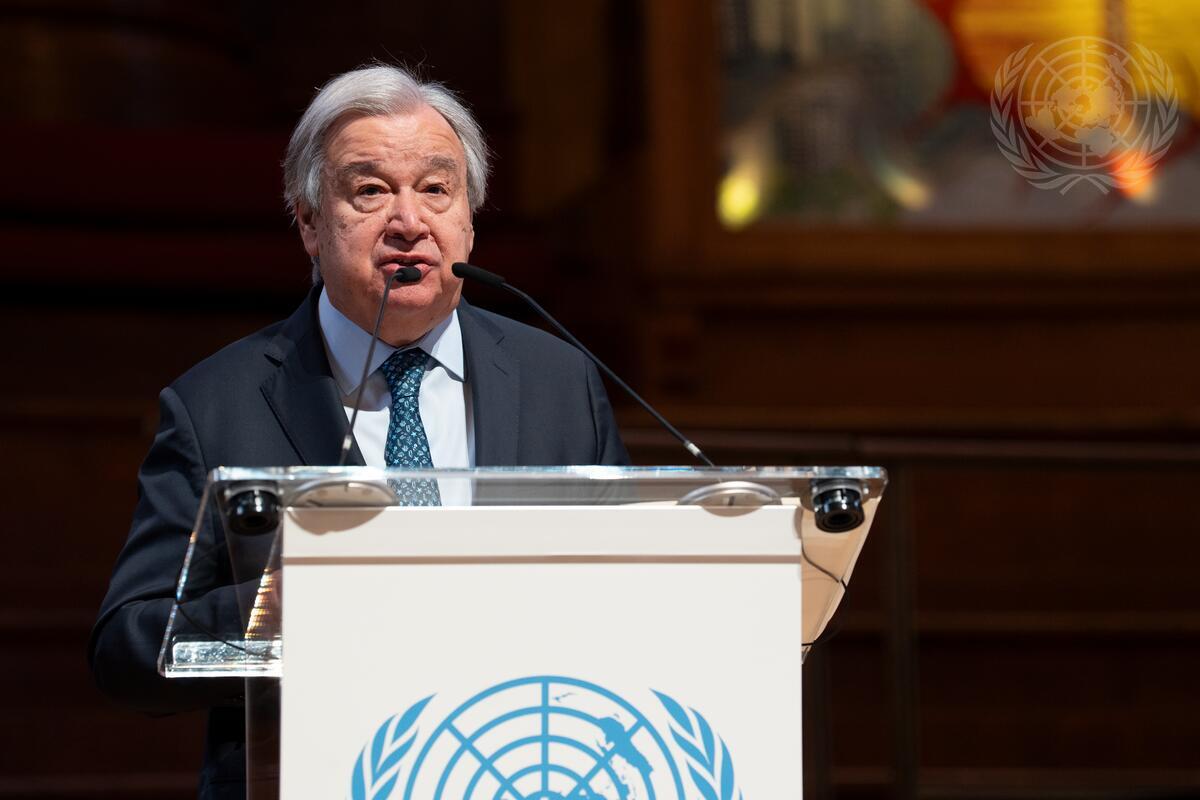
 UN Secretary-General António Guterres: US aid cuts will make world ‘less healthy, less safe and less prosperous’. [photo: UN Photo
Digital Asset Management System]
UN Secretary-General António Guterres: US aid cuts will make world ‘less healthy, less safe and less prosperous’. [photo: UN Photo
Digital Asset Management System]
[This is an excerpt from an article in The Round Table: The Commonwealth Journal of International Affairs and Policy Studies.]
What came to be known as the ‘Accra Reset’ was a vision based on different governance and financing arrangements in development, which was then presented at a meeting on the sidelines of the 2025 UN General Assembly in September 2025, and extended in terms of geographical coverage, participation, themes and sectors to constitute a new broader global development agenda. As President Mahama stated in Accra, ‘Africa must no longer be the patient; it must be the architect and advocate of its own health destiny’ (Erondu, Citation2025, p. 12). As he later stated in New York, ‘The world needs a reset, a re-engineering of the very logic of development itself’, adding that ‘it was right that the global south should take the lead, for it is in our countries that the collapse of the old-world order will be felt most acutely’ (Jerving, Citation2025a). The most significant aspect of the Accra meeting, and its follow-up in New York, was the emphasis placed by speakers on the need to recognise that a specific era of international development was coming to an end, with shifting and reduced donor funding, tightened conditionalities, increased tied procurement, the expectation that recipient countries had to shoulder a significantly greater share of the costs of their own development, and that the private sectors of both donors and aid recipients would have a larger role to play in development.
Economic resilience in a fragmented world: the role of the Commonwealth in trade and investment
UK to merge foreign and aid developments departments
By the beginning of 2026, optimistic assessments of the AFGHS’s prospects appeared to have been justified, with 14 African countries having signed bilateral five-year MOUs with Washington (the use of the MOU format is significant; as statements of intent they are not legally binding), totalling over US$16 billion of US commitments. These MOUs constituted further evidence of the United States’ shift away from multilateralism under the Trump Administration, and its preference for direct government-to-government assistance. All prominently featured the co-financing approach advocated by Washington, which requires substantial contributions by beneficiary countries and aims to reduce long-term dependence on aid. For example, the MOU signed with Kenya on 4 December 2025 committed the United States to provide around US$1.6 billion, while the Kenyan government committed to co-finance activities up to US$850 million, the latter representing close to 35% of total planned expenditure by the parties under the agreement. And in terms of the transactional aspects of the agreement, US commercial interests and Washington’s promotion of the private sector were clearly laid out in the MOU, with the signatories committing to ‘work together to support American companies seeking to establish operations in Kenya in accordance with the laws and regulations of the Republic of Kenya’ (Republic of Kenya, Citation2025, p. 22). All AFGHS ‘Cooperation Frameworks’ that have been made public largely followed the format of the Kenyan compact, and contained strict implementation timelines, performance targets, a monitoring architecture and referenced consequences in terms of non-compliance in the form of the reduction or cessation of US funding should partner countries fail to make good on their co-financing commitments. Despite concerns over the loss of bargaining power, and Washington’s undisguised linkage of aid to the promotion of its other interests as evident in the AFGHS agreements, one African public health expert commented that in relation to the AFGHS agreements (but which might be equally applicable to all ODA arrangements):
It is far more honest than anything the US government has said about global health ever. There’s something reassuring about that – we know the game we are in now. It’s a different thing from the charity case…. Your hand is stronger when you know what the terms of the deal are, unlike when it is under the table. (Jerving, Citation2025b)
A new ODA regime will therefore be a product of the convergence of core interests currently expressed by key actors on both sides of the donor–recipient divide. On the one hand, a Western donor reform agenda, spearheaded by Washington, will attach significantly greater importance than previously to the objectives of strengthening developing country self-reliance through a focus on reducing long-term aid dependency. Donors are also likely to pursue this agenda more vigorously, notwithstanding a reduced resource envelope with which to do so. This might be achieved by insisting on faster progress on key performance benchmarks, carving out a greater role for the private sector in development processes, a streamlined international development architecture and the use of clear exit strategies, while simultaneously pursuing both the geo-strategic and commercial self-interest now openly proclaimed in revised Western donor policies. On the other hand, these priorities will intersect with a reinvigorated search by developing countries, and in particular African countries, for ‘economic sovereignty’, i.e. the capacity to make decisions on economic and social issues independently, without the unwelcome foreign interference enabled by their heavy reliance on external aid. The development policies and programmes they pursue will reflect not only current reduced ODA, but also the likelihood of more cuts as Western donors continue to focus on other priorities and enforce their sunset clauses on aid. They will also be increasingly reliant on the results of their own domestic resource mobilisation efforts, their ability to find a place for their own and foreign private companies in support of their development programmes, and the capacity to design and implement innovative financing strategies to fill funding gaps.
Mark Simpson is with the Institute of Commonwealth Studies, School of Advanced Study, University of London.
Related articles:
Drivers for the humanitarian reset
Where do cuts to USAID leave the future of foreign aid in Africa?