
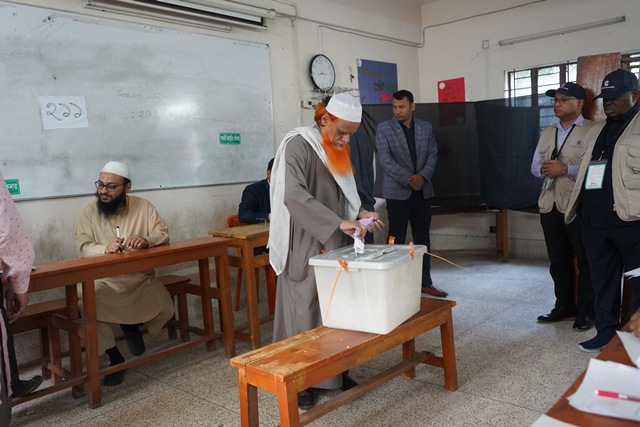
 February 2026: The Commonwealth Observer Group, led by H.E Nana Akufo-Addo, former President of Ghana, and the Commonwealth Observer team in Bangladesh. [photo: ComSec Flikr]
[This is an excerpt from an article in The Round Table: The Commonwealth Journal of International Affairs and Policy Studies. Views expressed do not reflect the position of the editorial board.]
In the matter of foreign policy, especially in its dealings with India, the new government enjoys, at least for now, the support of the Delhi leadership. Prime Minister Narendra Modi’s government has no desire to see Bangladesh slip into the hands of anti-India elements whose activities during the Yunus regime left ties between the two countries gravely damaged. Modi has already invited Rahman and his family to India, a visit that could take place sooner rather than later. Whether or not the visit will be at a state level has not been spelt out, although the assumption is that talks between the leaders of the two countries will be in line with established protocol. In other words, the expectation is that the visit will be official. The new position of the BNP vis-à-vis India is an encouraging departure from the party’s earlier posture, either in opposition or in government, when its politics was stridently anti-Indian. The new government’s ties with China are expected to be friendly given that, in its earlier periods in office, the BNP generally enjoyed comfortable relations with Beijing. As for ties with ASEAN, new initiatives towards rebuilding diplomatic bridges and economic relations, especially in matters of Bangladesh’s export of manpower to its member-states, will be part of the economic focus of the new government. Historically, Bangladesh’s ties with ASEAN have been cordial and stable, a trend that will likely be maintained in the post-election circumstances.
A crucial element in the new political situation in Bangladesh relates to the role of the Awami League, whose leader, former prime minister Sheikh Hasina, has been in exile in Delhi since the fall of her government. To date, the party has been unable to shape a credible strategy regarding its future politics through the induction of new leadership in its inner councils. However, the worry here is that, with a large number of the party’s leaders being in prison or in exile abroad, there are no indications as to who might emerge as either new faces or influential figures in a revived Awami League. Decision-making remains in the hands of Sheikh Hasina, and party leaders still defer to her. Even so, the Awami League casts a long shadow over the country’s political landscape, a factor that may persuade Tariq Rahman into reaching out to the League’s party leadership, in the interests of revitalising democracy in Bangladesh. There is also the question of previous politicisation of the civil service and security forces. In Bangladesh’s history, the civil administration and the police administration have never been completely free of ruling party influence. In the period of Awami League government from 2009–2024, however, such influence permeated the system. On the issue of the judiciary, under Sheikh Hasina’s government, the judiciary was subjected to systematic emasculation through the appointment of politically partisan judges at all levels of the system, a reality that any new political dispensation will find hard to countermand.
Democratic regression in South Asia: diverging paths in five political systems
Fortunes, and much else, changes in Bangladesh
Bangladesh: A dangerous landslide
That said, since the formation of the new government, Awami League offices, which came under mob attacks in the aftermath of August 2024, have been reopened in various parts of the country. Such developments are being seen as a cautious move by the new government towards inaugurating a process of accommodative politics in Bangladesh. Of course, the BNP government remains cognisant of the need to handle these overtures to the Awami League with extreme caution. The signs are that the BNP leadership is keenly aware it cannot govern well if the broad Awami League base at the local municipal level, and in such institutions as the universities and among various professional groups, is kept on the margins of national politics.
The new government faces significant challenges. The economy, which enjoyed between 6% and 7% GDP under the Sheikh Hasina government, slipped to 3% during the period of the Yunus regime. Education provision and access have suffered, with religious extremist mobs and diehard Islamist elements compelling teachers at schools and colleges to resign. The banking sector is in a fragile state, with reports coming in that many are on the verge of collapse. (There have also been questions regarding the financial credentials and experience of the new governor of the central bank, who replaces an appointee of the Yunus regime.) A particular difficulty facing the government will be the review of all agreements reached by the interim regime with foreign firms and governments in critical areas such as economic collaboration and defence. Such issues, notably permitting foreign companies to handle cargo at Chittagong Port and American interest in a potential role on St Martin’s Island in the Bay of Bengal, clearly point to a need for the newly elected parliament to revisit these agreements and ascertain whether or not they redound to the benefit of Bangladesh’s citizens.
The BNP government will be expected to take measures aimed at the release of hundreds of political leaders, journalists, artistes and civil society activists arrested by the Yunus administration but given no access to legal representation. Additionally, demands are being made for investigations into the murder of hundreds of police personnel as well as arson attacks on police stations across the country by mobs following the overthrow of the Sheikh Hasina government. It remains a sad commentary on the Yunus government that it took no steps towards a restoration of the rule of law and indeed was perceived to be acquiescent to the anarchy unleashed by mob violence over the past 18 months.
It is too early to suggest that, with the election having produced a new government, social and political stability have been restored in Bangladesh. There are still too many hurdles to overcome, and too many questions to be answered to public satisfaction before democratic, inclusive politics truly takes off.
Syed Badrul Ahsan is Deputy Editor, The Round Table and a Senior Research Fellow, Institute of Commonwealth Studies.