
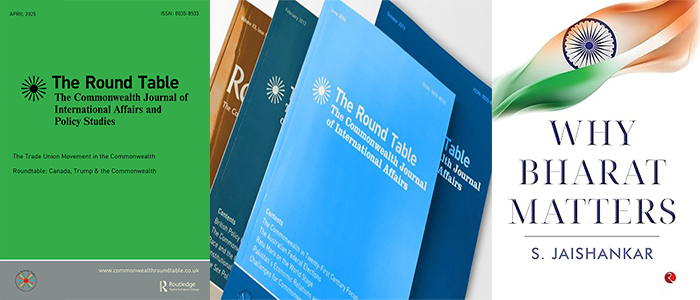
[This is an excerpt from an article in The Round Table: The Commonwealth Journal of International Affairs and Policy Studies.]
As a Commonwealth scholar reflecting on India’s evolving diplomatic identity, one recognises how the nation is repositioning itself. This dynamic gesture impacts regionally and within the larger fabric of postcolonial international relations. Why Bharat Matters, written by S. Jaishankar, the current External Affairs Minister of India, presents a strong and considered account of the country’s transformation in its foreign policy. The book contains eleven essays thematically organised in an amalgam of his diplomatic thinking, state strategies, and civilisational reflections, where Jaishankar does not present his account just as a memoir. He takes deliberate steps to explain and frame the foreign policy changes India has undergone in the past decade. Jaishankar reflects on his experiences in his roles as an Ambassador, Foreign Secretary, and Minister, in demonstrating a country that is no longer satisfied to just passively engage an increasingly global discourse, but intends to actively shape it.
The thrust of the book is in reasserting India’s position in the world through the notions of civilisational identity and strategic autonomy. The author explicates that India needs to move beyond a defensive posture and essentially embrace the confidence that it has had historically as Bharat. The civilisational framing seeks to alter the self-perception of the country and the way in which it interacts in the world, and is arguably more than simply rhetorical.
This emphasis on Indigenous narrative repeats throughout the book and culminates in a call for India to embrace its heritage in navigating international affairs. The title becomes emblematic of this vision, where Bharat is a metaphor for rootedness, depth, and continuity.
The book is structured into eleven chapters, which include ‘Presenting a World View’, ‘Foreign Policy and You’, ‘The State of the World’, ‘Back to the Future’, ‘A Transformational Decade’, ‘Making Friends, Influencing People’, ‘Quad: A Grouping Foretold’, ‘Dealing with China’, ‘Re-Imagining Security’, ‘The Roads Not Taken’, and ‘Why Bharat Matters’. The book moves from principle to policy, from narrative to realpolitik. In this process, Jaishankar introduces several critical ideas. One is the concept of people-centric diplomacy. Rather than limiting foreign policy to elite domains, he argues it must tangibly benefit the citizen. From evacuation operations in Afghanistan and Ukraine to pandemic-time diplomacy, the point is made repeatedly: diplomacy must work for the people.
Bharat or India? Narendra Modi reopens an old debate
From India to Bharat: nationalism in a multi-national polity
Strategic autonomy is another foundational pillar. Jaishankar consistently contests the notion of India being non-committal or indecisive. India’s stance on the Ukraine conflict and the refusal to join trade groupings such as RCEP are cast as deliberate, sovereign, and calculated. His articulation positions India not on the fence, but on its own ground. The first chapter deals with the importance of the Global South and positions India as both a representative of and a voice for the developing world. The G20 presidency is framed as a watershed moment, particularly in its success in securing the African Union’s permanent membership, and brings to the forefront food security, digital inclusion, and sustainable development. The book provides original perspectives, especially in combining classical Indian thought with contemporary policy. By referencing Hanuman and Sri Krishna as diplomatic archetypes, Jaishankar ties foreign policy to a cultural continuum.
Adding to the contemporary contextualisation in this volume are frames such as techno-geopolitics and digital sovereignty, where the author cautions against strategic exposure emanating from dependence on data and digital systems. Using India’s push on millets at the G20 and Harris’s second position on the absurdity of war from an indigenous knowledge and practice standpoint as a demonstration of soft power, this exploration is rich. One of the most frank sections of the book is the chapter on China. The narrative acknowledges that there is abnormality in bilateral ties following Galwan, and acknowledges that China represents a strategic challenge to India. In a way that does not exaggerate the significance, Jaishankar emphasises that peace on the border is the first condition for any meaningful relationship. This calibrated realism comes through in his discussions of security, supply chains, regional partnerships, and in particular the Quad.
The limitations are readily apparent: despite the strong parts of the book, Jaishankar closely relates his perspective with the present government’s vision and minimally engages with alternative viewpoints or critiques. Although the author’s institutional position explains the alignment with prevailing policy narratives, the book would have benefited from a more expansive analytical scope that engaged with diverse viewpoints and fostered greater intellectual depth. There is also a noticeable emphasis on the Prime Minister’s leadership, which, while contextually valid, borders at times on political tribute.
Stylistically, the book is lucid and purposeful. The tone is diplomatic yet accessible, avoiding academic jargon while maintaining intellectual depth. Each chapter stands on its own while contributing to a cohesive narrative. For scholars, policymakers, and students of international relations, the book provides both insight and argument. For readers from Commonwealth countries, it offers a postcolonial reading of foreign policy. There, India no longer accepts imposed narratives but asserts its voice with confidence and clarity.
Why Bharat Matters is more than a recounting of India’s external affairs; it is a strategic manifesto wrapped in civilisational thought. It affirms India’s ambition to participate in the global order and shape it.
Sheen Thankalayam is with the Department of Media Studies, Christ University, Bangalore, India.
Why Bharat Matters by Subrahmanyam Jaishankar, New Delhi, Rupa Publications, 2024.