
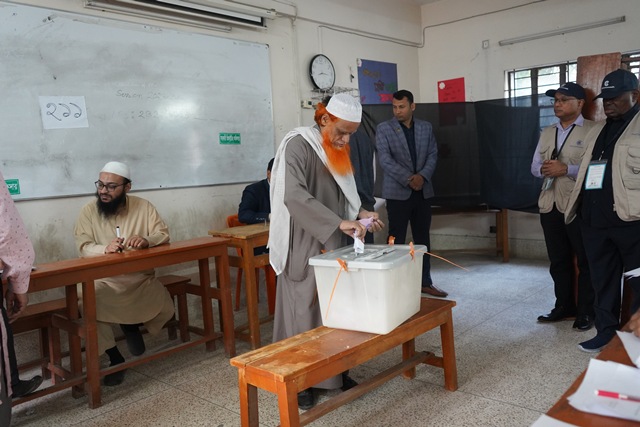
 February 2026: The Commonwealth Observer team in Bangladesh. [photo: Commonwealth Secretariat Flikr]
[This is an excerpt from an article in The Round Table: The Commonwealth Journal of International Affairs and Policy Studies. Opinions do not reflect the position of the editorial board.]
The infrastructure projects under India’s ‘Act East Policy’ have already suffered a setback since the coup in Myanmar. Recent instability in Bangladesh further adds to the critical challenges faced by the projects. The ongoing civil war in Myanmar have also contributed to the refugee influx into India. In July 2024, approximately 1,500 refugees from Myanmar entered Mizoram, bringing the total number of Myanmar refugees in Mizoram to 35,125, according to All India Radio (Mizzima, Citation2024). Illegal immigration from Bangladesh has historically been concerning for India’s northeast states, and the ongoing socio-political tensions in Bangladesh may further escalate these concerns. Mohammed Yunus’s controversial remark in Beijing about India’s northeast’s ‘landlocked’ situation has exacerbated the issue further, causing severe concerns about the sovereignty and integrity of Indian territory. Fresh protests erupted in Arunachal Pradesh following provocative claims by political figures in Bangladesh about Northeast India being part of ‘Greater Bangladesh’ (Mehta, Citation2025).
An unstable Myanmar and Bangladesh could also create room for external influence in northeast India and exacerbate issues of cross-border violence. The threat of insurgent groups operating from Myanmar and Bangladesh may loom large under such conditions. It should be noted that the insurgent groups in Northeast India, such as the United Liberation Front of Asom (ULFA) and the National Democratic Front of Bodoland (NDFB), received support and sanctuary from the BNP-Jamaat coalition during the 1990s and early 2000s (The Week, Citation2025). However, following Hasina’s ‘zero-tolerance’ policy against terrorism and militancy, the Indian insurgent groups faced a significant crackdown in the country. Today, once again, the BNP is back in power, and the Jamaat has secured significant electoral gains along the Assam frontier, which emerges as a legitimate concern for India (Talukdar, Citation2026). Moreover, the spillover effects of Myanmar’s internal conflict have been linked to Manipur’s ethnic tensions, compelling the Indian state to impose stricter vigilance across the Indo-Myanmar border (Pulipaka, Citation2025). In addition to this, the junta, instead of preventing Indian insurgents from using their territory, has been harbouring them in exchange for their help in fighting the pro-democracy PDF and other ethnic armed organisations (The Irrawaddy, Citation2021). Such refuge has allowed militant groups like the People’s Liberation Army of Manipur and Manipur’s Naga People’s Front to use Myanmar as a base for executing attacks on Indian soil, including the November 2021 ambush on the Assam Rifles Convoy in Manipur (Advani, Citation2024).
Democratic regression in South Asia: diverging paths in five political systems
Unwelcomed? The Effects of Statelessness on Involuntary Refugee Repatriation in Bangladesh and Myanmar
China’s growing influence in both Myanmar and Bangladesh also poses a significant national security challenge for the country. A potential Pakistan-China-Bangladesh nexus under Rahman’s leadership in Bangladesh might impact New Delhi’s influence in South Asia. Internally, the issue of illegal immigration and the rising anti-India sentiment in Bangladesh may have domestic and cross-border security implications, particularly against the backdrop of the upcoming West Bengal and Assam elections (Srinivasan, Citation2026).
India’s twin-track policy of maintaining diplomatic ties with the military junta in Yangon while engaging with the EAOs and the National Unity Government may help New Delhi better navigate the post-election scenario in Myanmar and secure its ‘Act East Policy’ objectives in the coming years. However, the glaring political instability and economic distress that remain entrenched in the country despite the elections poses formidable challenges for overall bilateral ties. In the case of Bangladesh, the immigrant question in Northeast India, the resurgence of Islamist groups, and rising anti-India sentiments in the country may act as limits to India’s options with Dhaka in the post-election landscape. However, it is possible that under Rahman’s political leadership in Bangladesh, the BNP may adopt a comparatively liberal stance, which could benefit India. In his campaign speeches, Rahman consistently advocated religious harmony, declaring that Bangladesh belongs to people of all religions, which bodes well for the Hindu minority residing there. Moreover, several encouraging diplomatic gestures reflect New Delhi’s willingness to engage Dhaka. These include External Affairs Minister S. Jaishankar’s visit to Dhaka following Khaleeda Zia’s demise and Prime Narendra Modi’s message of congratulations to Rahman on his victory, one of the first from global leaders. Despite such engagement, the nature of Rahman’s leadership in Bangladesh will undoubtedly characterise much of India–Bangladesh relations in the years to come.
The political scenario in Myanmar and Bangladesh has changed, posing critical challenges for India. These changes impinge on India’s cross-border security, connectivity and people-to-people linkages, creating a situation that is daunting and equally precarious. In the coming years, India’s engagement with these two countries will aim to address these critical concerns to ensure that its strategic and security interests are met.
Shaoni Guha Mazumder, Political Science, Presidency University, Kolkata, India and Obja Borah Hazarika, Political Science, Dibrugarh University, Dibrugarh, India.