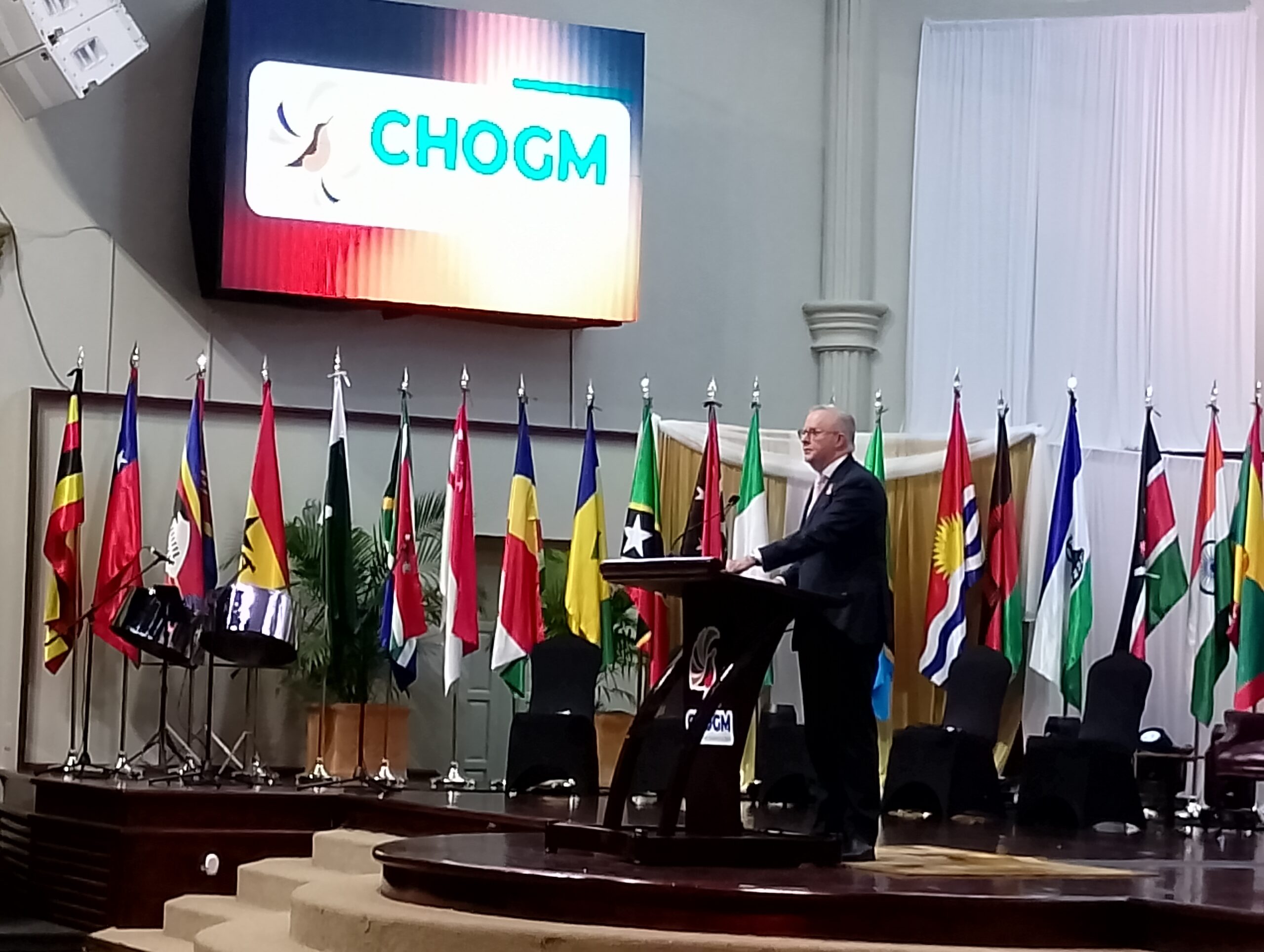
 Australian Prime Minister Anthony Albanese delivering the keynote address at the CHOGM 2026 Forum and Events launch. [photo: Debbie Ransome]
Was it a mistake for Anthony Albanese to attend the Commonwealth Heads of Government Meeting in CHOGM in Antigua and Barbuda? Viewing the CHOGM from Australia, there was much media commentary to this effect, especially in the Murdoch press led by The Australian. The argument was that CHOGM was not sufficiently central to Australia’s interests to warrant the prime minister’s attendance. Unfortunately for Albanese, CHOGM coincided with a decision by the Reserve Bank to raise the cash rate to 4.85%, the highest in nearly 20 years, highlighting the challenge of inflation.
Pictorial coverage of Albanese highlighted him in a tropical location enjoying the CHOGM cricket match as a spectator and attending a reception on Andrew Forrest’s eco-friendly yacht (Forrest is a philanthropically minded mining magnate from Western Australia). Footage of Albanese with King Charles and meeting Andy Burnham and Mark Carney one-to-one conveyed positive outcomes for the Australian prime minister.
Albanese had the honour of delivering one of the major addresses at CHOGM, perhaps reflecting his position as the longest serving of the prime ministers attending from the “old Commonwealth”. He focused on broader Commonwealth themes relating to development, trade and climate change, while also highlighting specific issues that were important to Australia: the campaign for a non-permanent seat on the United Nations Security in 2029-2030; the forthcoming COP (Conference of the Parties on climate change) in Turkey, and relations with the Pacific island countries. He began his address by emphasising the importance of democracy in the Commonwealth, including the issue of ensuring the safety of elected representatives (referring particularly to the injuries inflicted recently on federal parliamentarian Dr Helen Haines, resulting in the loss of both her legs).
A positive outcome for Albanese was his one-on-one meetings with both UK Prime Minister Andy Burnham and Canadian Prime Minister Mark Carney.
The UK-Australia issue that received most attention in Australia was the push to require British backpackers (on youth visas) to spend time in regional Australia where they can contribute labour in areas such as agriculture and hospitality. Under the UK-Australia free trade agreement as signed in 2021, there is no such restriction, nor are Australians on a similar visa in the UK restricted as to where they spend time. The issue was raised but no resolution was achieved at CHOGM. There is pressure on the Australian government to reduce immigration, but some industries in regional areas are concerned that the labour they need will not be available. Non-British visitors on youth visas are required to spend time in regional areas. From a British perspective, of course, there were far weightier matters on Burnham’s CHOGM agenda.
Sue Onslow’s CHOGM 2026 impressions
Albanese and Burnham were able to highlight their joint commitment to AUKUS, as well as discussing AI, the need for enhanced protection for parliamentarians, and ways of responding to the toxic online environment.
Albanese also had discussions with former British prime minister Gordon Brown, the UK’s special reviewer for global finance and cooperation, an important position for promoting the needs of the Global South.
Albanese’s meeting with Carney covered issues such as critical minerals, AI, and the proposal that Canada become an associate member of the European Union (possibly relevant to Australia). Carney’s speech at Davos in January 2026 where he argued convincingly for such an order has won widespread favour, including in Australia. The “elephant in the room” is the trade war between Canada and the US and President Trump’s demand that Canada become the 51st US state (wasn’t that Australia’s title?). There is sympathy in Australia (as in other countries) for Canada in its conflict with the US, but US allies such as Australia (and the UK) find it difficult to support Canada openly. Support for Canada emerges more indirectly in statements supporting a rules-based international order.
Interestingly, the CHOGM communique does express support for some Commonwealth countries in disputes they have with neighbours: Belize against Guatemala; Guyana against Venezuela; Cyprus against North Cyprus. But not Canada against the US. There is avoidance in relation to the bigger geopolitical and geo-economic issues.
The slavery issue featured in Australian reporting about CHOGM, although less so than in the British media. This issue is not strictly a Commonwealth issue as such. It is primarily an issue between the UK and the Commonwealth Caribbean, although the demand for reparations extends to other countries that were involved in the slave trade and the slave system in this region, such as Spain, France, the Netherlands, Portugal (Brazil), and Denmark (Danish West Indies, now the US Virgin Islands) (does the UK have responsibility for slavery as it developed in British America before the emergence of an independent US?). The CHOGM communique indicated an advance in that the UK and the Caribbean countries were to undertake a “structured dialogue”. Albanese indicated general support while steering clear of any implications for Australia. As well as slavery, the 2024 Samoa CHOGM communique referred to blackbirding and indigenous dispossession, both of which are relevant to Australia, but these matters did not feature in the 2026 communique. Albanese deflected a question as to whether any Pacific island countries had raised the issue of reparations for blackbirding (Pacific trading in indentured labourers) with him. Construing indigenous dispossession in Australia as an issue requiring reparations would have huge implications.
A lot of the criticism of Albanese attending CHOGM hinged on the argument that the meeting was not very relevant to Australian interests, particularly domestic interests at this time, but implicitly international interests. This is short-sighted and self-centred. The Commonwealth, as highlighted by CHOGM, provides an opportunity for Australia to demonstrate “good international citizenship”. In supporting the Commonwealth and participating in CHOGM, Australia is helping to address the needs of the Global South, especially small states (the Commonwealth defines 33 out of its 56 members as small states). Measures to help developing countries access climate finance and restructure their debt do not grab headlines, but can have a long-term impact on people in the Global South. The Commonwealth’s role in these areas recalls Max Weber’s adage about politics being “a strong and slow boring of hard boards”.
There is an argument that CHOGM could be held less frequently. Lower-level meetings could still be held on a more frequent basis. Would this result in better attendance by heads of government? There can be more pressing demands at home and internationally. It was noticeable that President Cyril Ramaphosa of South Africa and President Narendra Modi of India were absent from this CHOGM, as they were from the Samoa CHOGM in 2024. Christopher Luxon, prime minister of New Zealand, did not attend because of the election in that country on 7 November. Another option is for heads to attend for shorter periods. Normally, the directly political meetings occur at the end of CHOGM, with the first few days devoted to meetings for civil society organisations.
Despite the criticism coming from some elements of the media and the Coalition opposition led by Angus Taylor, Albanese can argue that he not only advanced Australian interests through his attendance at CHOGM, but also demonstrated Australia’s credentials as a moral actor. While the international visibility of the Commonwealth is small compared with the United Nations or the G-20, it is a stage where Australia can play a major role if there is the political will.
Derek McDougall is the Professorial Fellow in the School of International Affairs, University of Melbourne. He is also a member of the Round Table International Advisory Board.
Related articles:
The Samoa CHOGM: What does it mean?
Derek McDougal’s Samoa diary series