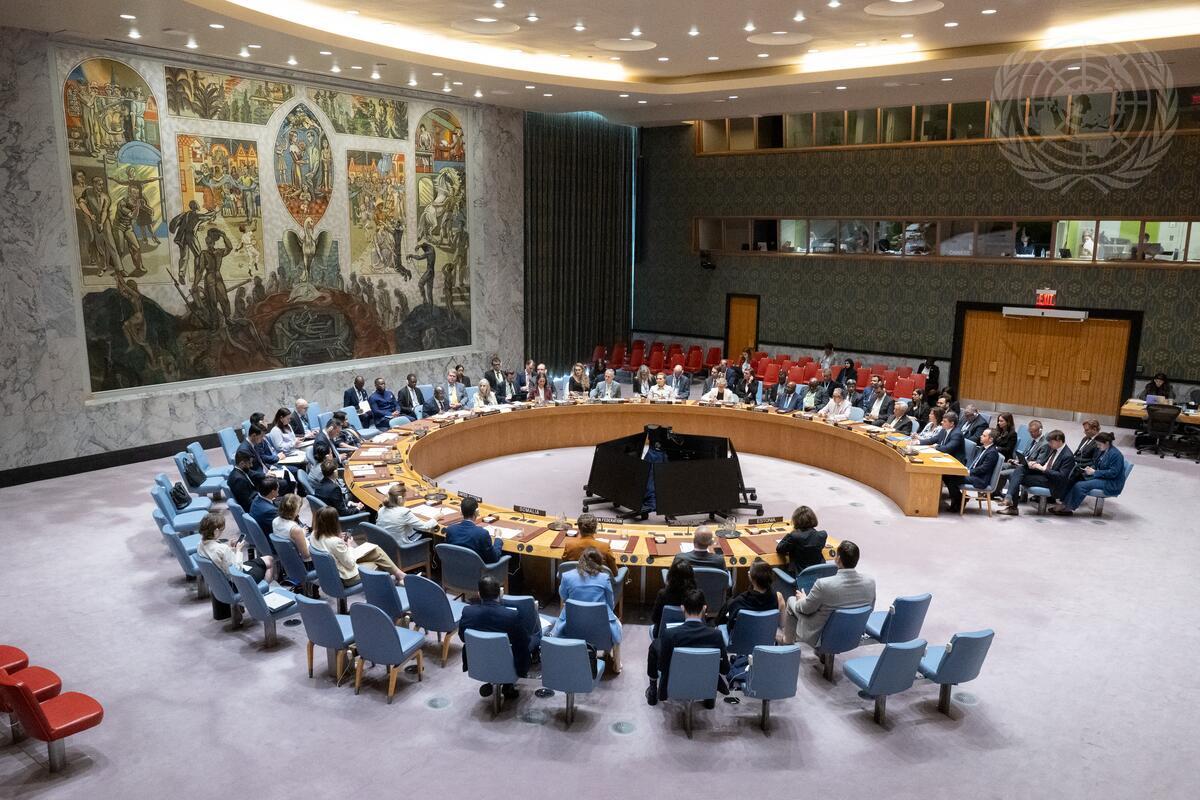
 July 2026: Security Council Meets on Maintenance of Peace and Security of Ukraine. [source: UN Photo/Eskinder Debebe]
[This is an excerpt from an article in The Round Table: The Commonwealth Journal of International Affairs and Policy Studies. Opinions do not reflect the position of the editorial board.]
In the days following Trinidad and Tobago’s overwhelming election to the United Nations Security Council, much attention has been paid to the result. Yet the more interesting story lies not in the 181 votes cast for the twin island state at the UN General Assembly in New York on 3 June 2026, but in the years of diplomacy that made those votes possible. Security Council campaigns are not won in a day. They are won through what we might call the art of the long game – the patient cultivation of trust, credibility, reciprocity and strategic partnerships. Far from being a surprise, Trinidad and Tobago’s election is the latest chapter in a long Caribbean tradition of multilateral statecraft and the enduring influence of small states in global affairs; this is a tradition both of us have had the privilege to observe from close quarters.
Indeed, Trinidad and Tobago’s election to the apex UN body is neither unprecedented nor accidental. Forty-one years after its first Security Council term in 1985–1986, the country is returning to the horseshoe table. Its election is the latest chapter in a broader Caribbean story. Jamaica has served four terms on the Council (1963–64, 1979–80, 2000–01, and 2015–16), as has Cuba (1949–50, 1960–61, 1990–91, and 2008–09). The Dominican Republic has also held four terms, while Haiti has served three. Barbados, Guyana, Saint Lucia and, more recently, Saint Vincent and the Grenadines have likewise demonstrated that small Caribbean states can earn the confidence of the international community and contribute meaningfully to the Security Council’s central task: the maintenance of international peace and security.
But how did Trinidad and Tobago accomplish this particular feat? The answer lies in a little-understood feature of multilateral diplomacy. Elections to the Security Council are not won through last-minute lobbying campaigns. They are the culmination of years of relationship-building, reciprocity and cooperation within regional groupings. In the case of Latin America and the Caribbean, these dynamics are particularly evident within the Latin American and Caribbean Group (GRULAC), whose members have long relied on consultation, cooperation, and informal understandings to manage candidacies for senior UN positions.
Natural disasters, Caribbean diplomacy and developmental introspection
Caribbean response to COVID-19: a regional approach to pandemic preparedness and resilience
Although no formal written rotation principle exists for Security Council elections within GRULAC, a tradition of consultation and accommodation has evolved over time. Caribbean and Latin American states have generally respected each other’s aspirations for representation in key multilateral institutions. The result has been a diplomatic culture built on trust, reciprocity and long-term engagement rather than short-term transactional politics. This is diplomacy understood as statecraft: the strategic use of relationships, ideas and institutions to advance national and regional interests in a complex international environment.
For small Caribbean states, influence is rarely derived from military strength or economic dominance. It is earned through credibility, consistency and the ability to build coalitions with Latin American partners. Caribbean diplomacy has historically relied on these assets. Whether advocating for decolonisation, development, climate resilience or international law, Caribbean states have often found influence through persuasion rather than coercion.
Recent experience demonstrates that small states do more than simply occupy seats. They can shape debates. Saint Vincent and the Grenadines’ tenure on the Security Council illustrated what one of us has elsewhere described as a diplomatic ‘door kicker’ – opening space for issues and perspectives that might otherwise be overlooked, including climate security. Small states may not possess vetoes, but they can influence agendas, frame discussions and remind the Council of concerns that larger powers sometimes neglect.
For decades, Caribbean leaders and diplomats have argued that small states can punch above their weight in multilateral institutions. The historical record suggests they were right. Repeated elections to the Security Council demonstrate that influence in world politics is not determined solely by population size, economic strength, or military power. Rather, it often depends on credibility, consistency, coalition-building and the ability to cultivate trust over time.
The repeated success of Caribbean states at the United Nations is not limited to Security Council elections. In 2023, Trinidad and Tobago’s Ambassador Dennis Francis was elected President of the 78th Session of the United Nations General Assembly, one of the most prestigious leadership positions in the multilateral system. His election reflected not only his personal diplomatic credentials but also years of patient engagement within GRULAC, where support for major candidacies is built through consultation, reciprocity and long-term relationship-building. Such outcomes are best understood not as isolated victories but as the fruits of sustained diplomatic investment and strategic statecraft.
Trinidad and Tobago assumes its seat in 2027 at a particularly consequential moment. The rules-based international order that emerged after 1945 is under increasing strain, yet no stable replacement has emerged. Great-power competition, geopolitical fragmentation, climate insecurity, technological disruption and declining confidence in multilateral institutions have created a period of profound transition and uncertainty. Caribbean and Latin American states are witnessing this rupture in the multilateral order firsthand.
Heightened tensions surrounding Cuba, Venezuela and Haiti, together with growing challenges to principles of sovereignty, non-intervention and international law, and concerns about the existential threat of global warming to the region, have placed renewed pressure on the multilateral system. For countries such as Trinidad and Tobago, the challenge will be to navigate these turbulent waters while remaining faithful to principles that have historically guided Caribbean diplomacy.
Andy Knight is with the Department of Political Science, University of Alberta, Edmonton, Alberta, Canada and the Institute of International Relations, The University of the West Indies and Winston Dookeran, a former Foreign Affairs Minister of Trinidad and Tobago, is with the Diplomatic Academy of the Caribbean and the Institute of International Relations, The University of the West Indies, St Augustine, Trinidad & Tobago.