
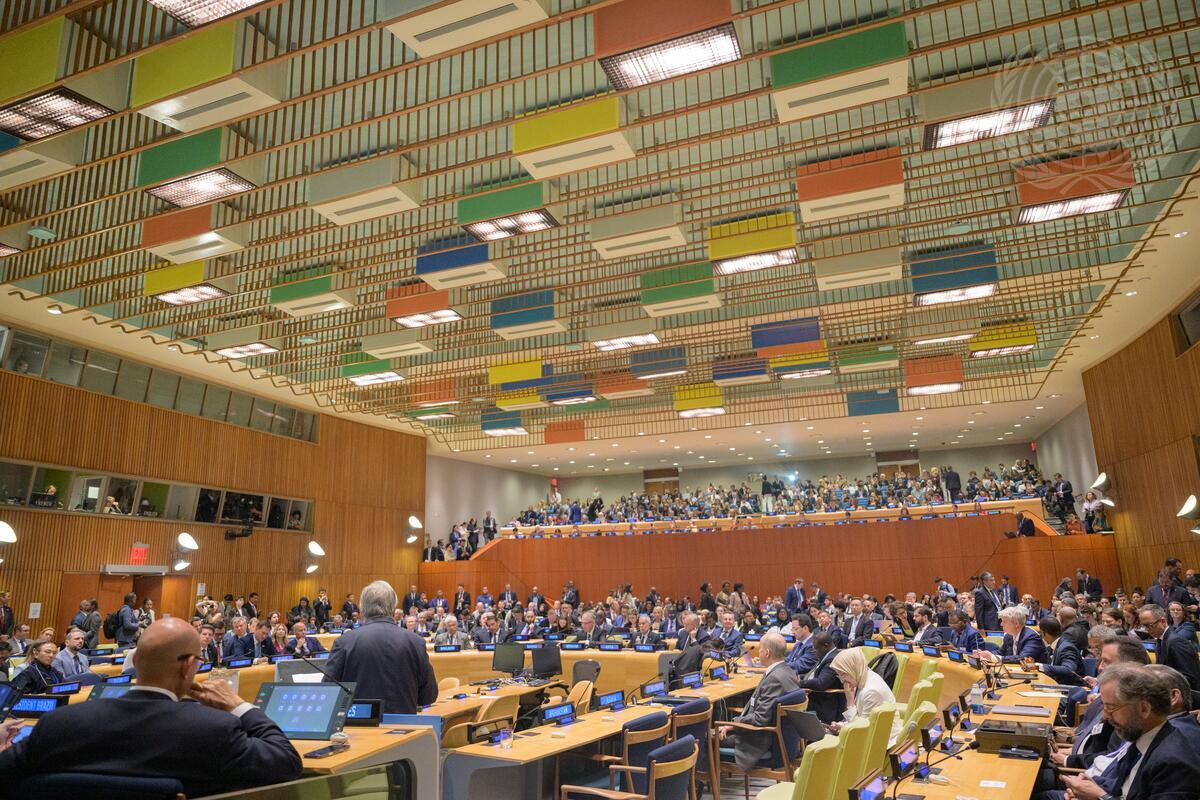
 UN Secretary-General António Guterres addresses the Climate Summit 2025. [photo: UN Media Assets]
[This is an excerpt from an article in The Round Table: The Commonwealth Journal of International Affairs and Policy Studies. Opinions do not reflect the position of the editorial board.]
The Upstream Carbon Tax: a developing country instrument for a global problem
The intellectual centrepiece of my participation at COP30 was the presentation of the Upstream Carbon Tax at the Wellhead (UCT-W). The proposal is deliberately designed from a starting point that virtually all existing carbon pricing frameworks ignore: the point of extraction. The UCT-W is a (carbon) tax levied on the sequestered, Scope 3 CO2 emissions embedded in every barrel of oil – the carbon that was locked underground and that, once extracted and burned, will enter the atmosphere wherever in the world the oil is eventually consumed. It taxes the carbon at the source, in the producing country, before it travels.
This is a fundamentally different approach from ‘downstream’ carbon taxes and trading systems, which are levied at the point of consumption or emission – primarily in developed countries, where the political barriers to such instruments have proven, in most cases, insurmountable. The UCT-W begins from the opposite end of the supply chain. It is administratively simpler. It places the revenue in the hands of producing nations rather than consuming ones. And it reframes the climate contribution of developing oil exporters from a question of sacrifice – of foregoing development to benefit a world that already industrialised – to one of fair, efficient, and sovereign participation in the global carbon pricing architecture. This matters enormously for nations like Guyana whose populations are asking, with complete legitimacy, why they should leave their oil in the ground when the countries demanding they do so built their prosperity by burning theirs.
The UCT-W can serve as the foundation for a climate club of producing nations – a coalition of fossil fuel exporters that agrees, collectively and unilaterally, to impose the tax on their own production. This is precisely analogous to what the European Union has done with its Carbon Border Adjustment Mechanism (C-BAM): a major economic bloc acting on its own authority to internalise carbon costs, without waiting for global consensus. The difference is that the UCT-W would put the revenue and the sovereign authority in the hands of producing nations in the Global South, rather than taxing their exports at the borders of wealthy importers.
How to hold power to account: The Commonwealth Foundation marshalls climate activists
The Commonwealth at COP29 and the road to COP30
Carbon pricing, climate coalitions and the opportunity created by COP30
The most structurally significant development at COP30 was the launch of a two-year work programme on climate and trade, and Brazil’s associated Open Coalition on Compliance Carbon Markets. While I presented on carbon pricing in the form of a carbon tax to be adopted by a climate club of producer countries from the Global South, Catherine Wolfram – the William Barton Rogers Professor of Energy Economics at MIT Sloan – was presenting the flagship report Building Climate Coalitions: Aligning Carbon Pricing, Trade, and Development in the Blue Zone; Wolfram served on an advisory committee to the COP30 Presidency that had been preparing the ground for exactly this outcome. The coalition framework draws on and refines the Nordhaus climate club concept: countries that establish a minimum domestic carbon price can join a coalition enjoying trade advantages, while those outside face border carbon adjustments. Critically, the working group’s framework incorporates graduated admission thresholds, drawing on earlier International Monetary Fund (IMF) modelling, that allow low- and middle-income countries to join at one-third the carbon price required of high-income nations. This is what converts a potentially exclusionary instrument into something closer to a fair architecture consistent with the principle of Common but Differentiated Responsibilities – and it is precisely within this framework that the UCT-W, implemented by a club of producing nations, could find its most natural institutional position.
The evidence that trade-linked carbon pricing can work is already accumulating faster than most economists predicted. The EU’s C-BAM, targeting steel, aluminium, fertiliser and cement, has induced countries to adopt domestic carbon pricing in order to capture the revenue themselves rather than surrender it to Brussels. Turkey has done so explicitly. China expanded its emissions trading system from electricity alone to cover steel, aluminium and cement. Brazil and India are moving in the same direction. This ‘Brussels effect’ opens a space for the Global South to act analogously: a producing-nation coalition implementing the UCT-W would create its own version of that effect, signalling to markets, investors and importing nations that the carbon embedded in exported oil carries a sovereign price.
Conclusion
I left Belém with a clearer sense of where the UCT-W proposal fits in the evolving global architecture. And I left with the conviction, renewed by everything I witnessed in that extraordinary Amazonian city, that the most important work of climate diplomacy now happens not in the formal plenary halls but in the sustained cooperation that COP catalyses and that persists long after the delegates have gone home. COP31 will be held in Turkey.
The Amazon has always absorbed what the world produces. It cannot go on doing so indefinitely. What COP30 in Belém demonstrated, despite everything, is that the world still knows this – and that the nations of our region, the Guianas, the Caribbean, the Amazon basin, and our partners across the Commonwealth, have both the standing and the obligation to make that knowledge actionable.
Thomas B. Singh, Department of Economics, University of Guyana GREEN Institute (UGGI), University of Guyana, Georgetown, Guyana.