
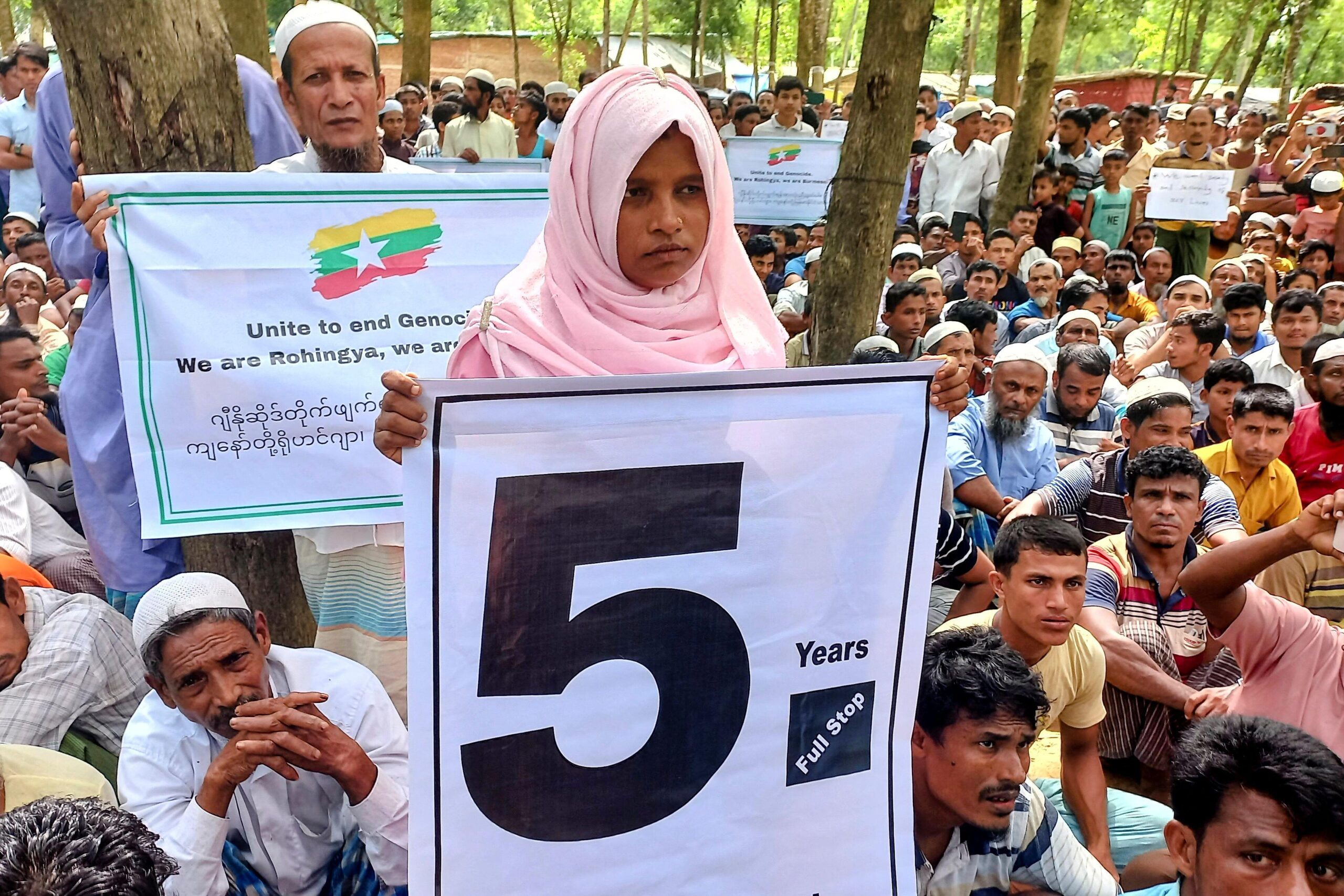
 August 2022: Rohingya refugees gather at the Kutupalong Refugee Camp to mark the 5th anniversary of their fleeing from Myanmar. [photo: Reuters/Rafiqur Rahman via Alamy]
[This is an excerpt from an article in The Round Table: The Commonwealth Journal of International Affairs and Policy Studies.]
Potential avenues for desecuritization
In Myanmar, after the military takeover in 2021, the lives of the Rohingya became increasingly miserable due growing military oppression. Before the takeover, under a democratic government, the Rohingya were constructed as threats by the Buddhists (Ibrahim, Citation2017; Myint-U, Citation2019). After 2021, they, like a million other Myanmar citizens, became subject to the atrocities of the military, and the emotional attachment to home becomes weakened if continuously under pressure (Buzan et al., Citation1998). The incidents of heavily crowded boats filled with Rohingya reflect the ‘growing desperation’ which drives these people to flee Myanmar and relief camps in Bangladesh (UNHCR, Citation2024b) where they live in fragile shelters in the middle of floodplains and landslide-prone hills, and are therefore exposed to storms, rains, flooding, and outbreaks of diseases (The New Humanitarian, Citation2019; UNHCR, 2024). Human trafficking and drug traders exploit their desperation.
Therefore, a cooperative framework among states located in the rim region, as well as committing to the principles for the well-being of the refugees, should be the prime focus of the states. To maintain national security, transparent screening mechanisms should be implemented to carefully assess those entering their territories. A desecuritized approach is imperative when addressing refugee issues. Desecuritization involves moving matters out of an emergency or security framework and into the realm of normal political discourse – here, the humanitarian domain (Buzan et al., Citation1998). Historical memories and socio-political contexts can often lead to the securitization of certain groups. However, India, historically known as a refugee-receiving nation, should assess each refugee group through a humanitarian lens, while simultaneously maintaining a robust security screening mechanism (Buzan et al., Citation1998).
Yet national security has been widened by including within its ambit various other sectors of security, which are constituted subjectively (Wæver, Citation1995). Shifting the discourse from viewing refugees as security threats to adopting a humanitarian approach – guided by narratives that prioritise human rights and humanitarian law – can contribute significantly to restoring the self-respect and dignity of the Rohingya community (Verma, Citation2024). The process of connecting refugees with security does not happen in isolation. People fear migrants and refugees as intruders and have hostile feelings against them, and states keep out those whom they fear threaten state sovereignty. Therefore, as Sadako Ogata, the UN High Commissioner for Refugees has said, the need is not only ‘humane treatment but also specific solutions to their problems, and a specific legal framework for their rights’ (Ogata, Citation2000; UNHCR, Citation1999). This could be achieved through the actors present in the state – the government, the media, and the public. India can recognise the UN Refugee Card as a valid form of identification for them to get access to basic services like healthcare and food (Sullivan & Sur, Citation2023). The government in May 2025 deported 40 Rohingya refugees., but it could uphold its legal obligations under international law and halt the deportations (Amnesty International, Citation2025). Various social media platforms played a significant role in fuelling hate speech and misinformation during the Rohingya genocide, which contributed to framing the Rohingya as a security threat both nationally and internationally. This led to some platforms like Meta coordinating with human rights organisations to monitor locally and practice content moderation to limit the spread of misinformation (Crystal, Citation2023). A similar approach could be adopted in the Indian context.
Unwelcomed? The Effects of Statelessness on Involuntary Refugee Repatriation in Bangladesh and Myanmar
Commonwealth countries must do more for Bangladesh’s Rohingya refugees
Repatriation Agreed – But Will the Rohingya Go Back?
The role of the government is crucial to provide protection to the refugees in its territory (Sen, Citation2003). By the end of 2020, 149 states were party to the 1951 Convention and the 1967 Protocol, while 44 members of the United Nations were not a party to either of these instruments. State behaviour is influenced by domestic as well as international factors. By not signing the Convention, India focused on strategic autonomy to decide who enters its territory because, in an anarchic international system, the primary aim of a state is its security and survival (Waltz, Citation1979). Yet India has hosted a large number of refugees since its independence, seen in the presence of Tibetan, Afghan, and Sri Lankan refugees. As a participant in the Global Refugee Forum and an endorser of the Global Compact on Refugees, and being a signatory to several international conventions that uphold human rights, India bears the responsibility of protecting minorities within its territory (Rajan, Citation2022). However, this cannot occur in isolation, as states are increasingly interconnected in today’s globalised world, and instability in one region can have far-reaching consequences across the globe.
Therefore, embracing a desecuritized framework is both timely and essential. There are several non-state actors in India who can play a significant role in addressing security concerns (Barthwal-Datta, Citation2013). The Zakaat Foundation of India in 2019 took the initiative to provide a 9,805 square ft plot for the Rohingya to reside; the Rohingya Human Rights Initiative founded in 2017 works towards promoting human rights of oppressed minorities world-wide; Save the Children took the responsibility in 2015 and works to ensure that Rohingya children receive education (Upadhyay, Citation2024).
India should take appropriate measures to deal with the crisis, taking into consideration domestic, regional, cross-border and international stakeholders (P. Sahoo, Citation2023). The relationship between the state, society, and newcomers is complex (Erdoğan, Citation2020). To call immigration a threat to national security shifts immigration from a low priority to a high issue that requires actions such as securing borders (Eroukhmanoff, Citation2018; Zülfikar Savcı et al., Citation2024). The Rohingya refugee crisis, stemming from events in Myanmar, led Bangladesh to establish shelters for the displaced. However, these camps are marked by precarious and dangerous living conditions prone to floods and a rise in crimes, smuggling and trafficking. Many Rohingya risk their lives attempting to escape by sea in pursuit of a better future. While India has not officially extended support to this group, its robust judiciary, active civil society, and human rights organisations have offered shelter and assistance. A constructive approach would involve the states working together in collaboration and managing the Rohingya influx, delivering humanitarian aid to those in genuine need, and ensuring thorough scrutiny of individuals where security concerns arise.
Nitika Angelina Rao & Suresh Kumar Digumarthi are with Political Science, GITAM, Hyderabad, India.