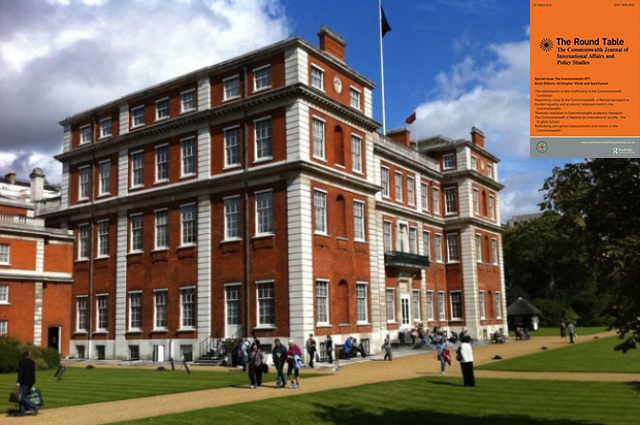
 [photos: Commonwealth Secretariat and Taylor & Francis]
[This is an excerpt from a special edition of The Round Table: The Commonwealth Journal of International Affairs and Policy Studies.]
In its early days, the Commonwealth of Nations functioned primarily through periodic regular Prime Ministers’ Meetings in London with a minimum of institutional structures since support was provided by the British civil service and relied on bilateral relationships between the UK and other member states (Fedorowich, Citation2011). Scholarship during this era focused heavily on constitutional arrangements, examining how the organisation reconciled sovereignty with continued association (Kumarasingham, Citation2018). The Australian scholar, Sir Keith Hancock, who later became the first Director of the Institute of Commonwealth Studies, argued that in the inter-war years the Commonwealth evolved through combining aspirations of independence with international cooperation (Hancock (Citation1942/1964) Louis, Citation2005), demonstrating British statecraft could reconcile tensions between local national patriotism and ongoing existence and coherence within a broader framework of British institutional liberty. In the post‑war era, this thesis was replaced in the context of empirical reality: since allegiance to the Crown was no longer a condition of membership, ‘the importance of like institutions and like purposes was enhanced’ (Galbraith, Citation1959, p. 92; and see Carrington, Citation1955; Mansergh, Citation1982). This suggested that the Commonwealth should not be understood in terms of imperial decline, but rather as a shift from institutional governance to informal network cooperation (Beloff, Citation1974).
Moving beyond historiographical debates, Commonwealth scholarship expanded into the relatively new discipline of International Relations through the seminal work of Margaret Doxey (Citation1989). Recent research in this area has examined such Commonwealth’s initiatives alongside persistent tensions regarding human rights, especially LGBTQ+ rights in some member states (Waites, Citation2015), and the Commonwealth’s efforts to position itself as a potential significant player in the global economy, promoting trade, investment and sustainable development. Initiatives such as the Commonwealth connectivity agenda and the sustainable blue economy (Voyer et al., Citation2022) as well as strengthening government–business partnerships, have been praised as building a more inclusive and resilient global economic system (P. Buckley et al., Citation2023).
Voices of the Commonwealth: An Oral History of the Modern Commonwealth 1965–2012
Thematic evolution in Commonwealth academic research: A big-data and machine learning analysis across 75 years of cross-disciplinary scholarship
While such initiatives underscore an ambition to remain relevant in an increasingly interconnected world, their tangible impact remains uneven. Since much of the Commonwealth’s economic cooperation appears aspirational, relying on voluntary commitments, critics argue that, without binding mechanisms or significant financial resources, the Commonwealth’s ability to influence global economic governance risks being more symbolic especially when compared to regional blocs such as the European Union or ASEAN (Kaufmann, Citation2026). Indeed, the plethora of international institutions present at both regional and international levels of structuration (Hay, Citation2000) leads to a crowded arena within which the Commonwealth must operate. Furthermore, other critics such as Philip Murphy, a former director of the Institute for Commonwealth Studies, have characterised the Commonwealth as ‘an irrelevant institution wallowing in imperial amnesia’ (Hirsch, Citation2018); or Kris Srinivasan (Citation2005), who argued the Commonwealth was a ‘nearly moribund colonial organisation’; or, in the context of its institutional design built around consensus and voluntary co-operation, ‘a pointless talking shop’ (BBC News, Citation2000). These charges of irrelevance are not helped by the very wide remit of no less than sixteen articles in the Commonwealth Charter that outline its core values and principles, and the gap between rhetoric and compliance.
Themes of the special issue
Growing tensions in the international system have exacerbated the challenges confronting the Commonwealth: these include eroding institutional capacity and financial support and the increasingly disrupted international system of transactional realpolitik. This leaves the Commonwealth at an important crossroad, dealing with challenges from two key directions. First, the attempt to find a new, reinvigorated raison d’etre, despite the attempts outlined in the previous section to regenerate a sense of mission since the early 2000s. Second, the rise (and rise) of multilevel governance: governance here refers to the mechanisms and strategies of coordination in the face of complex reciprocal interdependence among operationally autonomous actors (Jessop, Citation2016, p. 50), which operates at different spatial levels of analysis that possess complex mutually reconstitutive interactions (Wylde, Citation2017, p. 53). Not only is this very difficult to unpick analytically but also leads to the inherent problem of actors’ ability to wield effective political power (and thus instigate real change) – particularly in the absence of binding mechanisms or significant financial resources.
Christopher Wylde & Syed Kamall, St Mary’s University, London.