[This is an excerpt from an article in The Round Table: The Commonwealth Journal of International Affairs and Policy Studies.]
The book can be recommended for the analysis it provides of the major contemporary issues in Australia’s engagement with the Pacific islands based on a region-wide approach. Specific situations are used to illustrate the general themes. The reader will find appropriate historical context to provide an understanding of why the various issues take their current form. There is depth in the analysis and readers can pursue topics further by referring to the extensive endnotes.
The policy recommendations assume that Australia is a moral actor and should be more generous in the way it relates to the PICs. Australia has too often followed a realpolitik approach, prioritising its own self-perceived interests. This is clear with a lot of the topics covered in the book, most obviously with climate change (Chapter 6). It is also evident recently with the various agreements being negotiated by Australia with the PICs, whereby Australia provides generous economic assistance in return for PICs prioritising their security relationship with Australia. Beginning with Tuvalu in 2023 (Falepili Union treaty), these agreements extended to Nauru (Naoero) in 2024, Papua New Guinea in 2025 (mutual defence treaty or Pukpuk Treaty), and Fiji (Ocean of Peace Alliance or Veitarini Treaty) and Vanuatu (Nakamal Agreement) in mid-2026; at that point there were also negotiations under way for a similar agreement with Solomon Islands. Australia sees China as a competitor in the region; the PICs clearly have strong connections to Australia but would generally prefer a ‘friends to all’ approach. They have found the additional Australian support persuasive.
While much of the discussion of the issues in the book focuses on the policies followed by Australian governments, I thought the analysis of the involvement of the private sector in Chapter 5 was most informative, highlighting the role of companies such as the Colonial Sugar Refining Company, Burns Philp, the British Phosphate Commission, ConZinc Rio Tinto of Australia (CRA) and Broken Hill Proprietary (BHP), often underpinning conflicts such as Bougainville (CRA, through Bougainville Copper Limited) and Ok Tedi in Papua New Guinea (BHP).
Book Review – Search for security: AUKUS and the new militarism
Book Review – Turbulence: Australian foreign policy in the Trump Era
Book Review – Pacific Power? Australia’s Strategy in the Pacific Islands
Another area of non-governmental involvement that could be considered concerns the role of churches, again with political implications. Evangelical Christianity is strong in the PICs; Scott Morrison’s first international trip as Australian prime minister in 2018 was to Solomon Islands where his conservative Christianity resonated with many local people.
While I think the major diplomatic-security and economic issues (extending to climate change) are well covered in this book, I would have liked more coverage of the issue of crime, perhaps as part of a broad definition of security. Issues such as drug trafficking are clearly an important part of Australia’s relationship with the PICs.
In establishing the context for the relationship, it would be helpful to point out that Australia’s relationship with the PICs is not unique. One can see this in the way in which imperial expansion in the past (including settler colonialism) relates to the current states system, thinking of regions such as the Americas (including the position of small island developing states (SIDS) in the Caribbean), southern Africa and indeed Russia with its ‘near abroad’. The historical discussion covers this point, but it could be emphasised more. Henry Reynolds in Looking from the North: Australian History from the Top Down (NewSouth, 2025) suggests an historical hypothetical about tropical Australia being established as a British colonial territory comparable to the British territories in Africa and how such an arrangement might have played out. The authors are right to point out the settler pressure for Britain to colonise various Pacific islands. It was convenient for Britain that Queensland as a self-governing colony had responsibility for north Queensland (as likewise with Western Australia and the northern parts of that colony and later state, and South Australia with its administration of the Northern Territory until 1911).
As part of the broader context, it is appropriate to comment on the geopolitical significance of the Pacific islands region. Globally the Pacific Ocean is strategically important, especially in relation to US–China rivalry. The PICs play some role in that context but a relatively minor one. In attempting to limit China’s influence with a range of PICs, Australia is supporting US strategy, although Australia also sees its policies and actions in this respect as being in its own interests.
In assessing the strategic significance of the PICs to Australia, some judgement is necessary as to how the Pacific islands region relates to Australia’s overall geopolitical perspective. Clearly the relationships with the US and China are very important, but also Northeast Asia (in addition to China), Southeast Asia, South Asia, and regions such as Europe and the Middle East. The PICs are important for Australia geopolitically primarily because of their proximity and potential to affect Australian interests adversely in various respects (as highlighted in the book); they are small states with even Papua New Guinea being classed as such by the Commonwealth.
Thinking of the PICs and other Pacific territories, Australia cooperates with Western powers such as the US and France that have a territorial presence in the region and has largely taken over from the United Kingdom since the independence of the various British territories. The compacts of free association that the US has with the Federated States of Micronesia, Marshall Islands and Palau are in some respects a model for what Australia has been attempting with the Commonwealth PICs more recently. We might also recall with the US that parts of the region are either US territories (Guam, American Samoa, Northern Marianas) or a US state (Hawaii), noting also the significance of Guam and Hawaii for US military strategy.
Derek McDougall is with the School of Social and Political Sciences, University of Melbourne.
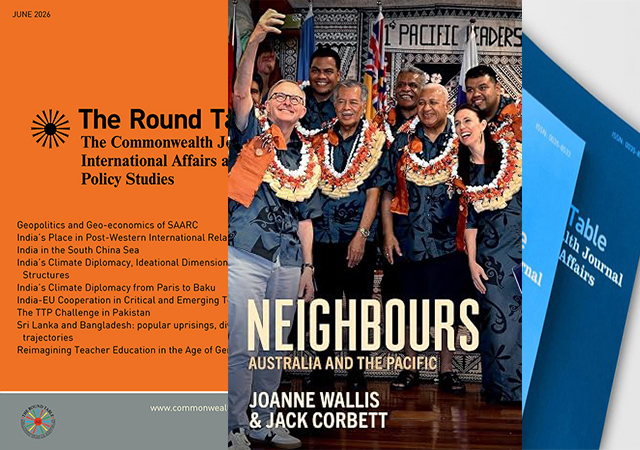
Neighbours: Australia and the Pacific by Joanne Wallis and Jack Corbett, Collingwood VIC, Australia, La Trobe University Press in conjunction with Black Inc., 2026.