 [source: Australian National University video]
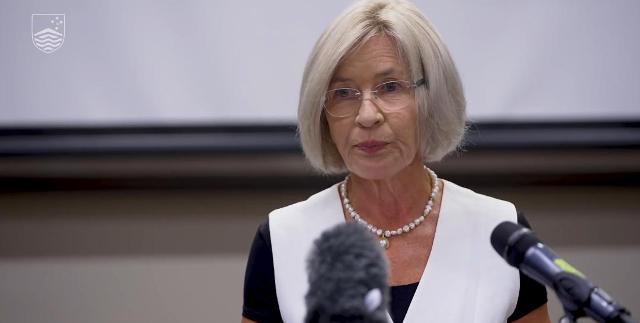
[These two excerpts are from the Anthony Low Commonwealth Lecture 2026, delivered at the Australian National University (ANU) College of Asia and the Pacific in April 2026. The full lecture can be found on the Round Table Journal website.]
The Commonwealth: more than the sum of its parts
Now – I know what some of you are thinking. Colonial relic. Anachronism. The organisation that gave us the Commonwealth Games and not much else. I thought something similar, once. What changed my mind was working inside the Commonwealth – and discovering that underneath the pomp and the disappointments, there is something genuinely without parallel: a voluntary association of 56 independent nations from India to Nigeria; from Australia to Jamaica; from South Africa to Singapore, built on the ruins of empire but not reducible to it.
The Commonwealth has never fully escaped that shadow. But it is not empire – and the distinction matters enormously, especially now. This is an organisation that works quietly across member states on election observation, legal reform, and a myriad of issues that larger organisations ignore. Commonwealth associations link parliaments, judiciaries and professional groups within and across regions. The majority of the world’s small island developing states – including most of our Pacific neighbours – are in the Commonwealth. They get real, practical value from membership: access to finance, technical assistance, and the kind of cooperation that no bilateral relationship can provide.
The Commonwealth is also the only intergovernmental entity that explicitly holds itself out to be values-led: with the demonstrated capacity – if not always the willingness – to suspend or expel member states that violate its core principles (Commonwealth Secretariat, Citation2013). It is the only intergovernmental entity to host – not just register – hundreds of civil society organisations operating across Commonwealth borders. And the Commonwealth is the only intergovernmental entity with a specific organisation, paid for and mandated by its member states, to advance the rights and interests of its citizens: 2.7 billion at last count. Nothing like this exists at the UN, the African Union, ASEAN, or the European Union.
In 2019, I was appointed to head that organisation: the Commonwealth Foundation. My job was to listen to the people and to take the key messages back to member states. The more I worked alongside Commonwealth civil society, the more I understood why governments – why most, if not all governments – genuinely fear civil society power. Why speech is suppressed. Why NGOs are closely monitored and controlled. Why freedom of assembly is seen as so threatening.
One of my duties as Director-General was to organise the Peoples Forum: the largest civil society gathering in the Commonwealth, which takes place every two years alongside the biennial Heads of Government meeting responsible for setting the Commonwealth’s political direction.
Part of the Forum includes a sit-down session between Foreign Ministers and representatives of civil society, which, as Director-General of the Foundation, I was responsible for moderating. Those decades at the UN hadn’t prepared me for this: I was used to NGOs being corralled off from the real action at international meetings: not a people’s summit that was an official event in the programme. And ministers sitting down and talking directly with civil society leaders? Never.
I want to take a few minutes here to show you a highlight reel from the most recent Peoples Forum, which took place in Samoa in 2024. I think that this, better than any words I could offer, really captures the energy, the commitment and the hope that we so desperately need to tap into right now.
Civil society as the real Commonwealth
Across all these issues, it is largely Commonwealth civil society – not Member States, that is speaking up – and speaking out. On media freedom, it was a coalition led by the Commonwealth Journalists Association (CJA) – and supported by the Foundation under my leadership – that drove the development of the Commonwealth Media Principles which were adopted by Heads of State at CHOGM in 2024 (Commonwealth Secretariat, Citation2024b). Civil society has been at the forefront of calling out Foreign Agents laws (CIVICUS, Citation2025b). And it is the people of the Commonwealth who have made abundantly clear their rejection of laws that savagely persecute those who are already so marginalised (Sun et al., Citation2024).
Can the Commonwealth pass the freedom test? As things stand – no. The gap between what Member States have committed to, and what they actually demand of themselves and each other is wide – and it is growing.
I believed, for a time, that the crisis in multilateralism would be the Commonwealth’s moment – that this peculiar, sprawling entity, representing a third of humanity, could step into the breach (Onslow & Lwabukuna, Citation2025). It should have. It did not.
But I do not despair. Because the Commonwealth is not its governments. It never has been. The Commonwealth is those people you saw in Samoa. It is the journalists filing public interest stories under real threat of prosecution. It is lawyers fighting media restrictions and foreign agents’ laws in international and national courts. It is the human rights activists who refuse to accept the criminalisation of sexual identity. They are not waiting for political will. They are the will.
Conclusion: the freedom test
Anthony Low spent his scholarly life documenting the end of empire and the fragile, imperfect structures that replaced it. He understood, better than most, what it actually costs to move from coercion to consent – and how easily that transition can be reversed (Low, Citation1991). The Commonwealth is the inheritor of this transition.
One of my final acts as Director-General was creating the post of Commonwealth Poet Laureate: an office currently held by the extraordinary Selina Tusitala Marsh, whom you saw in the video. Selina is a Kiwi. She is also Samoan, Tuvaluan, English, Scottish and French: she is the Commonwealth in a single person. Her inaugural poem is called Uncommon Banyan, after the tree that begins as a strangler and becomes, through that very violence, something that sustains an entire ecosystem.
I am going to quote just a single stanza of Selina’s wonderful poem:
What tree grows 56 nations strong?
What canopy spans half the globe’s song?
Only this Uncommon Banyan
Born from colonial trauma’s seed, violence that became our need
To grow beyond the strangler’s grip, transform that toxic kinship into voluntary creed (Tusitala Marsh, Citation2026).
The voluntary creed Selina describes did not arrive easily. And it will not be lost dramatically. That is the real danger: losing these hard-won gains – losing our space – slowly, legally, and with the lights still on.
The freedom test is not a question about the Commonwealth. It is a question about us.
Dr Anne Gallagher is with the Australian National University, Canberra, Australia. She is also the former Director-General of the Commonwealth Foundation and member of the Round Table Edigtorial Board.