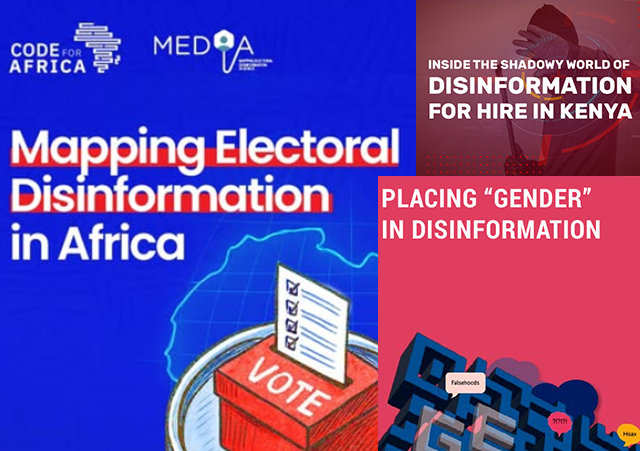
 Report covers [clockwise: Code for Africa, Foundation. Mozilla.org, Association for Progressive Communications.]
[This is an excerpt from an article in The Round Table: The Commonwealth Journal of International Affairs and Policy Studies.]
Questioning women’s qualifications and competence
Critics of Kenya’s constitutional two-thirds gender provision frequently dismiss women nominated through affirmative action as ‘politician’s wives, girlfriends, and mistresses’ (Citizen Digital, Citation2022). Concerns have also been raised about the transparency of the nomination process, with some alleging that women are selected merely as proxies for male political figures. According to Interviewee 10, this rhetoric manifests in the frequent labelling of women politicians as ‘slay queens’ or ‘socialites’, implying that their political ascent is rooted in personal relationships with powerful men rather than merit or competence.
Interviewee 7 described these attacks as ‘below-the-neck’, where the scrutiny directed at women focuses not on their political ideas or policy proposals, but on their bodies, personal relationships and affiliations. ‘The assumption is that they couldn’t have achieved this on their own – that they must be involved with a powerful man within the party. These attacks, which target women’s personal lives rather than their competence, are pervasive’, said Interviewee 7. The unequal scrutiny applied to women also shapes how their actions are judged. Interviewee 10 pointed out that when women politicians are implicated in wrongdoing, the backlash is often disproportionately harsh. ‘Any misconduct by a woman is immediately framed as unacceptable because she is a woman’, they said. ‘When male politicians steal or cheat, it does not provoke the same level of moral outrage.’
Interviewee 4, a representative from a Kenyan fact-checking organisation, stressed that gendered disinformation is not confined to electoral politics but affects women in leadership more broadly. ‘Whenever a woman is called upon to share her expertise or opinions, the first line of attack is often to question her qualifications’, they noted. This tendency is particularly evident when women are perceived to be outperforming or challenging their male counterparts in public discourse. According to Interviewee 4, such dismissals act as a powerful deterrent to women’s participation in political life.
Navigating digital harms: Using artificial intelligence to triage support for journalists
From ‘Climate Barbie’ to “freedom of abuse”: Women in the online spotlight
In February 2025, gendered disinformation was evident in a fake graphic circulated on social media featuring Igembe North Member of Parliament Julius Taitumu. The image included a fabricated quote falsely attributed to Taitumu, criticising the appointment of Chief Justice Martha Koome and claiming that ‘many male judges’ were more qualified. A fact-checking investigation debunked the graphic, noting that it reinforced gender bias by implying that Koome, and by extension other women in leadership, were unfit for high office based solely on their gender (Juma, Citation2025).
Conclusion
This study examined the framing strategies of gendered attacks on public leaders in Kenya by drawing on interviews with Kenyan experts (i.e., fact-checkers, an investigative journalist, an advocate specialising in digital rights and policy, and staff members from NGOs focused on women’s empowerment and digital equity) and analysing media coverage of women politicians active during the 2017 and 2022 general elections. Findings indicate that gendered attacks on women politicians are pervasive across both national and county levels of government. Online harassment, in particular, has a profound psychological impact with examples of women reducing or entirely withdrawing from social media engagement, especially those running public campaigns. As one interviewee explained, fear of harassment discourages women from posting or reading comments, leading to diminished visibility and reduced interaction with supporters. This climate of fear fosters self-censorship, influencing the topics women are willing to address publicly and pushing them towards safer, less controversial content.
The effects extend beyond social media platforms. Interviewees reported that some women decline media interviews or public appearances due to the risk of misrepresentation and further online attacks.
Nicola Davies-Laubscher, the Digital Media Sociology Lab, Centre for Film and Media Studies, University of Cape Town, Cape Town, South Africa. Dani Madrid-Morales School of Information, Journalism and Communication, University of Sheffield, Sheffield, UK. Herman Wasserman Centre for Information Integrity in Africa, Stellenbosch University, Stellenbosch, South Africa.