[This is an excerpt from an article in The Round Table: The Commonwealth Journal of International Affairs and Policy Studies.]
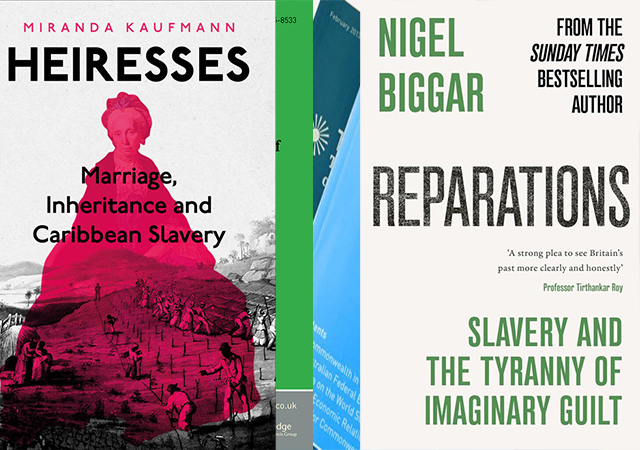
These books could hardly be more different. Both are by well-known authors. Both are well written and accessible. One is a detailed, meticulously researched book exploring in minute detail the lives of nine British women. They were heiresses who benefitted from Caribbean enslavement. The other a sweeping argument, an overview of Britain’s responsibility for reparations. Each, in their own way, plays a role in the evolving debate about what, if anything, the current British public owes to the descendants of the men and women their ancestors carried across the Atlantic to slavery. Both draw on deep scholarship and are motivated by long-held and passionate beliefs. They are useful and welcome, even though their arguments are diametrically opposed.
Kaufmann opens her introduction with a witty literary reference: ‘It is a truth universally acknowledged that a single woman in possession of a good fortune, must be in want of a husband.’ (emphasis in the text. p. 1). The book is a careful examination of women from the late 17th century whose wealth was founded on the huge profits made in the plantations of the Caribbean. Their fortunes made the women very attractive and over two centuries more than 150 such heiresses were ‘grafted into British society’, as Kaufmann puts it. (p.5). They married into the aristocracy and were wedded to the famous. Everyone from Horatio Nelson to John Sloane (whose collection formed the basis of the British Museum and other great institutions) saw in these women an attraction that cannot simply be put down to their intelligence, good looks or graces.
The heiresses do not appear to have questioned the morality of the origins of their wealth, any more than men did, even though they took active roles in managing their Caribbean estates. Most of their British husbands went out of their way to ensure that they had no African ancestry, but not all of them. Kaufmann says that of the 150 she surveyed, just 18 had African roots (p. 7). Among them was Frances Dalzelle (1729–1778), who was the daughter of a Jamaican slave, even though she was later declared legally white. Dalzelle’s good looks were probably the reason for her privileged treatment. Judging by her portrait, ‘She had dark hair and eyes, and perhaps a slight curl of her hair, but very fair skin (although one wonders whether the artist purposefully exaggerated this) and a slim, straight nose’ (p. 63). Her story is meticulously told, although sometimes the thread of the narrative gets lost in the weeds of detail, and might have benefitted from a sharper editorial pen. There is a discordant note on language at the very start of the book. Kaufmann says: ‘I write Black with a capital letter as it conveys a shared cultural identity, but white with lower case’ (p.ix). This is difficult to understand. The black men and women transported across the Atlantic came from many areas of Africa, even when they were sold at a single location. They may not have been of the same ethic group or rank; spoken the same language or have been of the same religion. How can this indicate a shared cultural identity, unless Kaufman suggests that their cultural identity was simply that which was imposed upon them. The evidence is that while slaves were cruelly abused, they retained important elements of their own cultures.
‘A partnership for everyone’: The case for a strategy on reparatory justice
Reparations for Slavery Becomes A Commonwealth Issue
Nigel Biggar’s book could hardly be more different. It is an elegant, tightly written attempt to demolish the case for reparations. For taking this stand, he has become the bête noir of the reparations campaigners. The problem, from their point of view, is that he is such an eloquent writer.
The title itself says it all – the argument for reparations is, in Biggar’s view, based on ‘imaginary guilt’. To be clear, he does not an attempt to avoid Britain’s role in the worst aspects of enslavement. ‘The conditions under which slaves were transported across the Atlantic were infamously dreadful, with the human cargo tightly packed below decks, initially shackled, starved of daily fresh air and sunlight for all but an hour or two, malnourished, dehydrated and prey to disease for a voyage lasting up to six weeks’ (p. 39–40.) Biggar quotes the almost indescribable conditions on board vessels, as witnessed by the former slave, Olaudah Equianio, who survived the transportation in the mid-1750’s to go on to become a powerful campaigner for abolition.
The Biggar argument – to reduce it to its bones – is that slavery was universal and not invented by Britain; enslavement did enrich some but was not responsible for British industrialisation; African elites were active participants in the trade; Britain campaigned passionately against international slavery after abolition, that thousands of the Navy’s sailors died freeing Africans, and that imposing the legacy of enslavement on present generations is illegitimate.
Martin Plaut, Institute of Commonwealth Studies and King’s College London.
Reparations: Slavery and the tyranny of imaginary guilt, by Nigel Biggar, London, Forum, 2025. Heiresses: Marriage, Inheritance and Caribbean Slavery, by Miranda Kaufmann, One World, London, 2025.