
 Gaza under attack. [photo: Alamy/ Cavan Images]
-
Introduction
The terror attacks on Israel by Hamas fighters on 7 October 2023, including the massacre of over 1,200 men, women and children and the taking of 251 hostages, brought full-scale war to Gaza. It also opened another dangerous chapter in the conflict in the Middle East. Deeply shocked and humiliated, the Israeli state has retaliated with overwhelming force. In striving to achieve its war aims of the total military defeat of Hamas and the return of all Israeli hostages, unimaginable horror has been visited upon the people of Gaza. The damage to housing stock, hospitals, schools, water and sanitation facilities, as well as agricultural land, has been immense and an estimated 1.9 million (90%) of the population have been internally displaced. Some 63, 459 people have been killed in Gaza since 2023, and many more wounded. [1] For months, only small amounts of emergency food aid were permitted to enter the territory, and this was restricted to new aid distribution sites, where there was a surge of shootings on a daily basis. The British Red Cross reported in July 2025 that 470,000 people in Gaza faced starvation (22% of the population), with children, pregnant women and the elderly especially vulnerable to severe malnutrition. [2]
Although the negotiated release of the hostages, as part of an agreed ceasefire, has so far proved far more successful than military recovery, it is not clear if Israel will accept the latest cease-fire proposals. Instead, the cabinet has agreed, and is now implementing, a plan for the IDF to take over Gaza City (and probably the rest of the territory), despite widespread opposition among the Israeli public.[3] The UN has estimated that some 87% of Gaza is either already occupied by the military or is subject to evacuation orders. On 22 August, the UN’s humanitarian agencies declared that “more than half a million people in Gaza are trapped in famine, marked by widespread starvation, destitution and preventable deaths” with many more likely to face catastrophic levels of food insecurity by the end of September.[4] Unless a new cease-fire can be agreed, Gaza’s long nightmare is therefore set to continue.
Meanwhile, the steady growth of Israeli settlements on the West Bank, illegal under international law, and increasing intimidation and settler violence reinforce the fear that the intent is to negate the viability of any future Palestinian state. Israel’s far-right Finance Minister, Bezalel Smotrich, recently supported plans to advance the ‘E1’ project, which seeks to build 3,000 homes between Jerusalem and the Maale Adumim settlement. If completed, this development would effectively cut off occupied East Jerusalem from the rest of the West Bank, a move, claims Smotrich, which would “bury the idea of a Palestinian state.”[5]
-
The Commonwealth and Palestine
In the face of such a humanitarian and political catastrophe, any role for the Commonwealth seems far-fetched, to say the least. Yet, as Professor David Erdos, of the University of Cambridge, has pointed out, for many years Commonwealth summit communiques of Commonwealth leaders have recorded concern at developments in the Middle East and have called for an end to violence and a peace that would entrench Israel’s security but also recognise the identity and rights of the Palestinian people.[6] This was especially so with changes to the character and composition of the modern Commonwealth, and the appointment of the first Commonwealth Secretary-General and creation of an independent Commonwealth Secretariat in 1965.
With the prospects of a peace agreement beginning to grow after 1991, the Commonwealth’s interest focussed on the Oslo process between Israel and the Palestine Liberation Organisation (PLO). Agreement on the Oslo Accords I & II in 1993 and 1995 brought closer the real possibility that an enduring peace might be achievable between the two protagonists, based on the mutual recognition both of the state of Israel and of an embryonic Palestinian state. In these circumstances, in February 1997, the PLO Representative in London, Afif Safieh, met with Chief Anyaoku, the then Commonwealth Secretary-General, and discussed Palestine’s possible membership of the Commonwealth.[7] On 15 July, Yasser Arafat, the first President of the newly established National Palestinian Authority (PA), called on Chief Anyaoku at Marlborough House and delivered Palestine’s formal application for Commonwealth membership.[8] At the same time, the Secretary-General was in discussion with the Israeli Ambassador to the UK, Moshe Raviv, about a similar application from Israel. His thinking reflected the duality of the Oslo process, in the expectation that Palestine would be granted formal statehood in 1999.[9]
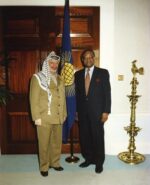
Yasser Arafat of the Palestine Authority calls on Commonwealth Secretary-General Chief Emeka Anyaoku to discus joining Commonwealth. Marlborough House London, 1997. [photo: Commonwealth Secretariat Flickr]
At the end of October 1997, the Commonwealth Heads of Government Meeting (CHOGM) took place in Edinburgh, with the new UK Prime Minister, Tony Blair, in the chair. At the summit’s day-long ‘retreat’ at the Old Course Hotel, St Andrews, Heads considered three applications for membership – from Yemen, Rwanda and from Palestine. Despite Palestine not yet being a sovereign state, there was a surprising degree of support for Palestine’s immediate admission, a reflection perhaps of the growing number of Commonwealth countries – some twenty-six in all – who had already recognised the state of Palestine. In the event, all three applications were kept under review, though Rwanda was to become a member twelve years later.
-
What has changed since 1997?
The assassination of Israeli Prime Minister, Yitzhak Rabin, in 1995 and the surprise election of Benjamin Netanyahu as the country’s Prime Minister in 1996 marked a changing mood in Israel and rising discontent among Palestinians. Within a few years the Oslo process had ground to a halt. For a variety of reasons, the Commonwealth fell silent on the issue.
What therefore has changed for the Commonwealth to now consider re-engaging on the Middle East and with Palestine?
- While the Commonwealth collectively may have stood still on Palestine, individual Commonwealth countries have not. Forty-one out of the Commonwealth’s current membership of fifty-six countries have now recognised the state of Palestine, and the UK, Australia, Malta and Canada recently announced that they too would now move to recognition. Other member countries, such as New Zealand, are likely to follow.[10]
- Palestine is now well established at the UN and in some of its principal agencies, having been given “non-member observer state” status by a majority vote of the UN General Assembly in November 2012.[11] Thereafter, the UN permitted the PA to use the title “the State of Palestine” in its offices and representative capacities. Many saw this development as de facto recognition of Palestinian authority. In 2024, the UN Security Council held a vote on granting Palestine full UN membership. While most voted in favour, the measure was blocked by the veto of the USA.[12] A month later, the UN General Assembly, in asking the Security Council to reconsider, stated its view that Palestine met all the requirements for full membership. It all also granted Palestine further rights within UNGA, short of the right to vote.[13] Palestine is now also a member of a plethora of international organisations and institutions.
- There are some who contend that, legally, Palestine cannot be recognised as a state since it fails to meet the provisions of the Montevideo Convention, in particular the four criteria of a permanent population, a defined territory, a government, and the capacity to enter into relations with other states. In the UK, a group of distinguished lawyers in membership of the House of Lords, including Lord Pannick, have challenged the legality of the British government’s intention to recognise the state of Palestine. [14] Others, such as the eminent international jurist Philippe Sands, respond that Palestine has met all those requirements and cite a positive Advisory Opinion of the International Court of Justice (ICJ) in 2024, even if the full exercise of statehood has been partially denied through war, illegal occupation and blockade.[15]
- Among the international community, there has been a shift in attitude by some states who previously saw the granting of statehood to Palestine as a crucial incentive to achieving peace and therefore the final element of any agreed settlement. Now, some of those states see the implacable opposition of the current Israeli government to Palestinian statehood and to negotiations on a ‘two-state’ solution, as an effective veto on such a development, while at the same time the displacement of Palestinians in Gaza and the rapid growth of illegal settlements in the West Bank are designed to render the notion of statehood impractical.
- Above all, many see what is now happening in Gaza as a relentless assault on the Palestinian people – by deliberate starvation, forced removal, disease and indiscriminate violence – contrary to international law and genocidal in character. That is why recognition, in whatever form and in whatever forum, is so important. There is little evidence that any one state, apart from the USA, can influence Israeli policy. But the first year of the Trump presidency has demonstrated that, if the profile is high enough and the resulting pressure has domestic consequences, indifference or acquiescence can be turned into a more active and positive policy response on the part of the US president. Any multilateral, intergovernmental network – especially one as far-reaching as the Commonwealth – can potentially play a role in highlighting the humanitarian catastrophe facing the Palestinian people. It is important that the world responds – including the growing chorus of opposition in Israel and in the wider Jewish diaspora.
Palestine and the modern Commonwealth: past engagements and future membership?
-
The next steps in the Commonwealth’s re-engagement
Since 1997, Palestine’s application for Commonwealth membership has ‘laid on the table’, neglected but not wholly ignored. Perhaps the first step could come from a member country (or acting with others) inquiring of the Commonwealth Secretary-General the status of Palestine’s application. This could then encourage Hon. Shirley Botchwey to open channels with the National Palestinian Authority in discussing Palestine’s historic application.
Given that, by September, at least 80% of the membership is expected to have recognised a Palestinian State, the issue of state sovereignty is unlikely to be the obstacle to membership that it was in 1997. Likewise, the key requirement of an applicant in demonstrating a former constitutional link with the UK or another Commonwealth country should not be a difficulty, given the three decades of the British mandate over Palestine between 1920 and 1948.
The discussions associated with Palestine’s 1997 application would have included the PA’s acceptance of the Commonwealth’s key characteristics and protocols, such as the use of English as the lingua franca of Commonwealth exchanges and recognition of Head of the Commonwealth (now King Charles III).
More problematic might be a demonstration of acceptance, and adherence, to Commonwealth core values, particularly on human rights, democracy and good governance. In that respect, evidence of some commitment to democratic governance would be easier to show in the West Bank than in Gaza. Despite ongoing disorder, occupation and violence, local elections have continued to be held in the West Bank from time to time but normal political activity has been difficult, including due to the detention of local Palestinian representatives. Legislative and Presidential elections across the territory have been repeatedly delayed, with continuing disputes between Fatah and Hamas. The latest phase of military conflict in Gaza, the almost complete destruction of the urban infrastructure, hospitals and other essential services, and the humanitarian crisis facing the territory, is hardly conducive to the early resumption of democratic activity, even given a peace agreement. As well as a much-reduced Hamas presence, armed gangs as well as occupying IDF troops would be unlikely to provide any comfort that a functioning democracy could be established, except by a painstaking process, in conditions of peace, under international scrutiny. However, as Victor Kattan has pointed out, in similar cases of recent conflict, the Commonwealth has made allowances for abnormal circumstances where membership might be beneficial.[16]
Even in advance of formal membership, there could be areas where the Commonwealth might provide assistance. In 1975, following Mozambique’s independence from Portuguese rule, a Commonwealth Fund for Mozambique was established to help the country develop its post-independence economy and bring stability to its governance. Contributors to the fund included donor countries outside the Commonwealth, and other international agencies.[17] Mozambique eventually became a Commonwealth member twenty years later.[18]
Similarly, the Commonwealth has an extensive network of accredited civil society and professional bodies. These include Muslim Aid and the Commonwealth Jewish Council, as well as organisations of doctors, nurses, engineers, lawyers, local government and parliamentary experts, and the like. Any of these could contribute to building Palestinian statehood, in advance of formal Commonwealth membership, and indeed Muslim Aid already works in Palestine on a range of projects.
-
Conclusion
Palestine’s last approach to the Commonwealth, seeking membership of the association, took place in a climate of hope and expectation. However briefly, it looked as though a historic reconciliation and dispensation between Arab and Jew might be possible.
Any approach today would be in much darker times, with the Palestinian people facing an existential crisis, rather than a bright future.
Can the Commonwealth respond and help avert a catastrophe?
[Editor’s note, 22 September, 2025: A longer version of this article is now available in The Round Table Journal.]
(Dr) Stuart Mole is a Senior Research Fellow, Institute of Commonwealth Studies, University of London and a member of the Round Table editorial board. Opinions expressed in articles do not reflect the position of the editorial board.
[1] Israel News, Haaretz, 14 August 2025 https://us18.campaign-archive.com (source: Gaza, Hamas-run Health Ministry)
[2] “What is happening in Gaza?” Red Cross 8 July 2025 https://www.redcross.org.uk/stories/disasters-and-emergencies/gaza
[3] Raffi Berg & Ruth Comerford “Israel approves plan to take control of Gaza City” BBC News 7 August 2025 https://www.bbc.co.uk/news/articles
[4] World Health Organisation “Famine confirmed for first time in Gaza” WHO joint news release 22 August 2025 https://www.who.int/news/item/22-08-2025-famine-confirmed-for-first-time-in-gaza
[5] Tom McArthur & Jon Donnison “Israeli settlement plans will ‘bury’ idea of a Palestinian state, minister says”, BBC News 14 August 2025 bbc.co.uk/news/articles/ckgdzxpkdd7o
[6] David Erdos “Palestine and the modern Commonwealth: past engagements and future membership?” The Round Table: The Commonwealth Journal of International Affairs 113:.3 (2024), 217-234
[7] “Palestine looks at membership of Commonwealth”, The Independent, Wednesday 19 February 1997 https://www.independent.co.uk/news/world/palestine-looks-at-membership-of-commonwealth-1279417.html
[8] Commonwealth Secretariat digital library, https://library.commonwealth.int/Portal/External/en-GB/DownloadimageFile/p.151/2008
[9] Emeka Anyaoku, The Inside Story of the Modern Commonwealth (London, Ibadan, Nairobi: Evans Brothers Ltd 2004) 271-272
[10] Winston Peters “NZ considering recognition of state of Palestine” 11 August 2025, Official NZ government website, Beehive.govt.nz/release/nz-considering-recognition-state-palestine
[11] “United Nations: The Question of Palestine” UN website, 29 November 2012 un.org/unispal/history/
[12] Press release “Security Council fails to recommend United Nations Membership for State of Palestine”, 18 April 2024 press.un.org/en/2024/sc15670.doc.htm
[13] Raffi Berg “UN general assembly calls on Security Council to admit Palestine as member” BBC News 11 May 2024 https://www.bbc.co.uk/news/world-middle-east-68983650
[14] Matt Dathan “Palestine vow breaks law, claim top lawyers”, The Times, 31 July 2025, 1
[15] “Montevideo Convention: what is it?” The Guardian 1 August 2025, 9
[16] Victor Kattan “Palestine’s Membership in the Commonwealth as a Contribution to a Lasting Peace in the Middle East” The Round Table: The Commonwealth Journal of International Affairs, 104:3 (2015) 297-305
[17] Olusola Akinrinade “Mozambique and the Commonwealth: The Anatomy of a Relationship” Australian Journal of Politics and History 38:1 (1992) 62-82
[18] Commonwealth Secretariat, The Auckland Communique November 1995 The Commonwealth iLibrary 48: 18-19, DOI: https://doi-org/10.14217/978184859558-1-en