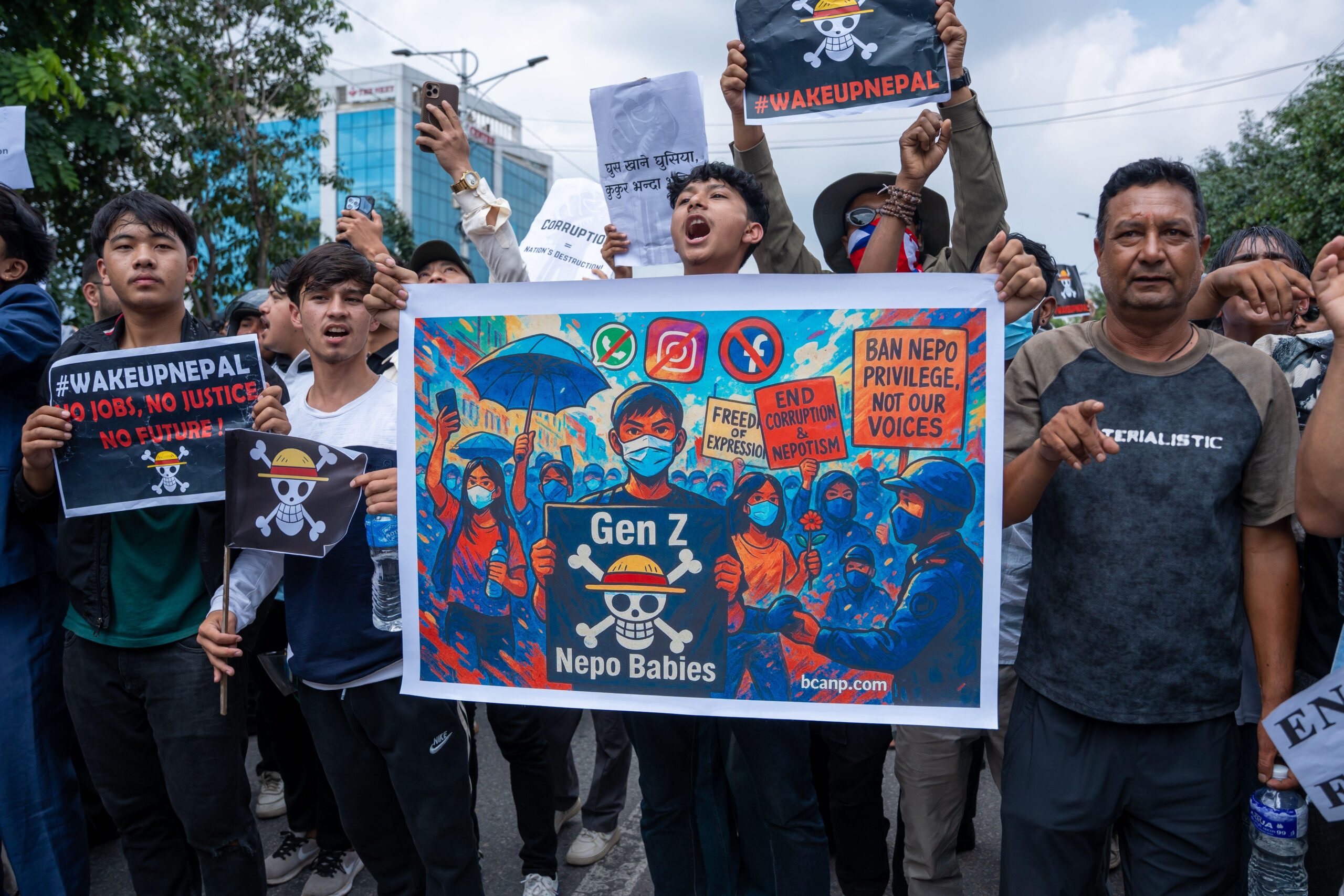
 9 September 2025, Kathmandu, Nepal. Gen Z protest. [photo: Rojen Maharjan/ Alamy]
[This is an excerpt from an article in The Round Table: The Commonwealth Journal of International Affairs. Opinions expressed do not reflect the opinion of the editorial board.]
The Gen Z uprisings in Nepal mark one of the most affecting episodes of youth-driven resistance in the history of the young republic. The killing of protesters by police in Kathmandu exposed not only the brutality of state repression but also the depths of a legitimacy crisis facing Nepal’s political class. Prime Minister K. P. Sharma Oli’s resignation and President Ram Chandra Poudel’s flight into military protection underscored the collapse of governmental authority. What began as digital dissent over corruption and social media bans swiftly escalated into a systemic challenge to Nepal’s democratic order. Scholars of legitimacy have long emphasised that political authority depends on citizens’ belief in the accountability, fairness and responsiveness of institutions (Habermas, Citation1975; Lipset, Citation1981). In Nepal, however, endemic corruption, dynastic politics and a culture of impunity have eroded this foundation (Baral, Citation2012). This Commonwealth Opinion argues that the protests represent a generational reckoning in which Gen Z, a cohort raised in the republic but deprived of its promises, has emerged as the principal challenger to elite hegemony.
Digital dissent and the ban that broke the republic
Social media served as the principal arena of dissent for Nepal’s youth in the months leading up to the protests. Pages such as ‘Next Generation Nepal’ became platforms for amplifying anger, exposing corruption and fostering horizontal solidarity. Digital activism has elsewhere enabled marginalised voices to circumvent authoritarian constraints (Tufekci, Citation2017), but in Nepal, the government’s decision to ban 26 platforms, including Instagram, Facebook, X and YouTube, functioned as a catalyst for rebellion. Theories of communication and legitimacy converge here: by closing off avenues of expression, the Oli government not only violated basic freedoms but also symbolically denied young people a voice in the republic. Scholars of digital authoritarianism warn that such restrictions often backfire, intensifying resentment and fuelling offline protest (Gunitsky, Citation2015). The ban radicalised Gen Z in Nepal, demonstrating that legitimacy today is inseparable from the digital public sphere.
Generational politics and the anger of Gen Z
Karl Mannheim’s (Citation1952/1997) classic account of generational consciousness illuminates the character of Nepal’s protests. Born after the Maoist conflict and coming of age in a republic marked by corruption, Gen Z in Nepal embodies disillusionment and democratic aspirations. Unlike earlier movements led by political parties or armed insurgents, this uprising was spontaneous, networked and leaderless, a hallmark of contemporary youth politics (Milkman, Citation2017). The symbolism of targeting party offices, government buildings, and the homes of political elites reflects a rejection not merely of policies but of the entire architecture of dynastic privilege. Online discourses around ‘Nepo Babies’ echo global critiques of nepotism but resonate locally as indictments of politicians’ children who flaunt wealth amid mass unemployment. Inglehart’s (Citation1997) theory of postmaterialist values suggests that generational cohorts may prioritise transparency, integrity and rights over traditional political patronage, thereby reshaping the political agenda.
Legitimacy crisis in a fragile republic
The erosion of legitimacy in Nepal has deep roots. Since the abolition of the monarchy in 2008, democratic institutions have been plagued by corruption, factionalism and constitutional instability. The Oli government’s authoritarian reflexes, social media bans, curfews and violent repression exemplify what O’Donnell (Citation1994) describes as ‘delegative democracy’, where leaders claim popular mandates but disregard accountability. By rising against these dynamics, Gen Z protesters exposed the contradictions of Nepal’s republic. They demanded not a new ideology but transparency, accountability and jobs, basic features of a functioning democracy. Their refusal to articulate hierarchical leadership or structured demands challenges conventional political analysis but also highlights the emergence of a ‘restless republic’ where legitimacy must be continuously renegotiated.
The China–Nepal–India Economic Corridor: wishful thinking or regional aspiration beyond rhetoric?
Opinion: Fair skin, unfair trade and invisible victims
Regional and Commonwealth dimensions
Nepal’s uprising resonates beyond its borders. South Asia has long struggled with corruption, generational discontent and democratic backsliding (Jaffrelot, Citation2021). Youth movements have increasingly become flashpoints for legitimacy crises from student protests in South Africa’s #FeesMustFall to climate activism in the Caribbean and the United Kingdom. The Nepal case underscores that legitimacy deficits, when combined with economic precarity and digital repression, produce explosive consequences.
Bharat Dhiman is with the Department of Journalism, Lady Shri Ram College for Women, University of Delhi, New Delhi, India.