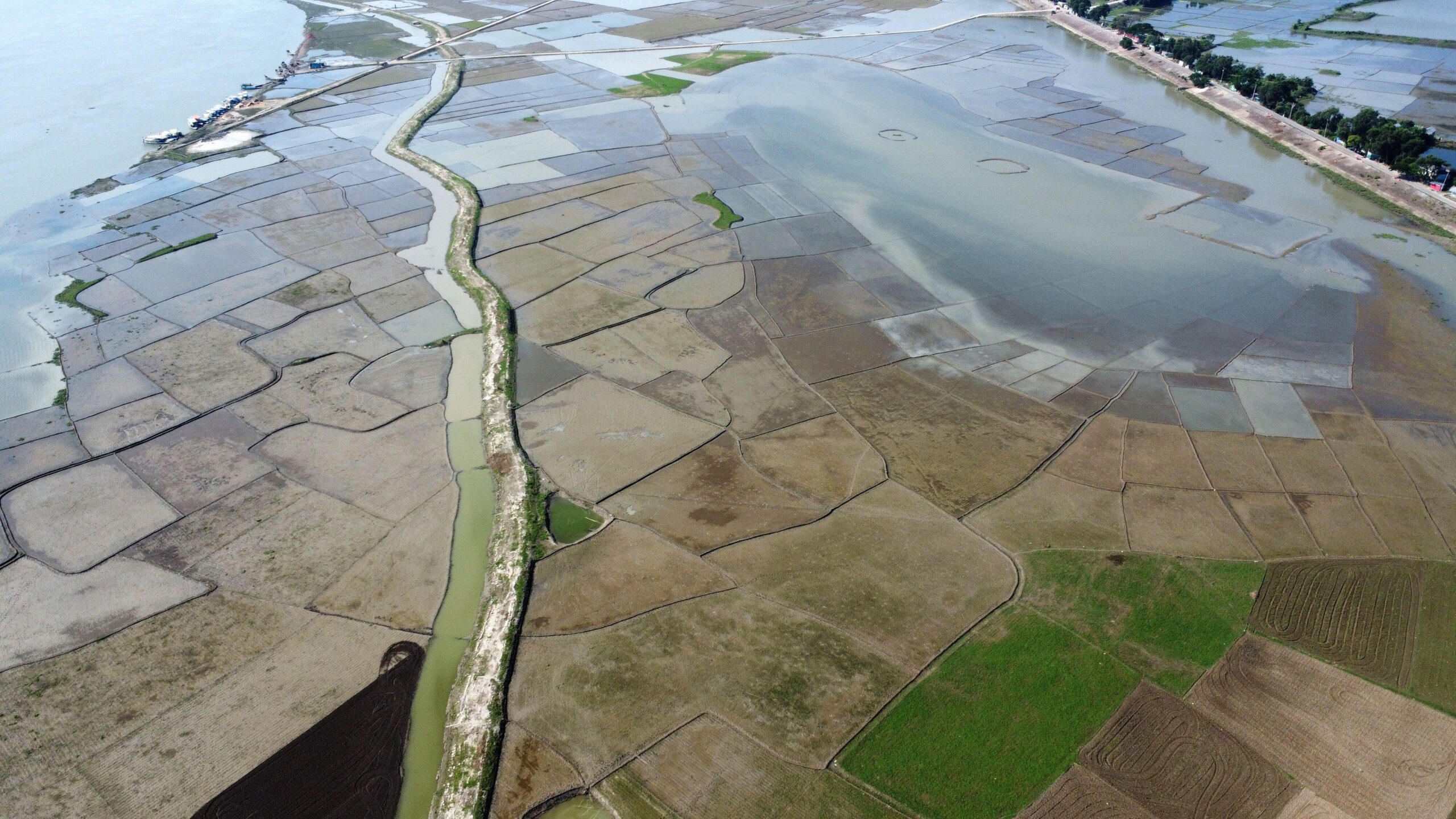
 November 2025: Bangladesh flooding and crop damage. [photo: Vector and Photos/ Alamy]
[This is an excerpt from an article in The Round Table: The Commonwealth Journal of International Affairs and Policy Studies.]
Global frameworks and the failure of protection
Despite growing international recognition of climate change as a driver of displacement, existing legal frameworks remain inadequate. The 1951 Refugee Convention does not account for environmental causes of migration. The Global Compact for Safe, Orderly and Regular Migration (GCM), adopted in 2018, includes climate change as a factor influencing migration decisions but lacks binding commitments (Global Compact for Safe, Orderly and Regular Migration, Citation2018). The United Nations Framework Convention on Climate Change’s Task Force on Displacement under the Warsaw International Mechanism has similarly failed to establish clear protocols for the protection of climate migrants (UNFCCC, Citation2018).
Meanwhile, the Sendai Framework for Disaster Risk Reduction promotes resilience but remains divorced from mobility rights. These fragmented approaches illustrate a broader reluctance within the international system to treat climate-induced migration as a rights-based issue. Instead, the dominant approach remains management-focused – emphasising return, resettlement, and containment over protection, justice or reparation. This failure is not merely bureaucratic – it is deeply political. It reflects an unwillingness by the Global North to reckon with its historical responsibility for climate change, and to accept the ethical implications of cross-border displacement driven by ecological harm.
Reframing the narrative: from securitisation to solidarity
To move forward, it is imperative to reject the dominant narrative that frames climate migrants as threats and instead adopt a justice-based approach to climate-induced mobility. This requires a fundamental shift in how we conceptualise and respond to displacement. First, we must move from a focus on national security to a commitment to human security – prioritising the protection of individuals over the preservation of borders, and ensuring displaced populations have access to livelihoods, housing, healthcare, and dignity. Second, the governance of climate migration must transition from control-oriented approaches to rights-based frameworks that recognise the legal and moral claims of climate-displaced persons, including their right to cross borders, secure legal status, and access resettlement pathways. Third, rather than relying on punitive surveillance technologies to manage migration, we should foster solidarity by employing technological tools for protection and by strengthening regional cooperation – particularly in South Asia – based on shared histories and cultural affinities. Finally, we must shift from a narrow focus on mitigation metrics to a broader commitment to reparative justice. This entails acknowledging the Global North’s disproportionate contribution to climate change and providing meaningful reparations to affected communities, including through relocation assistance, visa facilitation, and inclusive migration policies that reflect historical responsibility and shared global obligation.
Media and migration: Challenging negative perceptions and misinformation
Climate change, migration and conflict in Bangladesh
Conclusion: Bangladesh as a compass for ethical climate governance
The securitisation of climate migration is not inevitable – it is a choice. It is a choice made by states to prioritise borders over bodies, surveillance over solidarity, and control over compassion. But there are other paths forward. Bangladesh, with its lived experience of climate vulnerability and its persistent advocacy for climate justice, stands at the heart of this crossroads. As the Global North tightens its borders and builds its walls – both literal and legal – it is the Global South, and countries like Bangladesh in particular, that must lead the call for a just transition. One that does not view mobility as a threat, but as a fundamental right. One that understands that the people moving are not invaders, but survivors of a crisis they did not create. We must therefore ask: will we continue to treat climate migrants as security risks to be managed, or as fellow humans to be protected? The answer will define not just the future of migration – but the moral legacy of our global climate response.
Aminur Rahman, International Relations, South Asian University, New Delhi, India.