On 23 July 2025, the International Court of Justice (ICJ) ruled on the obligations of states under international law to ensure the protection of the climate system and the legal consequences when states cause significant harm to the environment. The ruling has been hailed as a victory for the world’s climate activists but what happens next?
That was the topic of discussion for a Commonwealth Foundation-organised webinar entitled Holding Power to Account: Climate Justice in the Wake of the ICJ Advisory Opinion, held on 14 October.
Some background for non-climate activists: a case study for the Round Table Journal on the ICJ ruling, outlines how, in 2019, students from eight Pacific nations came together and launched an organisation known as the Pacific Islands Students Fighting Climate Change (PISFCC). The objective was to persuade Pacific Island states to take the issue of climate change, climate justice and human rights to the ICJ. The result was the July 2025 ICJ ruling on the Obligations of States in respect of Climate Change.
Even by today’s virtual conference standards, the October 2025 “What Next” webinar pulled in the participants, boasting more than 6,000 registrants from across the Commonwealth. While the title might have been a bit of a mouthful, the message was simple – webinar chair, broadcaster Myra Anubi, opened the session describing the ICJ ruling as an “historic tool” and a “weapon” in the hands of climate activists.
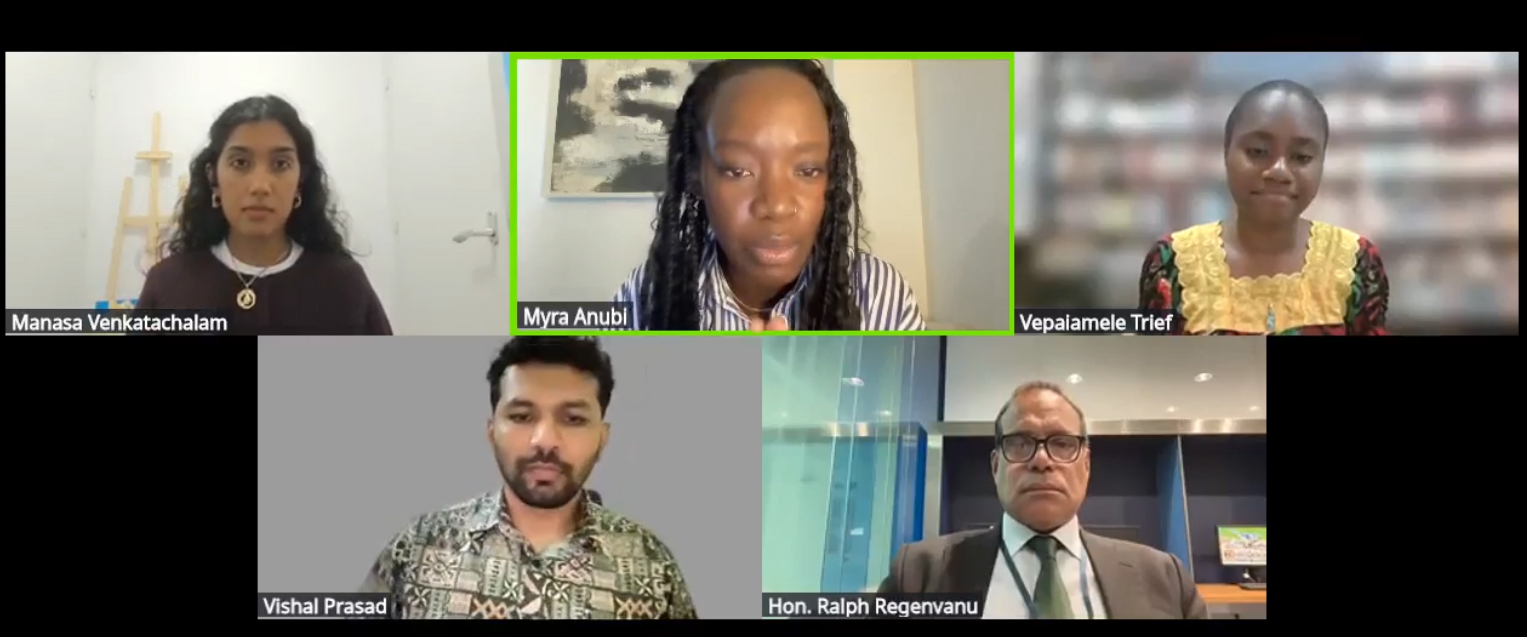
The webinar panel included leading figures from Pacific and Commonwealth climate activism:
- Myra Anubi, journalist and broadcaster, best known as presenter of the BBC World Service’s Fixing The World programme;
- Vishal Prasad, a law student at the University of the South Pacific who became Director of the Pacific Islands Students Fighting Climate Change. They took a Vanuatu island cause to make it into a Pacific lobby and on to a global legal challenge;
- Ralph Regenvanu, Vanuatu’s Climate Change Minister still working on the global potential of the ICJ ruling;
- Manasa Venkatachalam, a legal consultant and researcher who has been working with the Vanuatu team;
- Vepaiamele Grace Treif, the 16-year-old NextGen Youth ambassador from Vanuatu who represented the voices of children and young people in the Pacific at the ICJ hearing.
The registrants, vocal in the webinar chatroom, hailed from all parts of the Commonwealth representing civil society, climate researchers, environmentalists, climate activists and sustainable architects.
“A legal tool is not enough,” panel chair Myra Anubi told her audience. “What’s next?”
View the webinar video here:
Collaboration
Vishal Prasad said that the key is collaboration. He outlined how collaboration, first with Vanuatu students and then Pacific students to work with their governments and regional bodies had taken their cause to the world’s highest court. “There is immense power in community,” he told the webinar. He pointed out that the upcoming November UN Climate Change Conference (COP30) will be the first global climate conference with this legal advisory in place as a “new baseline”. He called for education on the “power” of the advisory so that civic society and other groups working on climate debt and human rights can understand how to hold countries and companies responsible for climate wrongs.
Minister Ralph Regenvanu explained how the ICJ advisory changed the obligations on climate change. He said that countries and corporations could no longer export their waste and hide behind the United Nations Convention on Climate Change. He explained that things had started to move when the Vanuatu government had been “humble” and listened to a group of students. “We (governments) don’t have all the answers,” he said. He advised climate activists to find and interact with sympathetic politicians to promote their causes.
He also put the emphasis on educating people on the implications of the ICJ advisory in the form of workshops for activists and young law students, teaching them to force accountability on climate action.
“Wake-up call”
Running through the conference – both in the panel and in the chatroom – was the optimism of youth and the gritty determination of civic society – qualities the Commonwealth Foundation has tapped into over the years.
Chair Anubi described the ICJ ruling as a “wake-up call” rather than “a piece of legal history”.
Manasa Venkatachalam said that the ICJ opinion shifted the narrative on climate law but there was still a need for “intergenerational collaboration” to stop countries and companies using legal loopholes on climate justice. She suggested dissecting the advisory and using the legalese to strengthen future demands on climate justice.
On the role of the Commonwealth, all the panellists spoke of education and support for small island states and promoting their voices in the global discussion. Ralph Regenvanu said that the Commonwealth could help to increase awareness and understanding of the ICJ ruling to allow it to be used as an “empowering tool”. Myra Anubi spoke of the Commonwealth’s role to support this education as she advised participants to use “any tool in our power” to get the climate justice messages across.
Participants discussed the value of using social platforms, rather than only relying on mainstream media, to get their messages across, through story-telling and other means.
Ms Anubi ended the webinar advising participants to “move from principle to practice”.
Vishal Prasad told participants that “people will listen if we push for it enough”.
Debbie Ransome is the Round Table website editor.
Related articles:
Press Conference: By the Government of Vanuatu – 2025 UN Ocean Conference (Nice, France) | UN Web TV
Special edition of the Round Table Journal on climate justice and the Commonwealth
The ICJ’s climate ruling: Is inaction on climate change now a legal liability? | Chatham House
Unpacking what the ICJ’s advisory opinion means for climate and environmental action | SEI