[This article is from The Round Table: The Commonwealth Journal of International Affairs and Policy Studies.]
This is a game-changing and potentially controversial contribution to academic and popular discourse around slavery and slave trades (note trades, plural) that should inform debates around reparations, although it ranges well beyond them.
Reasonably priced and attractively produced, the book includes maps and well-chosen illustrations, which encapsulate Plaut’s chronological range. The first of these shows Nubian prisoners guarded by Egyptian soldiers and comes from c.2900 BCE. The last shows Barak and Michelle Obama at the Gate of No Return.
Plaut, formerly Africa Editor for the BBC World Service, has impressive credentials and connections to media, academic and government networks. Fifty-plus pages of bibliography and endnotes show that he has combed a great volume of scholarly and secondary literature and contemporary journalism. As a young student and activist in South Africa, his interest was piqued by the story of Abdullah Abdulrahman, the grandson of a slave. He came to believe that the academic attention, with attendant reactions of indignation and shame to the (hi)stories and legacies of the transatlantic slave trade has ‘swamped’ other stories, allowing them to be silenced or ignored, distorting current debates. So his ‘aim in writing this book is to provide a single source that attempts to cover the whole canvas of slavery in Africa … I will try to dispel some myths that have grown up around the subject’ (p. 1). Transatlantic slavery accounted for perhaps 20% or 25% of Africa’s historic enslavement (p. 218). It is only part of a much bigger picture.
So, it is not true that slavery was imposed on Africa from outside. It is misleading to conflate slavery with colonialism. Trans-Atlantic slavery was not the only form of African enslavement. Britain was not the greatest conductor of slaves across the Atlantic (Portugal started first and finished last). African agency – as enslavers and traders – should not be ignored. There is a pressing need for debate in the Arab and Muslim world. Slavery certainly did not end in the 19th century and can still be found in at least five African states today: Mauritania, Mali, Niger, Libya, Sudan. Part 6 of the book, ‘Slavery Today’, with the aid of some shocking statistics and reportage details links with current intractable conflicts, migration, trafficking and terrorism.
While never downplaying or excusing the atrocities of the Atlantic trade, Plaut places it in a much wider spatial and much longer chronological perspective, back to ancient Egypt and forward to the 21st century, drawing on an impressive range of secondary literature and providing good maps and statistical tables with all due caveats whenever possible.
He has some striking juxtapositions. At the time of the American Civil War, there were as many slaves in the Sokoto caliphate (one of the largest slave states in modern history) as in southern states of America (p. 112). In recent years, there has been much justified indignation over the sums paid in compensation to Caribbean plantation owners at emancipation. Plaut draws attention to the cost in money and lives of the Royal Navy’s anti-slaving squadrons off Africa. ‘The cost to Britain was huge: possibly the most expensive humanitarian campaign of all time’ (p. 153). At its peak this amounted to 1–2% of British government spending – a sum comparable to the compensation paid out to slave owners for the loss of their assets after 1833. In a point not often made, he claims that one sailor died for every nine slaves freed.
Unusually, Plaut brings in the story of white Europeans (and Americans) enslaved by Africans, highlighting the huge number of slaves, of all skin colours in the Ottoman Empire and the reach of the Barbary Corsairs, raiding as far as Iceland and Newfoundland. In 1796, the United States paid one fifteenth of its federal spending for the release of 107 American captives. The first victory of the United States on foreign soil was the capture of the Tripolitan city of Derna after a dramatic march across the desert from Alexandria (p. 191).
The final chapter asks ‘Can African slavery be finally ended?’ Plaut briefly and pessimistically examines the role of the UN, the African Union, the Arab League and UNESCO. He calls for much more research, including the opening of closed archives in the Arab world, more rigorous debate and a refusal to look away from present day abuses, before concluding: ‘The continent’s people have suffered immensely over the centuries and their plight has yet to end. All must accept their share of responsibility’ (p. 219).
Terry Barringer is the Reviews Editor of The Round Table Journal.
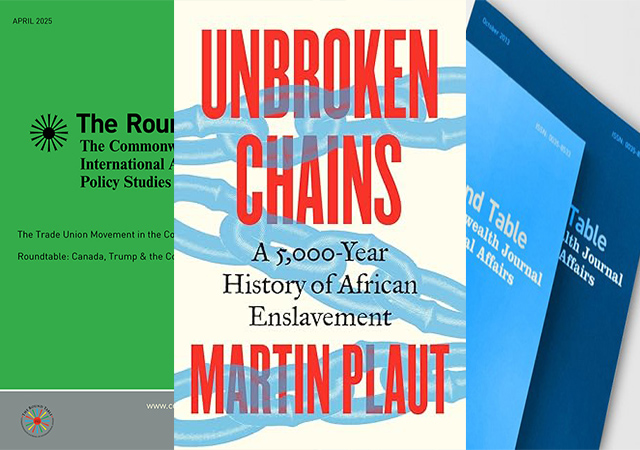
Unbroken chains: a 5,000 year history of African enslavement by Martin Plaut, London, Hurst, 2025.