
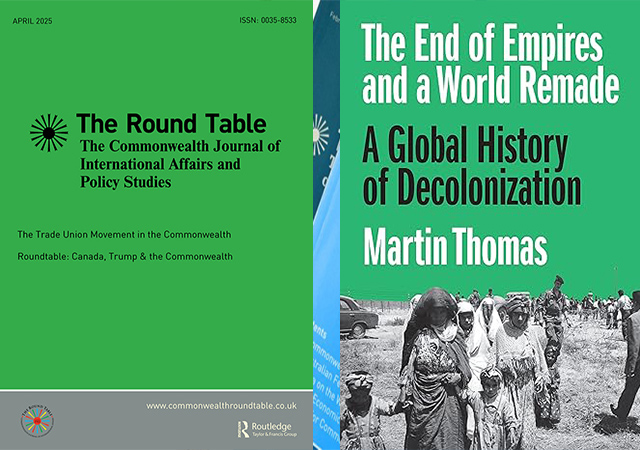
[This is an excerpt from an article in The Round Table: The Commonwealth Journal of International Affairs and Policy Studies.]
Martin Thomas’s study of decolonisation is impressive. At 670 pages, including around 100 pages of bibliography and close to 200 pages of notes, it offers a sweeping view of global decolonisation, particularly in the British and French Empires. Although many of the arguments will be familiar to specialists, it is a valuable and clear statement with some new ideas. The book will have a wide appeal and be useful to undergraduates, and will no doubt become an essential introduction to the subject.
Thomas views decolonisation as one of ‘four great determinants of geopolitical change in living memory’ (p. 3), alongside the two world wars, the Cold War, and globalisation. Rather than seeing decolonisation as ‘disintegrative’ (p. 4) by pulling empires apart, Thomas instead views it as a connected process, linked to as well as creating transnational ideas and networks. Global anticolonial networks are an important example. Thomas highlights the role of anti-imperial cities as contact sites and interestingly pays attention to cultural networks alongside political ones. The chapter on ‘conference cultures’ focuses on Bandung and the series of Third World conferences and resulting collective identities, such as the Non-Aligned Movement, that grew with decolonisation. Thomas recognises that these movements could be contradictory and had their own blind spots, urging caution ‘before representing these networks as a unified global movement for decolonization’ (p. 308). Nonetheless, Thomas is clear that decolonisation should be understood as connected and cannot be understood looking at a single empire or colony’s experience.
Another engaging, and less studied, aspect of decolonisation is rights and international law. Throughout the book, Thomas links the debates over decolonisation to discussions about international law, human rights, and tensions between individual or social and economic rights. He argues that ‘International law … was, after 1945, edging toward the repudiation of colonialism’ (p. 339), and that ‘staking claims to rights’ (p. 56) was a driving force for many of those fighting against empire. Debates over international law were also tied to possible models for post-colonial polities and the nation-states that emerged as successors. Thomas argues that ‘Boxing themselves into the quest for nationhood, anticolonial nationalists inadvertently ensured that the international order after formal decolonization would not redistribute power or resources’ (p. 38). Thus, the outcome of reaching independence as nation-states embedded a particular form of international law that prioritised nation-states as arbiters and protectors of rights. These connections are less well known and make clear how decolonisation fundamentally shaped the wider international system. Another similarly welcome theme is the environmental degradation and ‘ecological disaster’ (p. 153) caused by colonialism and wars of decolonisation.
Thomas’s study of violence is particularly relevant. Unsurprisingly, violence features throughout the book; at least seven chapters have violence as a central theme. Two arguments stand out. First is Thomas’s understanding of the Greater Second World War: that from the perspective of many colonies, the 1945 date for the end of war that looks so clear in Europe was not apparent. Instead, peace and war were blurred, as violence continued in colonies in Asia through and beyond 1945. This included European efforts to retake colonies occupied by Japan, described as an act of ‘imperial self-delusion’ (p. 144). The lack of distinction between peace and war meant the Second World War merged into colonial conflicts such as those in Vietnam and Malaya.
The second argument concerns what Thomas calls ‘the civilianisation of violence’ (221). This chapter reflects on the victims of ‘decolonization wars’ (p. 203) such as those in Algeria and Kenya. Thomas asks if colonial violence was distinct and argues that the political economy in which it occurred, and colonial ideas of civilisational difference between European and colonial populations, made different forms of violence appear acceptable in colonies. Therefore, Thomas argues, to understand these wars it is necessary to focus on unarmed civilians, not just the insurgents and security forces who were actively fighting. Women and refugees receive particular attention here as ‘contested decolonization … was experienced as something closer to civil war for many of the rural and urban communities among which it was fought’ (p. 238)
Poppy Cullen is a Lecturer in International History at Loughborough University and a member of the Round Table editorial board.
The end of empires and a world remade: A global history of decolonization by Martin Thomas, Princeton, NJ, Princeton University Press, 2024.