
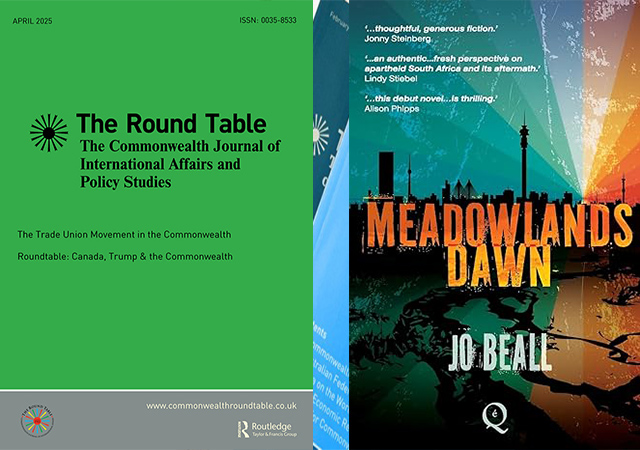
[This is an excerpt from an article in The Round Table: The Commonwealth Journal of International Affairs and Policy Studies.]
A brief author’s note on the very first page of Meadowlands Dawn explains that this novel is inspired by Beall’s ‘own experience as an activist and political prisoner’. A declaration is thus in order. At the time of her long period of incarceration in solitary confinement in the early 1980s in Durban, during which she was hospitalised, this reviewer was a member of the Detainees’ Support Committee which campaigned for her (and many others’) release. Beall was also a university colleague in Durban, until her painful decision to make a new life in the UK. Decades then elapsed; we went our separate ways and lost touch.
Meadowlands Dawn is not an easy read. The cover commendations – ‘thoughtful’, ‘generous’, ‘thrilling’ – do not really prepare the reader for the menacing threats of violence and violation that permeate the chapters of Part 1, nor the guilelessness and vulnerability of Verity, the central character, caught up in circumstances she does not altogether understand. A young white admin assistant at a medical school in Durban, she had flirted with Tariq Randeree, an Indian doctor who also happened to be connected to the armed struggle; their developing relationship is thus entangled in dangerous politics as well as family tensions about ‘crossing the colour line’. She becomes a willing activist, yet seems to lack the measure of her own naiveté. She is detained after trying to assist Tariq and another activist to escape the country.
Round Table Journal book reviews
Commonwealth Bookshelf
Beall portrays with extraordinary power the sense of total isolation from family, friends and support that is solitary confinement, if anything made worse by the odd friendly gesture from a prison guard or the sound of a comrade in a nearby cell. As the days drag on, the little control she has – such as remembering what the date is – diminishes and confusion and doubt set in: whose version of events can be trusted? Has Verity been loved, or has she been cynically used? And just when the reader thinks the worst must be over for her, worse happens. The physical danger, the hideous invasiveness, is almost palpable. Even the humour is grim: one of the white policemen is called Swart (‘Black’) – there really was a notorious one by that name in Durban at the time.
Fast forward some 30 years, to Verity’s return to a post-liberation South Africa in Part 2 of the novel. She is on a quest to heal still-open wounds – to reconnect with her family, to confront those who had incarcerated and tortured her but seemingly escaped justice and to discover what had happened to her former lover. Change is visible everywhere but disorients her: the pushy, entitled new black middle class; the chaotic state of the archives she hopes to consult; the threatening, razor-wired fencing surrounding suburban properties that speaks of growing inequality. And there are disconcerting continuities that have carried over from the apartheid years, too: whatever she had fought for all those years previously, there are still insular communities of race, getting in the way of human interaction. She embarks on what seems an unlikely series of adventures and ends up in the sprawling townships of Soweto, looking for closure. She finds several of her former torturers but the confrontations do not readily lend themselves to closure.
It is said that a debut novel is often strongly autobiographical, and there are certainly strands of this novel that draw on Beall’s experience. But Meadowlands Dawn is not autobiography. Verity herself notes: ‘I’m not writing a history. I’m just trying to understand the past’. (p. 161)
Heather Hughes is with the University of Lincoln.
Meadowlands Dawn by Jo Beall, Brighton, Epoque Press, 2024.