[This is an excerpt from an article in The Round Table: The Commonwealth Journal of International Affairs and Policy Studies.]
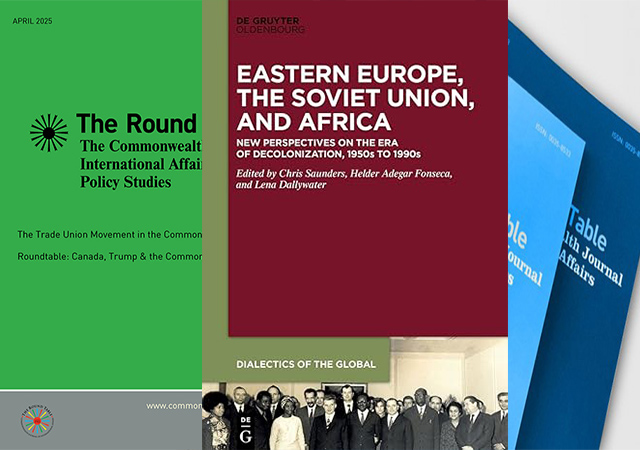
This volume makes a significant contribution to the historical analysis of the relationship between African liberation movements and governments, and the states and citizens of the Soviet Union and Eastern Europe. As the editors helpfully illustrate in the Introduction, this has been a burgeoning research field for nearly two decades: Westad’s Global Cold War (2005) inspired the rejection of a binary geopolitical rivalry of two superpower-led blocs as the basis of Cold War causation, refocusing historical research on a ‘third world’/global South initiative in shaping relations with both ‘West’ and ‘East’. Scholarship on southern African liberation movements has in particular developed an analytical, open-ended historiographical approach that seeks to explain – rather than assume from their ideological affiliation – the actions and motives of movement leaders and supporters, as well as their foreign allies.
The editors of this volume, who have themselves significantly contributed to these historiographical developments, including in a counterpart 2019 edited volume, demonstrate the continuing effectiveness of this approach here. Initial ‘East–South’ comparative analysis often benefited from the new abundance of Soviet and Eastern European archival materials but was hampered by a relative dearth of equivalent materials from the African side; this prompted innovative oral historical research, but this sometimes resulted in uneven findings that suggested an ‘Eastern gaze’. More recent work, including some chapters here, has partially addressed this problem by the identification and empathetic usage of new Africa-centred source materials uncovered from diverse origins including personal archives, and the identification of African ‘voices’ within official records.
This also enabled a welcome shift away from a focus on the institutional study of state-to-state or state-to-movement relations, and an increased emphasis on transnational flows of resources – military, financial and otherwise; people – soldiers and diplomats, but also students and cultural ambassadors such as dancers, trade unionists and sportspeople; and ideas, collegially and also combatively, on how to fight and to build a nation, but also concerning class, race and gender. All of this helps decentre high politics and ideology as causation, and focuses attention on multiple, overlapping factors – economic, psychological and emotional – for the myriad diplomatic, military, social and personal relationships that made up these historically significant relations.
This volume is divided into three main parts of 4–5 chapters apiece. Part I, ‘Lusophone Connections’, demonstrates the significant development of Lusophone African liberation historiography, and, more importantly, its integration into a broader Pan-African historiography. For historiographical, archival and linguistic reasons, the study of anti-Portuguese liberation movements’ considerable relations with the Soviet bloc has, with few exceptions, developed separately from Anglophone African analyses. These chapters demonstrate the wealth and fluidity of movement relationships: far from acting within strict ideological boundaries, leaders opportunistically sought support from a wide range of actors, and in different forms. Direct military struggle was often less important than recognition by external organisations and representation, for example in filmed propaganda and broadcasting. Helder Fonseca’s exhaustive accounting of the institutional engagements provides data showing the scale and diversity of Angolan movements’ relations with the Eastern Bloc, the effectiveness of which commonly depended on the political orientation and support of neighbouring African states, including Tanzania, Congo-Kinshasa (DRC) and Congo Brazzaville. Joāo Fusco Ribeiro (Chapter 3) demonstrates how the Sino-Soviet split of the 1960s intersected with the growing division between the Angolan liberation movements, UNITA and the MPLA, in ways that shaped their ongoing post-independence conflict. The Sino-Soviet split’s broader impact is considered by Alexandr Voevodskiy (Chapter 7). Ana Moledo (Chapter 4) provides a highly original analysis of the Lusophone movements’ engagement with the socialist-aligned World Federation of Trade Unions (WFTU) and its (under-researched) African Workers’ University in Conakry.
A particular strength of this collection is studies of a wide range of Eastern European countries. These include Yugoslavia – Alba Martín Luque (Chapter 4) documents its role in producing film propaganda for Mozambican movement Frelimo – but also Czechoslovakia: Barbora Menclová (Chapter 6) analyses the export of Czechoslovak expertise to post-independence Angola in medicine, energy supply and industry.
Miles Larmer is with the University of Florida.
Eastern Europe, the Soviet Union, and Africa: New perspectives on the era of decolonization, 1950s to 1990s, edited by Chris Saunders, Helder Adegar Fonseca and Lena Dallywater, Berlin/Boston, De Gruyter Oldenbourg, 2023.