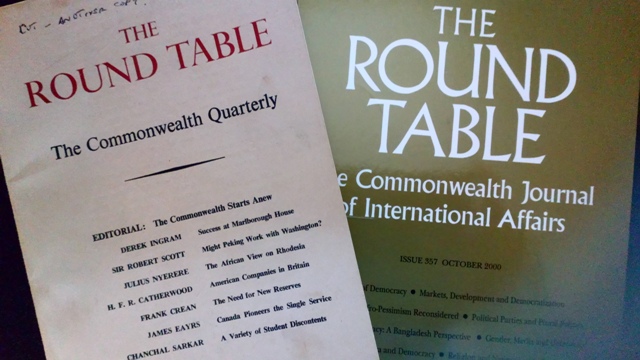
Since 1910, The Round Table journal has been providing analysis of international affairs from Commonwealth perspectives. As such, its archive provides an invaluable historical resource for those wishing to learn more about contemporary attitudes to the major international questions over more than 100 years, from the eve of the First World War to the early twenty-first century, including the transition from empire to Commonwealth, and political developments in Commonwealth member-states, often written by leading experts or practitioners.
Thanks to an agreement with the journal’s publishers, Taylor & Francis, we will be highlighting and making freely available a new article every two weeks, chosen either for its relevance to a current issue, or going back 100, 75, 50 25 years, from this archive.
Until 1966 all articles in the journal were anonymous (as was the case with many other publications at the time). However, it has been possible to identify the authors in a large number of cases, from the papers of the editorial board. For a list, see appendix F here.
To visit the full archive of the journal, click here.
NB: Articles are free-to-view for six weeks after inclusion on the home page.
The following is a list of articles selected since 2021:
Current
D.M. Davin, ‘My language and myself: English as creative power’, 66/261 (1976), 19-25
‘To the author of Beowulf, Anglo-Saxon must have seemed the very perfection of language, and all change a corruption’, observed the New Zealand-born publisher and author Dan Davin Published fifty years ago as part of a symposium on the future of the English language, Davin’s article outlined two possible fates for the English language: either it would fragment into national and regional dialects, much as the Romance languages arose from the disjected ruins of Latin, or, ‘because of its flexibility, because of the political power of some of the nations that speak it, and because of the universalizing influences of the media and of travel’, it might become ‘a single world language’.
‘India: Politics and Religion’, 16/64 (1926), 771-91
Communalist antagonism between Hindus and Muslims has been a significant, and disruptive, force in Indian politics, influencing both policy decisions and actions of political parties. This article from 100 years ago by John Coatman, a member of the Indian Legislative Assembly, discusses the intertwined role of religious identities and political affiliations – which went on to deliver partition of the Indian subcontinent and remains divisive in Modi’s India today. The author calls for ‘responsive and inclusive governance’ as the only hope for facing down communalism.
Meredith Hooper, ‘The Ignoring of Antarctica’, 85/337 (1996), 63-72
Meredith Hooper was a scholar, broadcaster, and children’s writer who, as in this article from thirty years ago, made it her life mission to raise awareness of Antarctica – not only its astounding beauty, which left her ‘with an overwhelming sense of human insignificance’ – but also for the absolute necessity for co-operation (as embodied in the Antarctic Treaty System) rather than competition in managing human activity on the frozen continent.
2026
Emeka Anyaoku, ‘Cultures of Democracy: A Commonwealth Perspective’, 89/357 (2000), 529-36
In this article from 25 years ago the Commonwealth’s recently-retired third secretary-general, Chief Emeka Anyaoku, offers an optimistic assessment of the Commonwealth’s commitment to upholding democratic values, citing the Harare Declaration of 1991 and the Auckland Declaration of 1995, alongside the Commonwealth’s good offices, capacity-building, and election observer roles. He warns however, that democracy cannot march on an empty stomach, and urges attention to the impact of poverty and underdevelopment, alongside global economic forces.
2025
Robert Colvile, ‘A Place to Stand: The Problems and Potential of the Commonwealth Ministerial Action Group’, 93/375 (2004), 343-53
On 12 November 1995 the Commonwealth adopted the Millbrook Programme, establishing a Commonwealth Ministerial Action Group (CMAG), to ‘police’ member states’ compliance with the principles of the Harare Declaration of 1991. In the article from 2004, Robert Colvile assesses CMAG’s effectiveness over its first few years. He suggests that it has some achievements to its credit, and has done far less harm than good; but faces a Sisyphean task, and is hamstrung by an unwillingness to face contentious issues.
‘A Policy for Rhodesia: direct rule by Britain’ [editorial], 56/222 (1966), 107-11
Sixty years ago, on 11 November 1965, the white settler minority regime in Rhodesia issued a Unilateral Declaration of Independence from Britain. This editorial from Leonard Beaton, describing the move as ‘disastrously wrong’, took a much harder line that the UK government of the time, arguing for the imposition of direct rule by the UK as a transition to a new multiracial constitution. In effect this is what happened in 1979-80, when Rhodesia returned to British control and then gained internationally-recognised independence as Zimbabwe.
Victor Kattan, ‘Palestine’s Membership in the Commonwealth as a Contribution to a Lasting Peace in the Middle East’, 104/3 (2015), 297-305
The Israeli-Palestinian conflict has erupted into violence on many occasions since Israel’s independence, and the problems seem as intractable as ever, with solutions agreeable to both sides hard to find. In this article from ten years ago, barrister and academic Victor Kattan suggests Palestinian membership of the Commonwealth as a stepping stone to membership of the United Nations, and as a means of coaxing both sides to the negotiating table on the basis of a two-state solution.
Alan Hutchison, ‘China in Africa: A Record of Pragmatism and Conservatism’, 65/259 (1975), 263-71
China is now a major player in Africa and in this article from 50 years ago Alan Hutchison outlines the historical background to a shift from ‘revolutionary rhetoric’ to ‘pragmatic conservative diplomacy’ in the last years of Mao’s rule. In those years China repositioned its Africa strategy from ‘subversion and pragmatism’ to focus on building state-to-state relations, from supporting armed struggle and ideological export to leveraging economic aid and development projects. This allowed China to build its influence – and later to exploit debt dependency and political leverage.
‘Nigeria: The African Giant: A Survey on the Eve of Independence’, 50/197 (1959), 55-63
On 1 Oct 1960, Nigeria, by far the most populous country in Africa, became independent and joined the Commonwealth. In this article from December the previous year, Sir Henry Willink (who had headed an inquiry into minority rights in Nigeria in 1957-8) surveyed the history of the country, its recent politics, and its prospects on the eve of independence, offering an optimistic assessment but concluding, with George Padmore, that ‘The great problem facing West Africa today is not liberation any more, but efficiency’.
‘Prospects of Federation in the British Caribbean’, 40/159 (1950), 226-32
75 years ago, all the Commonwealth countries in the Caribbean were still chafing under colonial rule, but many in Britain thought the islands too small to succeed as independent nations. In this article the British minister of state for colonial affairs in Attlee’s Labour government, Lord Listowel, describes the prospects for a Caribbean federation as ‘the shortest path towards political independence’. The West Indies Federation was inaugurated in 1958 but collapsed within four years.
‘The Irish Free State: An Ex-Unionist View’, 16/61 (1925), 29-44
100 years ago, soon after the 1921 Treaty, this former Southern Irish Unionist expresses cautious optimism about the Free State’s likely progress, highlighting the complexities of rebuilding a new nation after intense conflict and political upheaval. He discusses how other countries have faced lingering problems relating to power sharing and minority rights – resolved in the Free State but continuing in the North – alongside struggles over cultural identity, the education curriculum, and language policies.
Achilles C. Emilianides, ‘The Republic of Cyprus and the Commonwealth in the 1960s’, 111/1 (2022), 19-30
On 16 August 1960 Cyprus achieved independence from the UK, and on 13 March 1961 it joined the Commonwealth (initially for a provisional period of five years), making it, at the time, by far the smallest Commonwealth country. This article from 2022 Achilles C. Emilianides traces the change in Cyprus’s attitude towards the Commonwealth in the 1960s, from scepticism to an embrace of the opportunities the Commonwealth provided for small states to pursue their own policy objectives.
‘A Senator Sees Red: Mr McCarthy and the State Department’, 40/159 (1950), 233-39
In this article from 75 years ago, and during a previous iteration of American culture wars, veteran American journalist Erwin Canham reported on the latest twist in Senator McCarthy’s ‘anti-red’ witch-hunt in the US, attacking the State Department (much to everyone else’s astonishment) as a hotbed of Communists. Canham writes, ‘As Dr. Goebbels discovered, lies and half-truths, repeated often enough, find lodgment. Especially when nobody is effectively proclaiming the truth’.
Derek Ingram, ‘The Right to Speak Freely’, 89/357 (2000), 623-32
In this article from 25 years ago, veteran Commonwealth journalist Derek Ingram notes that, despite setting out the democratic principles to which Commonwealth member states supposedly adhered, the Harare Declaration of 1991 signally failed to mention freedom of expression. Surveying the state of the media around the Commonwealth, he detects a general deterioration in the quality of the media across the Commonwealth, with particular threats from governments seeking to control information, but also from multinationals and reliance on a few global sources of information.
‘The Problem of Sovereignty’, 65/257 (1975), 3-12
The European Union has had to wrestle with a notion of national sovereignty – state authority over its territory, and independence from external authority – harking back to the 1648 Treaty of Westphalia. This editorial from 50 years ago by Robert Jackson (subsequently a Conservative MEP and MP) finds inadequacies in the perceived, descriptive, and normative elements in the concept. In the new Europe political entities are interdependent, power distributed across multiple layers, political legitimacy to come from collectively agreed-upon ends.
‘A Commonwealth Secretariat’, 55/217 (1964), 3-5
The Commonwealth Secretariat came into existence on 1 July 1965, with Canadian diplomat Arnold Smith as the Commonwealth’s first secretary-general. In this article from the previous December Dermot Morrah, editor of the journal, anticipated the Secretariat as forming ‘the first confederal institution’ of the Commonwealth. While enumerating an ambitious programme, Morrah noted that, although based for convenience in London, ‘it is important to maintain in its working the same impulse from oversea to which its foundation responded’.
‘Achimota’, 16/61 (1925), 78-95
Debates over educational philosophy and the curriculum remain highly salient across the Commonwealth today. This article, by A.G. Frazer, is a case study of the Prince of Wales College at Achimota, Gold Coast (now Ghana), founded the previous year, illuminating contemporary colonial educational practices. Here we read of the problems of transplanting British educational models without due adaptation. The article advocates for ‘pupils [to] learn in their own vernacular’ so that they learn about the local as well as the global.
‘Russia’s Eastern Marches: Sinkiang and Tibet’, 40/160 (1950), 334-40
Until its invasion by China in 1950-51, Tibet was (although claimed by China, and a protectorate between 1720 and 1911) recognised as a de facto independent state, under the rule of the Dalai Lama. In this article published six months before the invasion (and amidst increasingly threatening noises from Mao’s China) Sir Olaf Caroe, a former member of the Indian Civil Service, examined the history of Tibet and Sinkiang against the background of geopolitical rivalries in the region, and the ‘Great Game’ between Russia and Britain for influence in the region.
Max Beloff, ‘America after Watergate: The Dangers of Constitutional Utopianism’, 65/257 (1975), 29-36
Some see the Watergate scandal as an example of how American constitutionalism works – which might be reassuring in a time when President Trump challenges its limits. However, in this wide-ranging article from 50 years ago Max (later Lord) Beloff argues that Watergate exposed the inherent vulnerabilities and unrealistic expectations of the American constitutional system. Courts functioned, impeachment processed, and a new president was peacefully installed. Yet, Beloff argues, there was executive overreach, faltering accountability, and checks and balances failures.
‘Cologne, The Security Pact and the League’, 15/59 (1925), 431-56
This article, by Philip Kerr (a former editor of the journal), looks at the critical place of Germany in Europe 100 years ago even in defeat – a debate resonating today as Germany prepares to step up re-arming in the face of Russian aggression. Here Kerr argues for the reintegration of Germany through the League of Nations and a revision of the Versailles reparations settlement, and presciently predicts that ‘there is certain to be a great internal battle between the progressive and reactionary forces in Germany’.
Richard Rathbone, ‘Casting “the Kingdome into another mold”: Ghana’s Troubled Transition to Independence’, 97/398 (2008), 705-18
The new Commonwealth secretary-general was previously Ghana’s minister for foreign affairs and regional integration. In this article from 2008 (part of a special issue on commemoration), historian Richard Rathbone describes Ghana’s independence day celebrations in 1957 against a background of the regional and political tensions and discords within the nascent independent state, concluding that the celebrations were a political triumph for Kwame Nkrumah, and important in consolidating both his power and his legacy.
Stephen Chan, ‘An Ornithology of Secretaries-General: The Commonwealth and its Leadership’, 94/380 (2005), 325-37
On 1 April Shirley Botchwey took office as the Commonwealth’s seventh secretary-general. In this article from 20 years ago, while taking into account the constraints on the role and the effects of external conditions on the nature and extent of it, Stephen Chan adopts an extended ornithological metaphor to assess the leadership styles and achievements of her first four predecessors: likening them, in turn, to a Weaver (Arnold Smith), a Bird of Paradise (Shridath Ramphal), a Hoopoe (Emeka Anyaoku), and a Kiwi (Don McKinnon).
2024
Pierre Elliott Trudeau, ‘The Commonwealth after Ottawa’, 64/253 (1974), 35-41
The 1973 Commonwealth Heads of Government Meeting was held in Ottawa. In this assessment and follow-on its host, the long-serving Canadian prime minister Pierre Elliott Trudeau, considered the role of the Commonwealth and its strengths. He placed particular value on the opportunity for heads to sit down together and share solutions and areas of agreement: ‘We should not underestimate the immense benefits which flow from talking frankly to one another, understanding better one another, eliminating areas of prejudice and irritation, helping one another’.
Ken Ross, ‘The Commonwealth’s contribution in the South Pacific’, 90/361 (2001), 555-62
In this article from 2001 New Zealander Ken Ross outlined the history of the South Pacific island states’ post-independence relationship with the Commonwealth. While highlighting some important Commonwealth contributions, he ended by echoing Arnold Smith’s observation that the Commonwealth was ‘only one of the available instruments of world politics, and sensible statesmen should choose whichever instrument is most appropriate’.
Matthew Neuhaus, ‘Renewing the Commonwealth – a reform agenda for a new Secretary-General’, 104/5 (2015), 539-49
The role of the Secretary-General is unusually important in setting the tone and agenda for the official Commonwealth. The last time that the Commonwealth chose a new holder of the office was in 2015. In this article from that year, Australian diplomat Matthew Neuhaus set out a clear and comprehensive reform agenda in terms both of aims and of organisation, much of which is even more relevant today.
Mark Robinson, ‘Choosing a Secretary-General – how do the Commonwealth and the United Nations compare?’, 106/5 (2017), 517-22
One of the key tasks of the forthcoming Commonwealth Heads of Government Meeting in Samoa will be to choose a new Secretary-General in succession to Baroness Scotland. In this article from 2017 veteran Commonwealth observer Mark Robinson compared the practices of the Commonwealth and the United Nations, and argued for greater clarity and transparency in the Commonwealth’s rules.
Chief Emeka Anyaoku, ‘The modern Commonwealth’, 100/416 (2011), 499-508
Chief Emeka Anyaoku was the third Commonwealth Secretary-General, serving from 1990 to 2000 (after a career which included many years as Shridath Ramphal’s deputy as well as Nigeria’s foreign minister). In this article from 2011 he reflected on both the challenges and the achievements of the Commonwealth, with a clear emphasis on the importance of fundamental principles and values.
‘Labour at the helm’, 14/55 (1924), 433-55
A hundred years ago the UK Labour Party formed its first, minority and short-lived, government under Ramsay MacDonald. Three months in, Percy Horsfall, a businessman with English Electric and Marconi, provided an assessment of MacDonald’s domestic and foreign policies, suggesting that ‘the voice of reason and of moderation has so far prevailed’ while highlighting numerous difficult challenges the government would have to face.
‘Is the Commonwealth a farce? An answer to “a Conservative”’, 54/215 (1964), 215-21
Sixty years ago the Conservative MP Enoch Powell (four years later to become infamous for his ‘rivers of blood’ speech on immigration) penned an article in The Times which described the Commonwealth as a ‘farce’: a mere relic of the empire, of no use to the UK, and potentially a drag on it. In this robust response, Timothy Raison (later himself a Conservative MP) set out the case for the Commonwealth.
S.C. Leslie, ‘The Israeli dimension; facing the facts’, 64/253 (1974), 25-32
In this piece written fifty years, the Australian-born civil servant S.C. Leslie focused on the historical background to how Israelis had, in his view inevitably, built up a bunker mentality in the face of a litany of dusty answers, four wars, and constant pressure by the UN, the UK, France, and the US, ‘who induced their 1956 withdrawal from Sinai under promise of future safeguards which proved inoperative’. The author quotes Mrs Meir in a speech in London: ‘it is hard to be small and alone’.
Paul D. Williams, ‘Blair’s Britain and the Commonwealth’, 94/380 (2005), 381-91
Labour came to power under Tony Blair in 1997, promising to re-set Britain’s relationship with the rest of the Commonwealth after the difficult years under Margaret Thatcher and John Major. In this article from 2005, Paul D. Williams suggests that the fanfare and solemn declarations failed to translate into concrete actions, and that the official Commonwealth remains ‘an institution relegated to the back burner’.
‘India’, 14/54 (1924), 344-62
One hundred years ago India was in turmoil as Gandhi instigated his non-co-operation movement, virtually rendering the so-called Montagu-Chelmsford constitutional reforms defunct almost at birth. Then Hindus and Muslims were united in their quest for democracy and independence. This article by the historian L.F. Rushbrook Williams captures the mood of Indians in those heady 1920s, disappointed not to receive Dominion status after joining the First World War effort.
‘Labour’s Commonwealth policy: the new look in Downing Street’, 55/217 (1964), 6-13
Sixty years ago a new Labour government came to power under Harold Wilson, facing crises over UDI in Rhodesia and a political crisis in British Guiana. In this article, George Cunningham, Labour’s Commonwealth secretary (and later a long-serving Labour MP) provided an optimistic assessment of Labour’s plans, and suggested that ‘No British government in the last half-century has come in with such a firm commitment to pursue a positive Commonwealth policy’.
Christopher Easter, ‘Small states development: a Commonwealth vulnerability index’, 88/351 (1999), 403-422
This article from 25 years ago starts with the startling fact that of the 42 independent developing countries with populations below 1.5 million at that point, 29 were members of the Commonwealth. The author goes on to show how small states are peculiarly vulnerable to economic, environmental, political and social shocks, and therefore deserving of special and differential treatment in the areas of trade and finance. The author proposes a ‘Commonwealth Vulnerability Index’ as a measure of small states’ vulnerability.
[Dermot Morrah,] ‘Crown without sceptre’, 39/155 (1949), 203-207
Seventy-five years ago, in April 1949 the Commonwealth was transformed by the London Declaration, which agreed that India would continue to be a member of the Commonwealth despite its intention to become a republic: the King was thereby transformed into ‘Head of the Commonwealth’. In this editorial (written by Dermot Morrah, a pronounced monarchist and sometime Arundel Herald) the Round Table welcomed the change as, in effect, very little change, and merely formalising what was inherent to the Commonwealth relationship.
[Colin Aikman,] ‘Samoa comes of age: the development of independence’, 51/204 (1961), 347-364
As the Commonwealth looks forward to Samoa hosting the next Commonwealth Heads of Government Meeting (CHOGM) this autumn, we look back to its independence more than sixty years ago, following its colonization by Germany from 1900 and then its administration from 1920 by New Zealand as a League of Nations then United Nations mandate. In this article Colin Aikman, a distinguished New Zealand jurist and diplomat, surveyed the background to independence, and offered a hopeful assessment for the young nation’s prospects.
Kiran Hassan, ‘The role of private electronic media in radicalising Pakistan’, 103/1 (2014), 65-81
The effects of the algorithms which lead social media users to more and more extreme content, and the role of social media in providing a platform for political extremists and the dissemination of misinformation, have become problems for all countries. In this article from ten years ago, Kiran Hassan (co-ordinator of freedom of expression and digital rights at the Institute of Commonwealth Studies) presciently analysed the role of social media in spreading extremism in Pakistan in the wake of 9/11.
Victor Kattan, ‘Palestine’s membership in the Commonwealth as a contribution to a lasting peace in the Middle East’, 104/3 (2015), 297-305
Written following the re-election of Benjamin Netanyahu as prime minister of Israel, this article highlighted the need for international pressure to breathe new life into a faltering peace process: on the one hand to persuade Israel to respect the international consensus on a two-state solution, abide by international law, and freeze settlement activity in the West Bank, and on the other to persuade Palestinians to enter into negotiations on a peace treaty. Palestinian and Israeli membership of the Commonwealth was suggested as a stepping-stone in this process.
‘Palestine: the wider hope’, 29/114 (1939), 252-277
From 1921 the UK administered the former Ottoman territories of Palestine and Transjordan as League of Nations ’mandates’. This followed the Balfour Declaration of 1917, which supported the establishment of a Jewish ‘national home’ in Palestine. By the late 1930s, communal violence between Arabs and Jewish settlers had resulted in the so-called ‘Arab uprising’. This article brought together (anonymously) contributions from Canon Charles Bridgeman (of Jerusalem), A. Alexander (of the Anglo-Jewish Association), Neville Laski (brother of Harold), and historian Arnold Toynbee; the latter (on behalf of the Round Table) advocated a federal solution in the wider region.
‘American‐European relations: the troubled partnership revisited’, 64/255 (1974), 319-30
The invasion of Ukraine left the world in a global energy crisis. The last such crisis followed from the fourth Arab-Israeli war in 1973, sparking divergences in American and European interests. This anonymous article provided an in-depth insider review of the intricate and evolving relations between the US and the EEC as they each navigated their roles in the changing global order. After Obama the gaze seems to have adjusted and a second Trump presidency may see the gulf widened – despite any shared approach to the Ukraine crisis.
Edith Penrose, ‘The oil “crisis”: dilemmas of policy’, 64/254 (1974), 135-146
The oil crisis in 1974 was triggered OPEC’s decision to restrict and control global supply. As Edith Penrose shows, it was US dependence on oil from the Middle East that prolonged the crisis, just as Europe is now dependent on Russian gas and oil and gas. Middle East countries took control of oil production in their countries in the 1970s, and the balance of power between East and West was altered. The current war may again reshape the global balance of power.
2023
Oddvar Hollup, ‘Ethnic identity, violence and the Estate Tamil minority in Sri Lanka’, 81/323 (1992), 315-338
In 1983, major ethnic riots convulsed Sir Lanka. These ethnic tensions later flared into civil war. In this article the roots of ethnic conflict in Sri Lanka are explored, with attention focused primarily on Indian Tamils (or Estate Tamils) in the aftermath of the 1983 ethnic riots. The author stresses the importance of underlying socio-economic factors, while not discounting the cultural and ideological differences that have shaped ethnic relations in the country.
John Renner, ‘The bitter aftermath of Iran’s national revolution: religious autocracy replaces the Shah’, 69/276 (1979), 284-90
Iran has again challenged democratic norms, with its brutal suppression of protests against the regime, and its supply of arms to Russia for use in the Ukraine conflict. In this article from October 1979, journalist John Renner (formerly based in Tehran) analysed the reasons why the pro-democracy intellectuals who had formed the core of the anti-Shah movement lost control to the Shi’ite clergy, such that the country ‘has drifted into an Islamic Republic nobody really knows anything about’.
[Robert Jackson,] ‘The future of the Commonwealth’, 63/249 (1973), 3-10
When the UK joined the EEC in 1973, many believed that the Commonwealth (with its previously strong trade links) might dissolve. The Round Table, in this editorial piece, argued that the Commonwealth would remain relevant, as nations became increasingly interdependent while co-operating to solve global issues. The Commonwealth, it argued, was unique – built on genuine bonds, based on shared history, and voluntary enough to survive even with the UK inside the EU.
[Robert Brand,] ‘The future of reparations and Allied debt’, 13/50 (1923), 273-88
The Treaty of Versailles forced Germany to acknowledge its ‘guilt’ in starting the First World War, and to promise vast reparations to the invaded and Allied countries. In this article from a hundred years ago (in the wake of France’s invasion of the Ruhr to secure German payments), the leading financier Robert Brand (later Lord Brand) reiterated the journal’s view that the reparations clauses were misguided, and contributed to the economic malaise the world found itself in.
E.C. Hodgkin, ‘Some reflections on a Middle East peace: is just peace lasting, or lasting peace just?’, 61/243 (1971), 383-88
After the Six Day War in 1967, the UN Security Council called for a ‘just and lasting Middle Eastern peace’. Nothing much seems to have changed more than fifty years on. Here journalist E.C. Hodgkin reminds of the complexities and divergent perspectives that were all too apparent even then. Presciently he wonders if genuine peace is possible given historical antecedents, cultural differences, and conflicting interests, and suggests prolonged truces instead, which is about where we are still, today.
Paul Arthur Berkman, ‘Our Common Future in the Arctic Ocean’, 101/2 (2012), 123-35
The melting of the Arctic ice-cap has brought to the fore numerous potential new opportunities for energy, shipping, fishing and tourism, and with it questions not only of sustainable development and environmental protection, but the law of the sea and international frameworks for peaceful regional co-operation. This article from 2012 advocates putting environmental security at the heart of the debate over the Arctic’s future.
Alan Hutchison, ‘China in Africa’, 65/259 (1975), 263-71
Much has been made of China’s growing influence in Africa, and its potential control over future supplies of scarce minerals and natural resources. In this article, Alan Hutchison takes us back to the earliest traces of Chinese influence some fifty years ago, prompted by the Sino-Soviet split, China’s Cultural Revolution, and the aftermath of the 1968 USSR invasion of Czechoslovakia. He reveals that China’s policies, even then, were pragmatic, even conservative.
[Sir Daniel Hall,] ‘Is British agriculture worth while?’, 13/51 (1923), 546-57
Since Brexit, British agriculture has had to find new outlets and new trade routes to avoid the new frictions of trade with the European Union. This article, by Sir Daniel Hall, the founder of Wye College, examined the challenges faced by the sector 100 years ago – including falling prices, reduced production, and increasing costs. Hall argued for bigger, more efficient farms that would improve productivity and wages, and a long-term, non-partisan approach to help UK agriculture recover and modernise
[A.W.A. Leeper,] ‘Revolution and counter revolution in Russia’, 10/38 (1920), 322-47
By the end of 1919, anti-Bolshevik forces in Russia had suffered significant defeats. This article by Australian diplomat Alexander Leeper provided a history of the internal conflicts, ineffective governance, and lack of clear support from the Allies that hindered the anti-Bolshevik forces. In parallel, the text discussed the complex situation in the Baltic States and the need for peace and trade relations with the new Soviet Russia in order to achieve global stability.
Freda Hawkins, ‘Migration as a Commonwealth concern’, 61/242 (1971), 253-59
More than fifty years ago a 1969 Migration Commonwealth Commission highlighted how the speed and sophistication of changes in travel and communications would change the rules and regulation of international migration across the association. Given mobile phones, trafficking, rubber dinghies, little may have changed since Canadian academic Freda Hawkins highlighted the issues. She called for nations to collaborate and view immigration through an international lens.
Evan H. Potter, ‘Canada in the Commonwealth’, 96/391 (2007), 447-463
In this article from 2007, Evan H. Potter provided an overview of Canada’s historical role in the Commonwealth and argued that Canada could, and perhaps should, take on a greater leadership role in the organisation. He acknowledged, however, that domestic public support for such a move might be difficult to generate. To judge by the intervening sixteen years, it is clear that this was perhaps a missed opportunity for Canada and the Commonwealth.
J.E.S. Fawcett, ‘British nationality and the Commonwealth: an historical survey’, 63/250 (1973), 259-269
In light of the UK’s Immigration Act 1971 and entry into the European Communities in 1973, there was much debate over the relationship between nationality and citizenship in the British Commonwealth. James (later Sir James) Fawcett, a distinguished human rights lawyer (later president of the European Commission for Human Rights) traced the history of British nationality law and the degradation of the status of Commonwealth citizenship, offering some solutions for the problems of remaining ‘dependent’ territories.
[R.H. Brand,] ‘Inflation and deflation’, 14/53 (1923), 27-45
After a period of rapid inflation during the First World War, the UK experienced a long period of deflation in the 1920s and early 1930s. In this article from a hundred years ago (and at the early part of that period of deflation, Robert Brand (later Lord Brand), the economist and banker, examined the underlying causes of deflation, suggesting that monetary policy and an overvalued pound (pegged to the gold standard) was largely to blame.
Subramaniam, ‘Unity and diversity in India: the strength of the Indian Union’, 2/248 (1972), 509-518
The centripetal and centrifugal forces in modern India have always been in constant tension. In this article from 1973, V. Subramaniam, then a professor of public administration at the University of Zambia (and later at Carleton University in Canada) identified and examined what he saw as the unifying forces, including cultural and historical as well as legal and constitutional factors, that counterbalanced the divisive forces, warning, however, that religious identity by itself could not produce unity.
Jerzy Lukaszewski, ‘The European Community and Eastern Europe: some geopolitical perspectives’, 63/249 (1973), 41-50
In this article from fifty years ago, Jerzy Lukaszewski, the exiled Polish academic and rector of the College of Europe in Bruges, examined Russian attitudes to European integration, setting Soviet attempts to undermine such integration in the context of continuities from Tsarism onwards. He notes that the USSR hoped that the entry of the UK that year would lead to a dilution of integration; and presciently pointed to the growing importance of China.
[Sir Olaf Caroe,] ‘Palestine in Asia’, 38/151 (June 1948), 643-8
On 14 May 1948 the UK ignominiously surrendered its UN mandate in Palestine (leading immediately to the first Arab-Israeli war). In this article published soon after, former governor of the North-West Frontier Province and ‘quintessential master of the Great Game’ Sir Olaf Caroe noted that ‘the atmosphere is supercharged with emotion and reason is cast out’. Anticipating the international enforcement of a truce, he lamented the absence of a federal Middle Eastern state in which Jews and Arabs could find a common home.
[Dermot Morrah,] ‘Coronation and Commonwealth, III: retrospect and prospect’, 43/172 (Sept 1953), 306-15
In this article from September 1953 – the third in a series exploring the meaning of the coronation for the empire and Commonwealth – Dermot Morrah, an Arundel Herald, waxed lyrical about the coronation of Elizabeth II, which he found ‘perfect beyond all expectation and all praise’. He nevertheless returned to his previous theme, the need for the ceremony to reflect the reality that Elizabeth was now Queen of many Commonwealth realms, suggesting a ‘crown of the Commonwealth’
[Kenneth H. Bailey,] ‘The King and his peoples’, 27/107 (June 1934), 467-84
The May 1937 coronation was originally planned for Edward VIII, but by the time it took place he had abdicated in favour of his brother, George VI. In this article, Australian law professor and international civil servant Kenneth (later Sir Kenneth) Bailey – noting how George VI had ascended to the throne by the ‘deliberate choice of the whole British Commonwealth of Nations’ – offered some suggestions for bringing the kind closer to all his subjects.
[Bernard Holland,] ‘The spirit of the coronation’, 1/4 (Aug 1911), 426-34
In this article from 1911, the civil servant and author Bernard Holland pointed to the fact that the British empire was already ‘a real Empire bound up with an alliance of independent commonwealths’, by which he meant the ‘dominions’ of Canada, Australia, New Zealand and (non-democratic) South Africa. The crown, he believed, was ‘not only the symbol, but the chief cause, of unity’.
Jerayatnam Wilson, ‘Ceylon’s (Sri Lanka’s) passage to Independence’, 88/349 (1999), 97-108
Sri Lanka became independent on 4 February 1948, as the dominion of Ceylon. (It became a republic as Sri Lanka in 1972.) In this article from 1999, Sri Lankan historian A. Jerayatnam Wilson traced the island’s path to independence, with a particular emphasis on the guarantees for the Tamil minority sought by the British government and given by the island’s first prime minister, D.S. Senanayake.
2022
[G.M. Trevelyan,] ‘Italy and the fascisti’, 13/49 (1922), 30-37
This year marks the hundredth anniversary of the rise to power of the original ‘fascist’, Benito Mussolini. In this report for the Round Table, the eminent liberal historian G.M. Trevelyan sought to explain the collapse of democracy and rise of fascism in Italy, attributing some of the blame to the way Italy had been treated by the UK and its allies. Like most contemporaries he was, as we now know, seriously deluded about the nature of fascism.
Richard Benwell, ‘The canaries in the coalmine: small states as climate change champions’, 100/413 (2011), 199-211
In a year in which climate change has made itself felt through numerous extreme weather events, small states (which comprise the vast majority of Commonwealth member states) are still looking for real progress on climate change, which in some cases threatens their very existence. In this article environmentalist Richard Benwell examines small states’ strategies for engaging in international negotiations to mitigate climate change, suggesting they are ‘norm-entrepreneurs’.
[Robert Jackson,] ‘Editorial: the British general election: democracy and inflation’, 64/254 (1974), 123-132
The last ‘great inflation’ in the UK, and indeed more globally, was in the 1970s. This was triggered by the OPEC oil price increase of 1974, and saw price rises as high as 27%. Today oil and gas prices have shot up again in the wake of the Ukraine invasion and Russia ‘weaponising’ energy. This article explores that inflationary economic turmoil of the early 1970s and its impact on our political processes. Could these be avoided as we try to stem the current bout of ‘great inflation’?
Mélanie Torrent, ‘Common grounds? Strategic partnerships for governance in the Commonwealth of Nations and the Organisation Internationale de la Francophonie’, 100/417 (2011), 605-21
At the Kigali summit in June 2022, Gabon and Togo joined the Commonwealth as its 55th and 56th members, following Mozambique and Rwanda as countries which had no colonial connection with the UK, and bringing to twelve the number of countries which are full members both of the Commonwealth and of La Francophonie. In this article from ten years ago, Mélanie Torrent looks at the consonances, shared aims, and shared challenges and opportunities of the two organisations.
Richard Herr, ‘Australia, security, and the Pacific Islands: from empire to Commonwealth’, 95/387 (2006), 705-16
Chinese ambitions in the Pacific have underlined both Australia’s security concerns and its close ties with the US and the UK. In this article from 2006, political scientist Richard Herr examines the Commonwealth context of Australia’s Pacific policy since the Second World War, and concludes that its hegemonic ambitions and strong ties with the US undermined prospects for a broader framework for regional security.
[Peter Kirk,] ‘United Kingdom: the Macmillan era ends’, 54/213 (1963), 63-74
Almost 60 years ago, another Conservative PM was forced from office in the UK after a moral crisis. Harold Macmillan resigned as UK premier in the wake of the so-called Profumo Affair, a historical echo, perhaps, of the ‘party-gate’ scandals which undermined Boris Johnson. This article, anonymous but by Conservative MP Peter Kirk, discusses Macmillan’s divisive premiership and his lack of judgment in dealing with his War Minister’s misconduct.
Saman Kelegama, ‘Transforming conflict with an economic dividend: the Sri Lankan experience’, 94/381 (2005), 429-442
There have been tears and conflict in the south Asian state of Sir Lanka this year, as the country struggles to find a way out of the current economic and political crises. Going further back, Saman Kelegama here discusses earlier conflict between the Tamil LTTE movement and the Government in the early 21st century, the failure to deliver the expected peace dividend and institutional weaknesses. Were these lessons learned?
Nicholas Bayne, ‘Britain, the G8 and the Commonwealth: lessons of the Birmingham summit’, 87/384 (1998), 445-57
The Commonwealth Games – the ‘friendly games’ – take place this year in the Midlands city of Birmingham, once known as a ‘workshop of the world’ with iconic brands known all over the Commonwealth such as HP sauce, Birds Custard, Typhoo Tea, Bourneville hot chocolate and Cadbury chocolate all produced there. This article harks back to a previous major gathering of the G8 in Birmingham, linked to the previous year’s CHOGM (Commonwealth Heads of Government Meeting) in Edinburgh. Both looked at the dangers posed by the ‘new’ globalisation, and shared concerns over India’s nuclear testing programme – still concerns today.
Stephen Chan, ‘Three birds of different feathers: the Commonwealth, the Commonwealth Secretary-General and the Commonwealth Secretariat’, 73/291 (1984), 299-310
Patricia Scotland was re-elected Commonwealth Secretary-General for another two years at the Kigali Commonwealth summit in June 2022. This early piece from now veteran Commonwealth-watcher Stephen Chan analysed her first three predecessors, using an avian analogy for each. What bird he would choose for the Secretaries-General who succeeded is an open question.
Stuart Mole, ‘Glasgow, the referendum and the Commonwealth Games’, 103/5 (2014), 453-55
With the Commonwealth Games opening in Birmingham on 28 July, we look back to two previous occasions when cities in the UK hosted the Commonwealth Games: Edinburgh in 1986 and Glasgow in 2014. In this commentary, Stuart Mole weaves together the sporting, political and Commonwealth contexts of the two contrasting Games: in 1986 when they faced near-bankruptcy, and in 2014 when their success gave a fillip to the movement for Scottish independence.
Yashpal Tandon, ‘The Organisation of African Unity’, 62/246 (1972), 221-30
Fifty years ago, preparations were being laid for the Organisation of African Unity, which was formally launched in Addis Ababa the following May, with 32 signatory governments. Although often criticised as a talking shop, the OAU was the first African intergovernmental organisation, aiming to eradicate colonialism and neo-colonialism and promote economic integration, and laid the foundations for its successor, the African Union. In this article Yashpal (Yash) Tandon assessed the challenges for the nascent institution.
Amelia Hadfield, ‘Notes from a CHOGM novice’, 97/394 (2008), 35-45
As we approach the Rwanda Commonwealth Heads of Government Meeting, we look back to the last time an African country hosted a CHOGM, Uganda in 2007. In this article, ‘CHOGM novice’ Amelia Hadfield took the measure of the meeting, and of what it represented both for Uganda and for the Commonwealth, emphasising how important the role of the host country can be.
Mark Robinson, ‘Choosing a Secretary-General – how do the Commonwealth and the United Nations compare?’, 106/5 (2017), 517-22
One of the key tasks of a Commonwealth Heads of Government Meeting is to choose a new Secretary-General, or to confirm the incumbent in the role. It is often said that the process for choosing a Commonwealth Secretary-General is less transparent than that for choosing a Pope. In this article from 2017 Mark Robinson compares the practices of the Commonwealth and the United Nations.
Sir Peter Marshall, ‘The Queen’s diamond jubilee: giving thanks and looking forward’, 101/3 (2012), 213-19
As we mark the Platinum Jubilee, we revisit this article from ten years ago, in which Sir Peter Marshall, a long-serving senior diplomat and Commonwealth official, offered personal reflections on the Queen’s reign and her role as head of the Commonwealth. Emphasising the theme of service, he also suggests that she has been the Commonwealth’s unifying force.
[Dermot Morrah,] ‘The coronation and the Commonwealth’, 42/168 (1952), 297-304
The Queen is of course head of the Commonwealth as well as monarch of many of its member countries. In this article published at the beginning of her reign Dermot Morrah (an ‘Arundel Herald’ as well as editor of the Round Table journal) gave a history of the coronation service, and suggested various ways in which it could be changed to reflect the Commonwealth dimensions of her role. In later articles, he called for a peripatetic monarchy, spending time in each Commonwealth realm.
[Philip Kerr,] ‘India and the empire’, 2/8 (1912), 587-626
In this article from 100 years ago (and following on from the durbar of the previous year), Philip Kerr (Later Lothian) considered the past and future place of India in the British empire. While the underlying racism and whitewashing of British rule will jar with all modern readers, the article was in some ways remarkable for its time in envisaging the inexorable growth of Indian self-government (albeit, as Kerr hoped, within the empire).
Bharat Wariavwalla, ‘Religion and nationalism in India: Ram the god of the Hindu nation’, 89/357 (2000), 593-605
The rise of Indian Prime Minister Narendra Modi’s Bharatiya Janata Party continues relatively unchecked since he swept to power in 2014 with its brand of Hindutva, or Hindu majoritarianism and nationalism. The recent new Citizenship Amendment Bill, which provoked riots and occupations, gave Hindu migrants rights, but not Muslims, the first example of discrimination in Indian law since independence. Such a rise of Hinduism was discussed in this article by Bharat Wariavwalla back in 2000.
Neville Brown, ‘A war against warming?’, 80/320 (1991), 445-53
‘The jury is still out’ on COP 26 in Glasgow which dominated UN climate change talks last year. Was there sufficient agreement to reduce global temperatures – especially without the express agreement of President Xi of China and Prime Minister Modi of India? With so many Commonwealth member states at risk, the debates remain critical today. Yet, the warnings about global warming were clear more than thirty years ago, as this article by Neville Brown shows.
[Lionel Curtis,] ‘A German of the resistance: the last letters of Count Helmuth James von Moltke’, 36/143 (1946), 213-31
A new film, Munich, was released earlier this year, based on one of Robert Harris’s intriguing novels set at the time of the Munich Agreement, the high (or low) point of Prime Minister Neville Chamberlain’s policy of appeasement. One of the central characters, Paul von Hartmann, an Oxford-educated aristocratic anti-Nazi, bears a resemblance to several real-life people including Helmuth James von Moltke, executed by the Nazis in January 1945, and here remembered by his friend Lionel Curtis.
Dev Murarka, ‘The Russian intervention: a Moscow analysis’, 71/282 (1981), 122-39
With more than 100,000 Russian troops massed on the Ukraine border, poised for invasion, it is worth looking back to an earlier Russian invasion, this time of Afghanistan in 1980 which provoked a number of articles in the Round Table including an editorial which talked of the ‘perilous’ shattering of the balances in the area, leaving Russian forces on the Pakistan border. However, the journal also published an article by Dev Murarka, who explained the ‘intervention’ from the Kremlin viewpoint.
2021
Ben Pimlott, ‘Some thoughts on the Queen and Commonwealth’, 87/347 (1998), 303-05
In 2022 the Commonwealth celebrates 70 years of Queen Elizabeth’s headship of the association. In this article from 1998 historian and royal biographer Ben Pimlott examines the Queen’s role in defining the headship, and in exercising an informal influence in its favour. He notes that her ‘political mistakes’ have almost entirely been in the domestic political arena, while her ‘constitutional-cum-political achievements’ have all been in the Commonwealth context.
Lord Howell, ‘The Commonwealth: a global network for the 21st century’, 100/414 (2011), 251-55
Successive British governments have blown hot and cold over the Commonwealth, but some politicians have consistently recognised and argued for its potential. One of these, David Howell (Lord Howell), argues, in this article from ten years ago, that the Commonwealth is an association made for the twenty-first-century world of networks and soft power. Whether the current UK government shares his vision is, alas, doubtful.
Michael Goldsmith, ‘Diplomatic rivalries and cultural one-upmanship: New Zealand’s long quest to become more Pacific than Australia’, 106/2 (2017), 187-96
The AUKUS pact (involving Australia but excluding New Zealand) has highlighted the differences between Australian and New Zealand approaches to the security concerns of the Pacific region. In this article, anthropologist Michael Goldsmith looks at the cultural underpinnings of New Zealand’s different approach to the Pacific, and subjects them to critical scrutiny.
Wang Gungwu, ‘The inside and outside of Chinese history’, 62/247 (1972), 283-95
The rise of China is now a given as we prepare for what international relations experts call a bi-polar world. But it was not always so. Chinese historians, back to Confucius, described a country with an interior view, and indeed the West for centuries only saw ‘a weak’ China. Here, historian Wang Gungwu tracks the key changes as Mao and his successors prepared the way for a newly ascendant, ‘universalist’ China.
[Dermot Morrah,] ‘Five speeches on world government’, 36/142 (1946), 117-26
At a time when nationalism is in the ascendant and international organisations are under attack from many sides, it is worth reflecting on how contemporaries viewed world problems 75 years ago, as they emerged from the horror of the Second World War. In this article, the Round Table’s editor draws together several recent speeches in favour of a decisive move towards a limited and democratically-elected world government.
‘France’, 6/24 (1916), 652-87
Napoleon Bonaparte, who died 200 years ago, put his country back at the forefront of global affairs where it remains today. It has been said that France is governed as much through the legacies of its philosophers (from Descartes to Montaigne to Rousseau) as of its kings, emperors, and politicians. How French thought shaped the national culture is traced in this fascinating article written at the height of the First World War.
Shridath Ramphal, ‘Nigeria’, 85/337 (1996), 9-12
Nigeria was suspended from the Commonwealth in 1995 after its military regime executed Ken Saro–Wiwa and ten others. In this speech, Shridath Ramphal (Secretary–General of the Commonwealth, 1975–90) makes an eloquent case for international action against military and undemocratic regimes. Nigeria was re-admitted to the Commonwealth in 1999 following the transfer of power to the democratically elected president, Olusegun Obasanjo.
Peter Shore, ‘Labour, Europe and the world’, 63/252 (1973), 425-35
After Brexit, just how is Britain faring? To many, Boris Johnson’s dream of a new ‘Global Britain’ and refreshed Commonwealth relations seem somewhat unrealised. Here, in the immediate aftermath of the UK joining the European Communities, Peter Shore, Labour’s Shadow Chancellor of the Exchequer, warns against simple ‘shortcuts to prosperity’, and argues that Britain should instead seek stronger Commonwealth ties.
[Lionel Curtis,] ‘Ireland’, 11/43 (1921), 465-534
Few journal articles can have had as much impact as this one by Lionel Curtis, published at the height of the war for Irish independence. Despite its patronising and even racist language, the key message of the article – that Ireland should be divided, with the south given the same degree of self-government as Canada – profoundly influenced Lloyd George, who appointed Curtis his adviser on Ireland in the subsequent negotiations.
Derek Ingram, ‘CHOGM diary’, 99/406 (2010), 23-26
The next CHOGM was expected in Rwanda, amid some degree of controversy. In this diary we can look back to a time when a CHOGM had true global impact and for all the right reasons – at 2010 in Port-of-Spain, Trinidad, when even French Prime Minister Nicolas Sarkozy attended. Derek Ingram, a veteran Commonwealth journalist, sets the scene – and notes Rwanda, a former Belgian colony, joining.
Philip Murphy, ‘Britain and the Commonwealth: confronting the past – imagining the future’, 100/414 (2011), 267-83
Britain’s relationship with the Commonwealth has always been complicated by its imperial past. In this inaugural lecture as director of the Institute of Commonwealth Studies, Philip Murphy traces the ups and downs of the UK’s engagement with the Commonwealth, and suggests that the Commonwealth provides the key to the UK making something positive and constructive out of its disturbing imperial past.
Bruce Matthews, ‘Myanmar’s agony: the struggle for democracy’, 82/325 (1993), 37-49
Dramatic and heart-rending images of the struggle for democracy in Myanmar (a former British colony but not so far a member of the Commonwealth) have filled our screens in recent months. The army seized power in 1962, and the struggle against the military junta dates back more than thirty years. Here Bruce Matthew tracks the origins of this struggle, with insights on the obstacles that the opposition to military rule has faced.
The RoundTable: The Commonwealth Journal of International Affairs