
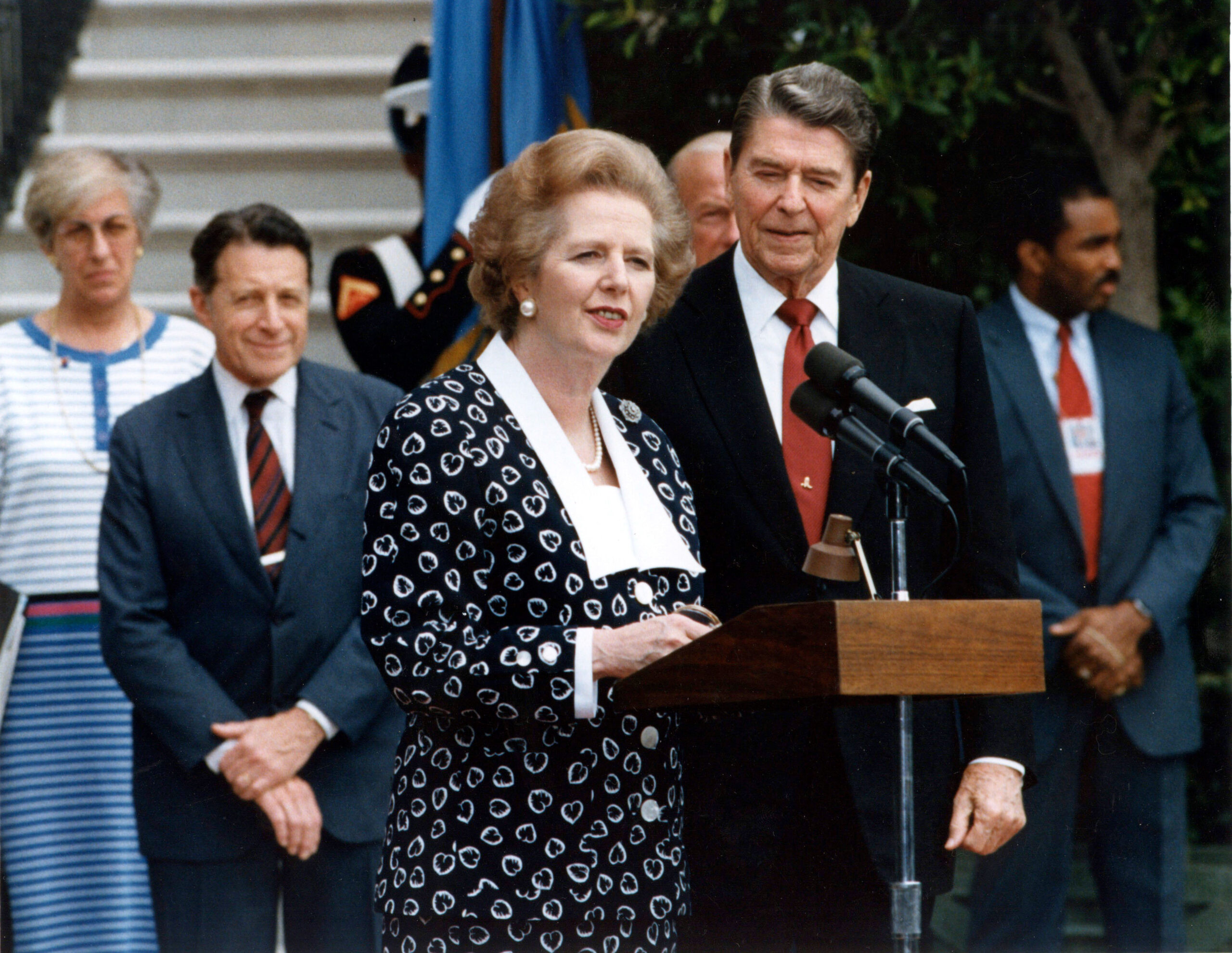
 June 1987: British Prime Minister Margaret Thatcher delivers remarks at the White House after meeting with President Ronald Reagan in June 1987 in Washington. At left is Secretary of Defence Caspar Weinberger. [photo: Alamy/ Linda D. Epstein/MCT]
[This is an excerpt from an article in The Round Table: The Commonwealth Journal of International Affairs and Policy Studies.]
Before the Argentine invasion, the Islanders had repeatedly expressed to the British government their desire to remain under British administration. The principle that the Islanders’ wishes were paramount became a central theme in British discourse and was repeatedly emphasised in various contexts, to underline the idea of Britain as a ‘protector of democracy’. This argument was further reinforced by appeals to international law, particularly the principle of self-determination embodied in the United Nations Charter. In his instructions to Anthony Williams, the UK Ambassador in Buenos Aires, Michael Fearn, head of the FCO South America department, underscored this position, stating: ‘The Islanders have the right to determine their own future’.Footnote18
This idea reappeared during the Anglo-Argentine talks in New York. The notion of protecting the Islanders’ right to choose their political future on the grounds of fundamental democratic principles was also prominent in external communications, such as Thatcher’s letters to Members of Parliament in response to inquiries regarding her Falklands policy. It was equally present in internal government discussions, including the Defence and Overseas meetings, where Thatcher succinctly summarised the British stance: ‘They [the Islanders] should be fully supported’.Footnote19
Once the decision to deploy the fleet had been made, the British argument for protecting democracy became less prominent, while the protection of international law emerged as Britain’s primary justification. This shift was particularly evident after the adoption of United Nations Security Council (UNSC) Resolution 502 on 3 April 1982, which demanded Argentina’s complete withdrawal from the Falklands. This was followed by Resolution 505 on 26 May, which called on both Britain and Argentina to agree to a ceasefire before negotiations could proceed. As Argentina refused to comply, it became necessary for a party to enforce these resolutions – a role that Britain asserted as its responsibility. This justification was captured in the argument that the conflict was not merely about the Falklands but about upholding a fundamental principle of international order: ‘Whether or not naked aggression should be allowed to succeed … [therefore the] aggressor must not be permitted to benefit from his aggression’. This argument further evolved into a broader geopolitical warning, emphasising that the stakes extended far beyond the fate of the Islanders: ‘More important than the fate of the Islanders. If Argentina were not stopped, it would be a disastrous precedent for the world as a whole’.Footnote20
In her discussions with other heads of state and government, Thatcher consistently framed the Falklands conflict as a broader struggle for the rule of law. She argued that Britain’s failure to defend the Falklands would set a dangerous precedent, placing many smaller nations at risk, as no one would come to their aid. Additionally, she warned of heightened global tensions should the UK fail to uphold international law. As she told Cameroon’s President Ahmadou Ahidjo on his visit to London: ‘If this rule over boundaries, which was accepted the world over, were to be overturned, it would be a recipe for chaos. Many other countries and islands around the world would live in fear of invasion’.Footnote21 Thatcher delivered the same message to Reagan, particularly when he attempted to convince her to halt the fleet.Footnote22 This rhetoric reflects a recurring hero-villain narrative, but this time within a status and symbolically driven framework. In this portrayal, Reagan’s reluctance to fully support Britain positioned him as the villain who was endangering international law, while Thatcher assumed the heroic role of its defender.
Thatcher’s rhetorical commitment to democracy and international law seemingly conflicts with her relationship with the authoritarian General Augusto Pinochet of Chile. This relationship was underpinned by ideological affinity: both were staunch anti-communists who had come to power in the wake of economic chaos and believed in using strong state power to enact free-market reforms. During the Falklands War, the value of this relationship was intensely pragmatic and instrumental. Pinochet provided critical intelligence and logistical support to Britain, allowing British aircraft to use Chilean airstrips for reconnaissance missions. Given the strategic necessity of Chilean assistance, Thatcher’s alignment with Pinochet was, in this specific context, a calculated decision. This reflects a recurring pattern in foreign policy, where moral rhetoric is often tempered by strategic necessity, and pre-existing ideological alliances are activated to serve immediate material needs (Kornbluh, Citation2013; Phythian, Citation2001).
Launch of The Round Table Special Section – ‘Falkland Islands: 40 years on’
America and Britain: Was There Ever A Special Relationship?
Whither the special relationship?
Conclusion: implications for political communication today in times of war
By mid-May 1982, the United States had shifted from cautious neutrality to active support for Britain’s campaign in the South Atlantic. It began providing intelligence, military equipment and access to strategic facilities. This shift was not automatic; it was in very large part the product of sustained political communication at the highest level, aimed at persuading a hesitant ally to take sides in a distant conflict. The Falklands crisis thus offers a revealing case of how leadership under pressure can shape alliance behaviour through discourse rather than coercion.
This article has explored how No.10, under Prime Minister Margaret Thatcher’s leadership, constructed a strategic narrative framework that blended empirical claims with emotional and moral appeals. In doing so, it effectively reframed the war not merely as a colonial dispute, but as a test of Western resolve and alliance credibility in the Cold War. Emotional resonance, often overlooked in studies of international diplomacy, proved essential in forging a sense of shared responsibility between London and Washington, as it empowered pro-UK elements within the Reagan administration, providing them with the necessary rationales to win the internal policy battle and secure crucial support for Britain.
The Falklands episode reminds us that even in close alliances, persuasion is not guaranteed. Strategic alignment alone is not enough. It must be supported by compelling narrative work, especially when the conflict’s stakes seem unevenly shared. Contemporary efforts by President Volodymyr Zelensky and Prime Minister Benjamin Netanyahu to secure sustained US backing in the Ukraine war and the Gaza/Iran conflict, respectively, echo Britain’s challenge in 1982. Both leaders face an American administration that is deeply entangled in domestic political divisions and which has shifting global priorities. Like Thatcher, they must construct narratives that resonate with American strategic and moral concerns, but in a far more fragmented and contested communications environment, as well as a more unstable and fraught international system.
Even among longstanding allies, support may not materialise without strategic and emotionally resonant communication. For smaller or mid-sized powers aiming to influence reluctant partners, persuasive leadership discourse is essential. When framed in terms familiar to an ally’s values and priorities, it can be as critical as material leverage. As Commonwealth states and their partners navigate an increasingly multipolar and fractured international order, the ability to frame crises in ways that generate shared responsibility will remain a vital diplomatic asset.
Matthieu Grandpierron is an Associate Professor, Department of Political Science, ICES, la Roche sur Yon, France, Researcher, Ecole Polytechnique, Palaiseau, France.