 [map: Zoonar GmbH/ Alamy]
[This is an excerpt from an article in The Round Table: The Commonwealth Journal of International Affairs and Policy Studies. Opinions expressed do not reflect the opinion of the editorial board.]
‘America First’ is a nationalist diplomatic doctrine that emphasises President Donald Trump’s economic and strategic interests over global or multilateral concerns. Under this mindset, Trump’s administration launched a volley of protectionist measures – notably through tariffs – that have reverberated across the globe. The broad use of tariffs as a weapon has upended long-standing coalitions and prompted concerns about the nature of the United States’ obligations to global trade organisations, especially the World Trade Organisation (WTO).
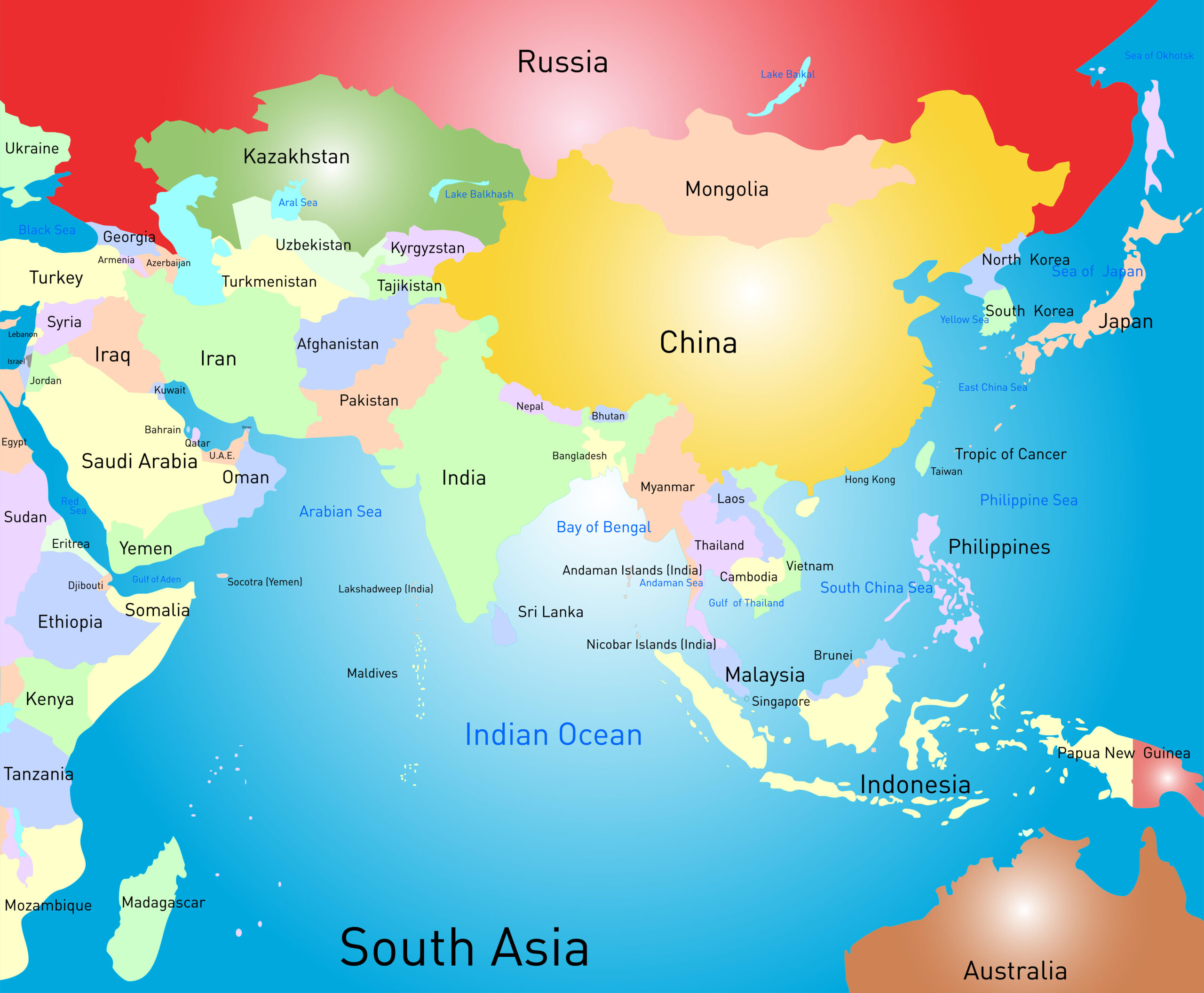
Although the primary targets of this planned doctrine were China and the European Union, the widespread impact of Trump’s trade policies has now affected the developing economies of Commonwealth countries, bringing about new changes in trade relations, supply chains and strategic alignments. This created significant uncertainty for Commonwealth nations, particularly in South Asia: Bangladesh, India, Maldives, Pakistan and Sri Lanka, which had long relied on predictable access to Western markets, particularly the United States and the United Kingdom.
Among South Asian Commonwealth countries, India was initially poised to benefit the most from the alteration in global industrial networks triggered by the US ‘tariff bomb’. But the situation changed suddenly after the India-Pakistan military conflict in the first week of May. On 10 May, Trump publicly claimed that he had brokered a ceasefire between the two countries by luring them with potential trade concessions. When India publicly rejected this claim, the Trump administration pressed for a trade deal on its terms. After several rounds of failed talks, on 31 July, Trump announced a 25% tariff on India. Less than a week later, on 6 August, Trump announced an additional 25% tariff on India, adding oil imports from Russia. This took the combined tariff rate to 50%.
India accounts for 2.7% of US imports, while other South Asian Commonwealth countries, including Bangladesh, Pakistan, Sri Lanka and the Maldives, account for less than 1% of US imports individually. Apart from India, the Trump administration has also imposed tariffs ranging from 10% to 20% on other South Asian Commonwealth countries (BBC Visual Journalism team [BBC], Citation2025).
Trump’s tariffs: An opportunity or challenge for India
India in the age of Trump’s return: strategic autonomy beyond the binary
Bangladesh, the world’s second-largest garment exporter behind China, has negotiated a 20% tariff on shipments to the United States, down from the 37% initially announced by Trump, and which provides some comfort to its exporters. However, the US tariffs have disrupted Bangladesh’s readymade clothing sector, and there are acute concerns about losing viability in one of its main markets. Bangladesh’s economy relies heavily on the readymade clothing industry, which generates over 80% of its total export revenues, employs approximately 4 million people, and contributes approximately 10% to the country’s GDP. The fact that the increased tariffs are consistent with those imposed to other major garment exporting countries, including India, Sri Lanka, Vietnam, Pakistan, and Indonesia is small comfort (Paul, Citation2025).
Pakistan’s trade relationship with the US is relatively modest. Pakistan, unlike India, managed to maintain its Generalised System of Preferences (GSP) status and escaped tariff retaliation. Even Pakistan’s export volumes to the United States – primarily textiles and garments – remained largely unaffected during the trade conflict. Trump has reduced the initial tariff on Pakistani imports from 29% to 19%, giving Pakistan a significant competitive advantage in basmati rice exports. Because the Trump administration increased the tariff rate on Indian shipments up to 50%, Indian grain became 31% more costly. India exports almost 300,000 tonnes (worth US$350 million) to the US per annum, and the heavy tariffs may hit exporters hard while giving Pakistan – another big supplier with a 19% levy on its goods – a vital advantage (Nibber, Citation2025). However, the bigger issue for Pakistan is the indirect economic fallout. With global trade slowing and investor confidence rattled, Pakistan’s already fragile economy is facing additional headwinds.
The US administration has reduced the tariff rate on Sri Lanka, a nation still in the process of rebuilding after the economic collapse of 2022, from the initial 44% to 20% from 7 August 2025. These tariffs are making it difficult for many of the country’s garment factories to continue business, but the reduction will definitely provide some relief (Buchwald, Citation2025; Press Trust of India, Citation2025). The United States is Sri Lanka’s largest garment buyer, generating more than 40% of overall exports in the industry. Whereas Sri Lanka has had strong ties with China and India over the past few years, these nations cannot immediately provide an alternative market to American purchasers. In this scenario, the potential of order cancellations, unemployment and increased debt load in Sri Lanka remains a distinct possibility.
The Maldives is also facing adverse effects of the levy of 10% tariffs by the Trump administration. The Maldives’ primary export to the United States is seafood, especially tuna. If the US raises tariffs further, or stretches them to other areas beyond seafood, Maldivian businesses selling products or services may need to reconsider their market strategies (Trade, Citation2025).
The overall impact of US tariffs on the Commonwealth nations of South Asia whose export-orientated sectors such as textiles, agriculture and manufacturing employ millions, has been order cancellations, factory slowdowns, and job instability. The extensive influence of these American protectionist measures on their economies and societies transcends the official economy, impacting informal labourers, minor suppliers and local consumer trends. However, building new business alliances, updating production standards and satisfying alternative market regulations require time and investment. Global protectionism, especially during the Trump’s second administration, has revived debates over whether South Asian Commonwealth nations should form an ASEAN-like economic structure. SAARC and BIMSTEC offer some collaboration, but their ineffectiveness shows the need for a more unified, economically focused union.
Manoj Kumar is with the Department of Journalism and Mass Communication, University of Allahabad, Prayagraj, India & Manish Sachan is with the Department of Journalism of Mass Communication, Manipal University Jaipur, Jaipur, India.