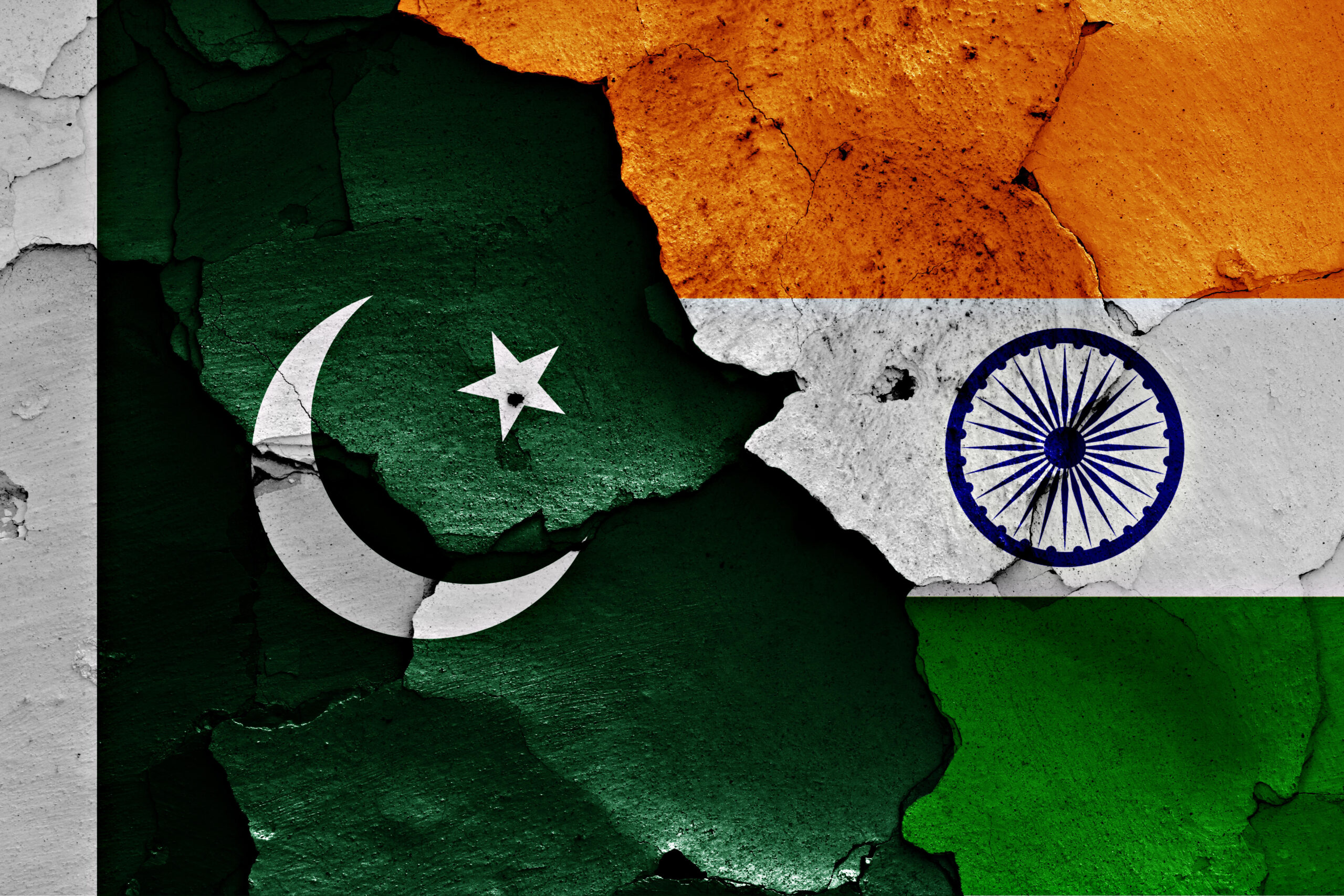
 [photo: Zoonar GmbH/ Alamy]
[This is an excerpt from an article in The Round Table: The Commonwealth Journal of International Affairs and Policy Studies. Opinions expressed do not reflect the position of the Round Table editorial board.]
It might seem eccentric, if not perverse, for a maverick like me to plead for peace when Operation Sindoor, India’s military response to Pakistan-sponsored terror, stands ‘paused’ rather than terminated and will, says the Government of India, be resumed if there is another terror strike.
I elaborate this plea for peace in terms of my personal experience of Pakistan which began with my appointment as India’s first-ever Consul-General in Karachi (1978–82) where I made so many friends that in the last 43 years since I returned from my post in Karachi, I have made at least 40 visits to Pakistan. My perspective is, therefore, imbued with my half-century of interaction with Pakistanis, high and low, stretching across the spectrum of politicians of every political hue, civil servants and diplomats (for whom I have the highest regard), journalists, writers and artists, businessmen from tycoons to humble shopkeepers, the hundreds of thousands of applicants for Indian visas, and stretching even to (mostly retired) military officers. This has led to my long-held view that the people of Pakistan, filled with goodwill towards us as a people, constitute our single biggest – if, alas, unused – asset. But that goodwill dissolves into ill will whenever it encounters Indian hostility, so it is a fragile asset that needs to be nurtured and handled with care and sensitivity, a difficult task in the midst of so much distrust between the two governments.
Although I have hardly ever been involved in official negotiations, I have been a colleague of most of the negotiators involved, on both sides, both political and diplomatic, over the past five decades and picked up a lot from them. As such, I am impressed at the speed with which we can conclude negotiations when there is a will to do so, as also the speed at which negotiations can be disrupted when that is the objective. This gives India-Pakistan relations the flavour of a game of snakes-and-ladders where ladders are as readily available for rapidly climbing to consensus as there are snakes present to swallow whatever progress has been made and return both countries – poisoned – to the point of departure.
India-Pakistan relations
The only way we can work out a via media to a stable and harmonious relationship is not through bitter or armed confrontation but through structured dialogue that is ‘uninterrupted and uninterruptible’. For when it is disrupted, it takes years to start again and instead of past progress kickstarting further progress, we start all over again – and break off the connection sooner than later. Notwithstanding this, the record shows the fruitful consequence of engaging with each other. Three examples should suffice. One, the 1960 Indus Waters Treaty (IWT) which survived several wars until India held it ‘in abeyance’ on the eve of Operation Sindoor after 65 years of continuous operation. Second, the 1972 Simla agreement that, in effect, removed the Kashmir issue from the ambit of multilateral forums and brought it into strict bilateralism, now held ‘in abeyance’ by Pakistan in retaliation for India doing the same with the IWT. And third, the 2007 Musharraf-Manmohan formula for rendering the Line of Control (LOC) in Kashmir ‘irrelevant’ by permitting and promoting people-to-people contact among Kashmiris across the LOC. The formula was negotiated via a backchannel and, but for the internal issue of President-cum-Chief of Army Staff Pervez Pervez Musharraf getting entangled with his Chief Justice, would have been signed into operation by the two heads in March 2007.
These accords were the outcome of agonised but unimpeded negotiations between the two countries. Moreover, they were concluded when the Pakistan presidency was in the hands of the military: Field Marshal Ayub Khan in 1960; the Chief Martial Law Administrator, as Zulfiqar Ali Bhutto styled himself, in 1972; and General Musharraf, when the backchannel functioned between 2004 and 2007. We can, therefore, conclude that we can negotiate successfully with military or military-controlled regimes provided talks take place with persistence.
The strategy of ‘Talks and Terror can’t go Together’ has not eliminated terror attacks on India and might, indeed, have enhanced the ‘terrorism mindset’ in Pakistan. Operation Sindoor, now paused and to be resumed whenever the next terrorist slips through our defences, has the unfortunate collateral damage of making the terrorists the primary arbiters of peace and war on the subcontinent. Refusing to talk with the Pakistan government unless and until they demonstrate definitively their distancing themselves from terrorist networks does little to rein in either the terrorists or their backers. The answer to terrorism lies less in a hopeless quest to get Pakistan to restrain them than in strengthening our domestic intelligence and homeland security arrangements, as the US did after 9/11. We have destroyed terrorist buildings and other physical infrastructure but not the terrorist mind or motivation. Physical infrastructure can easily and inexpensively be rebuilt, the ranks of dead terrorists quickly replaced, and terror training resumed. India’s very military successes have the unintended consequence of strengthening the army’s hold on the Pakistan government and the Pakistan popular imagination, as witness the promotion to Field Marshal of hardliner Asim Munir. We may be more, not less vulnerable to Pak-based, Pak-supported and Pak-sponsored terrorism.
The way out of this cul de sac is to decide, as mature nuclear weapon powers, to restart and intensify bilateral negotiations on the most urgent issues that divide us. The divisions are real.
Mani Shankar Aiyar is an Indian career diplomat (1963–1989), ), including as Consul General, Karachi (1978–1982); member of parliament [Congress Party] (1991–2016), & Cabinet minister (2006–2009); author & columnist (currently for Frontline of Chennai).