
 Source: https://data.worldbank.org/indicator/SI.POV.GINI
[These are two excerpts from an article in The Round Table: The Commonwealth Journal of International Affairs and Policy Studies.]
Economic inequality has become a major threat to democratic nations across the world. On 3 July 2025, the US Congress passed the One Big Beautiful Bill Act (OBBBA), which included cuts to Medicare, Medicaid, and the Supplementary Nutrition Assistance Program (SNAP) from the American budget (Phaneuf, Citation2025). This was matched by the attempt by Germany to reduce the benefits for Ukrainian refugees (Hirunews, Citation2025), the increase of the pension age in France (The Guardian, Citation2025), and the United Kingdom’s decision to cut its welfare budget (apnews.com, Citation2025), signalling that nations are willing to transfer funds from welfare to the capitalist economy, and to strengthen their defence systems.
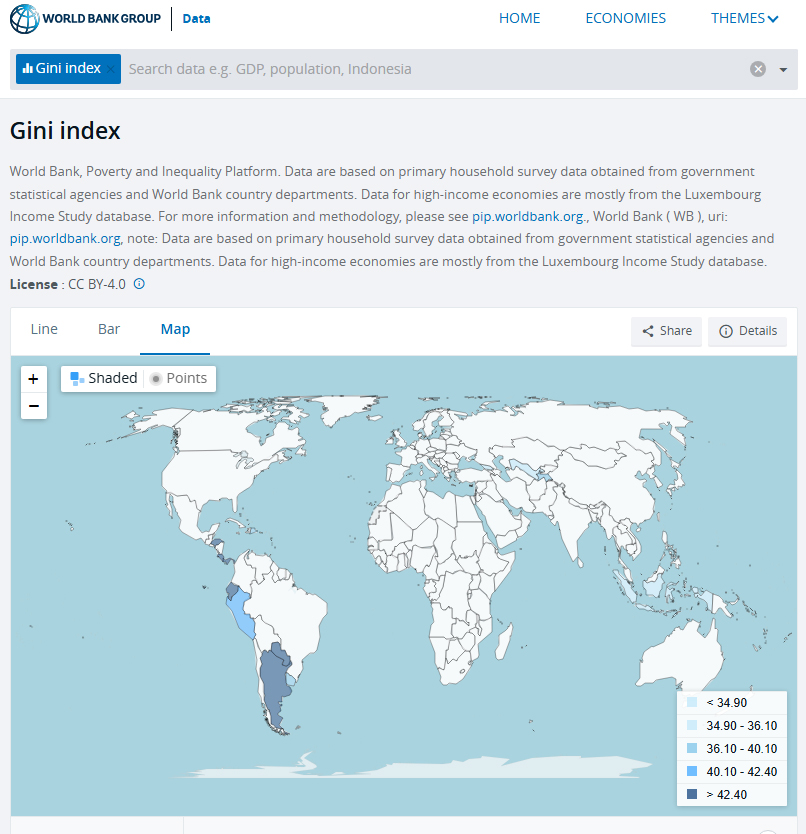
Amidst all this, the World Bank has ranked India fourth globally in income inequality, with a Gini index score of 25.5 in 2023.Footnote1 This score is encouraging as it suggests that India is doing better to reduce economic inequality than many other G7 nations: the UK had a 32.4 Gini score in 2021, the United States (USA) had a 41.8 Gini score in 2023, and China a 35.7 Gini score in 2021 (Press Information Bureau, Citation2025; World Bank, Citation2025b). In 2020–21 India increased spending on welfare to an all-time high of 30% of total expenditure and 5.3% of GDP, thanks to the Pradhan Mantri Garib Kalyan Anna Yojana and Mahatma Gandhi National Rural Employment Guarantee Scheme. However, India has failed to sustain this momentum. By 2023–24, the share of welfare expenditure had declined to 19%, comprising 2.8% of total GDP, which is marginally lower than that of 2014–15 (The Wire, Citation2025). This decline is worrying, as it may harm the objective of social equality.
It is also worth noting that income and wealth are increasingly concentrated in a narrow stratum of society, while the number of millionaires is growing. In 2024, India witnessed a remarkable expansion of 39,000 millionaires every dayFootnote2 with a 4.4% growth rate, bringing this number to 917,000 (CNBC TV18, Citation2025). The Global Wealth Report also measured a Gini coefficient of 0.74 for India with a global rank of 8th position from the bottom on the wealth inequality index. The paradox could be explained by the fact that income does not match wealth, and vice versa. Some nations have high levels of wealth and comparatively lower average salaries, while others display a high average salary but lower wealth. The differences in the Gini index based on income and wealth are paramount, yet the figures can be confusing, making it difficult to understand the real picture of economic inequality in the world and the significance of the figures in the World Bank report.
The Indian economy at 75
Missing worldview in the economic agenda of Bharatiya Janata Party: what can be learned from Social and Solidarity Economy?
The truth of economic equality
India is at the take-off or early stage of its economic development; according to most economic theories, higher inequalities are observed at this stage. Showing a low inequality with unsupportive results on the other economic parameters halts the scope for improvements.
First, it is important to accept the fact that changing the data collection methods will not help in reducing the disparity between the rich and the poor. No matter how tactfully worthy these changes are, they eventually mislead the democratic foundation of the country.
Second, should India go for higher taxes? Higher inequality may indeed hold back the economic growth rate in an early stage of economic development, but it cannot be reduced by charging higher income tax at this stage of the economy (Shin, Citation2012). Prudent and progressive tax policies will help in economic growth without infringing on India’s welfare policies. These include addressing tax loopholes to protect the national interest from tax evasion (in the case of the rich). Levying more taxes on the ultra-wealthy can be a solution but potentially risks reducing their investment in the future. The French trio of economists, Thomas Piketty, Emmanuel Saez and Gabriel Zucman, have suggested that it is easier to tax wealth and corporate earnings than personal income, with an additional condition of an exit tax in the case of the migration of the rich from a country (Banerjee, Citation2025).
Third, demystifying the art of hiding money is crucial. Rich people do not readily disclose their income, and find ways and means to divert their funds. This socioeconomic group may reinvest and save money from their earnings and expand their wealth by increasing their holdings of shares. They may generate natural monopolies to maintain this perpetual cycle. Identifying and controlling these activities help to address the issue.
Fourth, when comparing the real state of economic equality, the government should refer to other parameters, such as investment in healthcare, social security, and education, as compared with nations that have higher incomes. A country needs funds for such welfare activities, and although tax collection has considerably increased in India, this is not enough to meet its infrastructural or welfare requirements.
Rohit Singh Tomar & Bharti Singh, Manipal University, Jaipur.